
EUDR and the Future of Global Coffee Flows into the European Market
As the European Union enforces the EUDR, coffee is no longer evaluated solely by quality or price, but by its ability to prove origin and environmental impact. Requirements on traceability, farm-level data, and “deforestation-free” production are reshaping how coffee is produced, traded, and granted access to the European market. In this context, transparency is no longer a competitive advantage, but a mandatory condition for global coffee flows to continue operating.
I. EUDR and the reorientation of global coffee flows
In recent years, the global coffee industry has reached a major turning point – one that goes beyond market dynamics and touches the core of sustainable development. The European Union Deforestation Regulation (EUDR) is not merely an environmental law; it is gradually becoming a “filtering benchmark” for every coffee shipment seeking access to the EU market, which accounts for a significant share of global coffee imports.

According to recent media reports, EUDR is widely regarded as a stringent screening mechanism that forces the coffee sector to change from within, rather than relying on surface-level improvements.
At the policy level, EUDR sets out clear requirements: all agricultural and forestry commodities, including coffee, imported into the EU must demonstrate that they have not caused deforestation or forest degradation after 31 December 2020, comply with the laws of the producing country, and be traceable down to individual plots of land. This is no longer an “optional” feature or an added value in quality certification, but a mandatory condition for customs clearance into the EU market.
These requirements have introduced a new layer of filtering within the global coffee supply chain. Instead of being assessed primarily on volume and cup quality, coffee is now evaluated based on data transparency and the legal integrity of the entire supply chain. Put simply, global coffee flows are beginning to clearly diverge into two main paths:
-
Coffee with clear, transparent origin data and legal compliance → continues to flow into the EU with lower compliance risk.
-
Coffee lacking traceability or complete legal documentation → faces delays, deeper inspections, or redirection to alternative markets with lower standards.
The traceability standards required by EUDR go far beyond general certifications. They demand geospatial data such as GPS coordinates of farm plots, land-use rights documentation, and proof that the land has not been deforested after 2020. This process , known as “due diligence” requires companies to proactively collect data, assess risks, and present evidence that their raw materials fully meet EUDR standards.

In production systems with well-established and rigorous data management, adaptation can be achieved with reasonable time and cost. However, in countries where coffee production relies heavily on smallholder farmers, meeting EUDR criteria presents a major technical and organizational challenge. An analysis by Channel News Asia (2023) highlights that many coffee farmers in Vietnam struggle with systematic land records and harvest data management. As a result, Vietnamese coffee faces the risk of failing to meet EUDR requirements in time without coordinated support and thorough preparation.
In this sense, EUDR is reshaping global coffee flows not simply as a new regulation to comply with, but as a structural transformation in how the industry operates. Instead of flowing freely along traditional routes, coffee now faces new “entry conditions”: data transparency and demonstrated environmental responsibility. This is a journey that all stakeholders, from smallholder farmers to large exporters must actively engage in.
II. Traceability: From compliance requirement to core infrastructure
As EUDR turns transparency into a mandatory condition for accessing the EU market, the concept of traceability is no longer a technical checklist or an auxiliary certification attached to a shipment. It is evolving into essential infrastructure – one that determines market access, data integrity across the value chain, and ultimately the long-term viability of the coffee sector in global trade.
Traceability is no longer a “paper checklist”
Traditionally, traceability was associated with certifications such as Organic, Fair Trade, or Rainforest Alliance, often viewed as value-added standards. Under EUDR, however, traceability becomes a legal requirement: no matter how high the quality of the coffee, without clear, consistent, and end-to-end proof of origin, the product cannot enter the EU market.
This explains why an increasing number of companies, cooperatives, and agricultural authorities in major coffee-producing countries are investing seriously in farm-level data systems and traceability frameworks, extending beyond individual enterprises to national-scale initiatives.


What does EUDR require from traceability systems?
EUDR does not simply ask whether data exists; it specifies what kind of data, how precise it must be, and whether it is consistently structured across the entire supply chain. Key requirements include:
Farm-level geospatial data
- Coffee entering the EU must be linked to accurate geographic data, including GPS coordinates and mapped boundaries of each plot.
- The goal is to ensure transparency and confirm that the product does not originate from land deforested or degraded after 31 December 2020 – a core EUDR criterion.
Consistency across the supply chain
- Traceability under EUDR requires continuous and connected data from farmers and traders to processors and exporters.
- Each stage must maintain clear records; fragmented or partial datasets are no longer sufficient.
Ability to prove origin at any time
- Traceability is not a one-time declaration. Companies must be able to respond to inspections even while multiple shipments are being exported simultaneously.
- This requires systems capable of tracing historical land-use data over time, including satellite imagery, forest monitoring records, and canopy cover maps.
As a result, EUDR transforms traceability from a formal requirement into a living data system – one that must be continuously updated. This is a scale and level of detail that many coffee supply chains have never previously operated at.
Long-term risks of not investing in data infrastructure?
An effective traceability system is not a simple spreadsheet or a collection of manually stored PDFs. It requires:
-
Digitized systems for collecting GPS data and land documentation.
-
Continuous integration with global forest monitoring and satellite datasets.
-
The ability to retrieve, audit, and verify historical data for each shipment.
Enterprises, cooperatives, or producing regions that fail to invest in such systems risk long-term exclusion from the EU market, as they cannot meet the requirement to tell a complete and verifiable origin story.

Some initiatives are already underway. In Vietnam, pilot projects establishing farm and forest databases in provinces such as Dak Lak and Lam Dong demonstrate practical steps toward EUDR-aligned traceability.
When transparency becomes the foundation, the coffee industry gains the capacity not only to comply with new regulations, but also to move closer to a truly responsible and sustainable supply chain – one increasingly demanded by the EU and a growing number of global markets.
III. Where does XLIII Coffee stand amid this shift?
While EUDR is forcing many coffee companies to urgently reassess their supply chains, collect farm-level data, and complete traceability documentation to meet legal requirements, XLIII Coffee approaches the situation from a different angle. The question is not “How can we comply in time?” but rather “Is the path we have chosen truly sustainable in the long run?”.
From the very beginning, XLIII Coffee has never treated traceability as a reactive requirement or a box to be ticked on a compliance checklist. Instead, traceability is embedded in our core operating philosophy: how we understand coffee, the people behind each bean, and our responsibility within the value chain.
Traceability Does Not Start with Law, but with a Perspective on Coffee
XLIII Coffee chose to build its origin information systems early on because we believe that a coffee lot only truly holds value when it is placed within the context of its land, its harvest season, and the people who produced it.
This approach aligns closely with broader trends in the European market, where consumers are increasingly concerned with product origin and environmental and social impact. Analyses published by European Coffee Trip and Global Coffee Report in 2024 – 2025 show that EU coffee buyers are no longer satisfied with generic descriptions, but demand specific, consistent, and verifiable information.


Transparency – The Foundation of a Responsible Coffee Chain
For XLIII Coffee, transparency is not a slogan, but a continuous practice expressed at multiple levels:
- Respect for Origin
Transparency ensures that origin is not “blurred” through commercialization. When information about growing regions, farming methods, and producers is preserved intact, the value of coffee is not homogenized or rendered anonymous within the global supply chain.
- Protecting the Value of Coffee
Traceability makes it possible to clearly distinguish responsibly produced coffee from coffee with insufficient oversight. This is especially critical under EUDR, where shipments that cannot prove origin risk exclusion from the EU market regardless of sensory quality. According to Vietnam News (2024), many European roasters have already begun prioritizing partners with robust data systems to minimize legal risk.
- Building Long-Term Trust
Transparency fosters trust with trade partners as well as end consumers. When origin stories are told consistently and honestly, brands no longer need to over-persuade – the data and practices speak for themselves.
EUDR as Both a Test and a Confirmation
From this perspective, EUDR does not alter XLIII Coffee’s direction; it validates the path already chosen. When the EU requires coffee to be traceable to individual plots, supported by clear legal documentation, and proven deforestation-free, it effectively confirms that only supply chains capable of telling a complete origin story can remain viable in the long term.

Recent analyses by Reuters and Financial Times also suggest that EUDR will accelerate a shift toward “fewer but more reliable suppliers” within the European coffee supply chain.
In this context, traceability is no longer a short-term competitive advantage, but a foundational condition for sustained market presence.
Anticipating the trend without chasing it
XLIII Coffee chooses to anticipate EUDR not by rushing to meet technical requirements, but by placing traceability at the center of its operations, from sourcing decisions and data recording to how we communicate with the market. Traceability has moved beyond being a system to become the spirit of the brand and the product itself: clear, responsible, and respectful of coffee’s original value.
In an industry undergoing profound transformation, where regulation, market forces, and consumer expectations increasingly intersect. This approach allows XLIII Coffee not only to adapt to EUDR, but to be ready for even higher standards ahead. Because ultimately, the future of coffee does not belong to the fastest-moving chains, but to those moving in the right direction and able to tell their story in full.
In conclusion,
EUDR is not merely a new European regulation; it is a clear signal that the way coffee is produced, traded, and evaluated is changing at a fundamental level. As transparency and traceability become mandatory conditions, global coffee flows are being reorganized toward greater responsibility and sustainability. In this context, traceability is no longer a reactive tool, but a foundation for long-term trust. For XLIII Coffee, EUDR simply confirms one truth: the future of coffee belongs to supply chains that understand their origins and are willing to tell those stories with honesty.
Images sourced from Nestlé Vietnam, Fincas Mierisch, Chepsangor Hills, Ratnagiri Coffee Estate, Muinami Estate, XLIII Coffee, and other references.
IV. FAQs
1. What is EUDR and why is the coffee sector strongly affected by it?
EUDR is the European Union Deforestation Regulation, which requires imported coffee to prove it is deforestation-free and fully traceable. The coffee sector is heavily impacted because the EU is one of the world’s largest consuming markets and coffee supply chains are often fragmented and difficult to trace to farm level.
2. How does traceability under EUDR differ from previous coffee certifications?
Traditional certifications focus on farming practices or social criteria, while EUDR requires detailed traceability down to individual land plots. EUDR traceability is legal in nature and applies across the entire supply chain, not just at a single production stage.
3. What risks does non-compliant coffee face under EUDR?
Coffee that cannot prove origin or legal compliance may be denied entry into the EU or subjected to stricter inspections. Over time, this increases costs, trade risks, and the likelihood of losing European partners.
4. Do smallholder farmers have opportunities under EUDR?
EUDR poses significant challenges for smallholders, but also creates opportunities if they are integrated into organized supply chains with proper data and traceability support. With transparency in place, smallholder coffee can still access the EU market at higher value.
5. Why is traceability considered the “foundation” of the future coffee supply chain?
Traceability enables supply chains to demonstrate legality, sustainability, and credibility amid tightening regulations. As transparency becomes mandatory, traceability is no longer a competitive edge, but the basis for long-term survival and growth.

Bài viết mới

- Taste the Origin
Rift Valley Coffee Caucus #03757 – A Testament to Western Kenya’s Collective Spirit
Turning our gaze to the Great Rift Valley of East Africa, the fertile volcanic landscapes are witnessing an inspiring transformation. Moving away from fierce, survival-driven competition, smallholder farmers in Western Kenya have chosen to join forces, forging a resilient and unified network. The Rift Valley Coffee Caucus #03757 lot stands as the ultimate testament to this remarkable collective synergy.

- Breaking News
Airworks Coffee & XLIII Coffee – A “handshake” that brings original flavors across borders
XLIII Coffee, alongside our key wholesale partner Airworks Coffee, officially announces the latest release of specialty coffee lots for the North American market. This event reaffirms our commitment to bringing original flavors across all geographical barriers to coffee enthusiasts.
Early access (for Subscribers of Airworks): 10:00 AM (PST) | Wednesday, April 29, 2026
General access: 10:00 AM (PST) | Friday, May 1, 2026
We invite our Customers and Partners to visit (airworkscoffee.com) for detailed information and to prepare for this special release!
- Taste the Origin
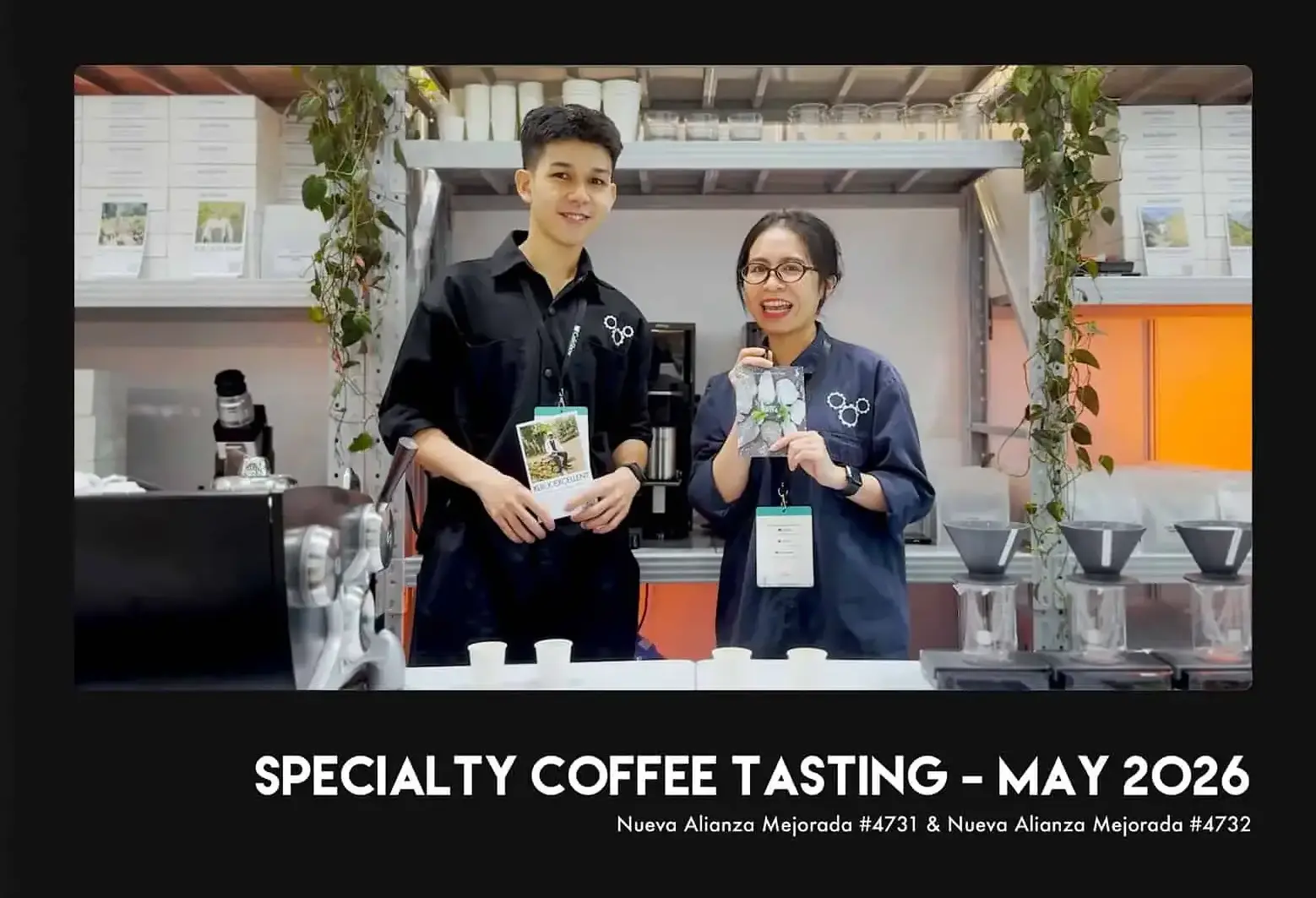
Unveiling May Discovery Subscription: Nueva Alianza Mejorada #4731 & Nueva Alianza Mejorada #4732
The Discovery Subscription is a silent dialogue, a place where the soul of the connoisseur finds a harmonious beat with distant lands. Like a transparent lens, we become storytellers, meticulously peeling back layers of cultural sediment, the breath of the soil, and the human philosophies hidden within every coffee bean.
May arrives with brilliant streaks of golden sunlight, a time when we long to hide beneath the lush, dew-drenched canopies of Santa Teresa. Amidst the silence of the Andes, when compassion touches Mother Earth, what will we hear? Perhaps it is a sweet response that nature reserves solely for souls who know how to wait patiently.

- Taste the Origin
Nueva Alianza Pacamara #4733 – The essence of Cusco with elegant jasmine notes
Nueva Alianza Pacamara #4733 is a testament to the miraculous terroir and dedicated cultivation of the renowned Cusco region. The combination of the characteristic Pacamara bean size and ideal altitude has forged a flavor profile of immense sophistication and depth. From the very first moment, this lot captivates with its elegant jasmine notes, radiating a gentle, pure fragrance akin to a flower blooming in the morning dew.

- Taste the Origin
Nueva Alianza Orange Gesha #4737 – An expedition of recessive genetic traits into the sensory realm
In a world of authenticity, Nueva Alianza Orange Gesha #4737 represents the proud emergence of rare biological traits often obscured by nature’s universality. Carrying a recessive genetic code, Lot #4737 embarks on an “expedition” into the connoisseur’s mind, where record-breaking fructose concentrations are released to perfectly fill every sensory gap with absolute smoothness and purity.
Through washed processing and extremely-light roasting, vibrant citrus nuances and ethereal floral notes, once hidden deep within the genetic structure, now manifest with power, transforming the tasting experience into a journey of ontological completion, where the rarity of recessive genes finally reigns supreme in flavor.

- Taste the Origin
Nueva Alianza Maragogipe #4735 – The “Giant” at the center of attention
Amidst a world of countless specialty coffee beans, Nueva Alianza Maragogipe #4735 emerges as a symbol of grandeur, instantly commanding attention with its distinct appearance. Affectionately dubbed the “Giant” for its impressively mutated “Elephant Bean” size, lot #4735 from Nueva Alianza stands as a testament to nature’s wonders in the Cusco region. Yet, its true allure extends far beyond its imposing exterior; hidden within these colossal beans lies a gentle “soul” blooming with pure floral and crystalline fruit notes.

Specialty Coffee in Vietnam
BRAND VALUE
YOU SHOULD HAVE KNOWN
XLIII Coffee has been aiming to become a big, impactful company with social responsibilities,
have access to high-quality raw materials and convey the complete original values of coffee to our customer
