
Rethinking the True Nature of Regenerative Agriculture Coffee
The coffee industry is currently riding a new wave under the name “regenerative agriculture.” However, this concept is increasingly being repeated and repackaged, becoming a favored label. But is regenerative coffee truly fostering meaningful regeneration, or is the term merely being used as a marketing tool to attract consumers?
This question is particularly crucial given that many consumers today are beginning to perceive regenerative agriculture as a sort of easy certification. In reality, regeneration is a long-term process—one that demands time, commitment, and a deep understanding of the interconnected relationships between land, climate, and community. So what exactly is being regenerated, for whom, and where does this process truly begin?

What Is the Root of Regenerative Coffee Farming?
In recent years, “regenerative agriculture” has appeared on coffee packaging, in international conferences, and in the marketing campaigns of major brands—often presented as a promise of responsibility, ethics, and sustainability. Yet behind this halo of virtue lies a growing disconnect from the very landscapes where this concept was born, preserved, and practiced across generations
The truth is that regenerative practices are not new. In Ethiopia, Colombia, Vietnam, and Guatemala, farmers have long implemented techniques to restore soil health, conserve water, and maintain biodiversity—long before the word “regenerative” appeared in any official report. Shade-grown coffee, crop rotation, and the use of natural green manures are time-honored traditional practices.
Moreover, the only people who truly understand what regeneration, sustainability, and longevity mean are the producers—the farmers themselves. They are not passive beneficiaries of corporate-designed regenerative models. These farmers don’t need to be taught sustainability; they live it. Through experience, intuition, and a deep relationship with nature, they truly understand what regeneration entails.

They live within the complex web of interactions between soil, water, livelihoods, and biodiversity. They know that the survival of the coffee tree is intertwined with their own survival. They understand that if the soil is depleted, if water sources dry up, if insects disappear—then coffee quality, income, and the future of their communities are at risk.
Most importantly, they know that the market will continue to buy their quality coffee if it’s produced sustainably, season after season. And this stability is what allows them to keep investing in farming practices that protect the land and benefit their communities.
Therefore, regenerative agriculture—or regenerative coffee farming—is not a “development project.” It is a sound business model, built on trust and long-term relationships between producers and buyers. It stems from lived experiences and the accumulated wisdom of generations who view agriculture as part of a broader ecological and social whole.
Reframing the Issue
Unfortunately, when these practices are evaluated by certification bodies, they are often reduced to rigid criteria—stripped of context and detached from the real needs of local communities.
In a discussion published by Intelligence Coffee, it was implied that when certification bodies and corporations begin to define what “regeneration” means, they also assume control over language, standards, and funding. What were once traditional, indigenous practices are now measured, verified, and categorized by people who have never set foot on a coffee farm. How can a certification agency in New Jersey possibly grasp the complex relationships between land, people, and tradition in Nicaragua?
Worse still, the very farmers who are regenerating every day are now required to prove it through documents, reports, and often costly fees. Meanwhile, brands easily market these farmers’ stories as symbols of progress—yet their voices and actual needs are being overshadowed.

It’s time to flip the narrative. Coffee producers are the ones who truly understand what long-term sustainability means. But how many of them are invited to global roundtable discussions? How many have the power to decide which standards should be applied to their own land? The coffee sector’s continued top-down approach to regeneration merely reinforces existing inequalities—where power, language, and value are dictated by those furthest from the source.
Personally, I don’t believe certification is entirely without value. However, if the coffee industry is genuinely serious about regeneration, then we must begin to look beyond labels and scorecards. We need to ask the fundamental, practical questions:
How has soil health improved?
How much carbon has been sequestered?
Are coffee plants more resilient to climate change?
Are farmers paid fairly and able to live healthily?
Are local communities genuinely empowered?
These are the questions that should come first—not the number of badges, or the ability to craft an inspiring story.

Listen to the Producers
You cannot solve a deeply systemic issue—rooted in histories of colonialism—with a generalized certification. The coffee industry must learn to listen. Not just to policymakers or market strategists—but to farmers. The ones who live on the land, feel the immediate effects of climate change, and are the only ones who truly know what is real, lasting, and sustainable.
“Regeneration” is not a marketing strategy. It is a promise of survival. And that promise only holds value when it is shaped, led, and enacted by the people who grow coffee at its origin—and when it is understood and nurtured across the entire supply and consumption chain.

Bài viết mới

- Taste the Origin
Nigussie Nare – Murago Outgrowers #03028: Cultivated from the Values of Sustainable Reciprocity
Nestled beneath the shade trees of Sidama, Bensa, the Nigussie Nare – Murago Outgrowers #03028 coffee lot serves as a living testament to the values of sustainable reciprocity. This symbiosis begins with the intimate bond between a rich indigenous ecosystem and the smallholder farmers of the Murago region. Each harvested bean is the culmination of a virtuous cycle: a stable environment produces exceptional bean quality, and sustainable economic growth, in turn, continues to protect the verdant canopy of the great forest.

- Taste the Origin
Rift Valley Coffee Caucus #03757 – A Testament to Western Kenya’s Collective Spirit
Turning our gaze to the Great Rift Valley of East Africa, the fertile volcanic landscapes are witnessing an inspiring transformation. Moving away from fierce, survival-driven competition, smallholder farmers in Western Kenya have chosen to join forces, forging a resilient and unified network. The Rift Valley Coffee Caucus #03757 lot stands as the ultimate testament to this remarkable collective synergy.

- Breaking News
Airworks Coffee & XLIII Coffee – A “handshake” that brings original flavors across borders
XLIII Coffee, alongside our key wholesale partner Airworks Coffee, officially announces the latest release of specialty coffee lots for the North American market. This event reaffirms our commitment to bringing original flavors across all geographical barriers to coffee enthusiasts.
Early access (for Subscribers of Airworks): 10:00 AM (PST) | Wednesday, April 29, 2026
General access: 10:00 AM (PST) | Friday, May 1, 2026
We invite our Customers and Partners to visit (airworkscoffee.com) for detailed information and to prepare for this special release!
- Taste the Origin
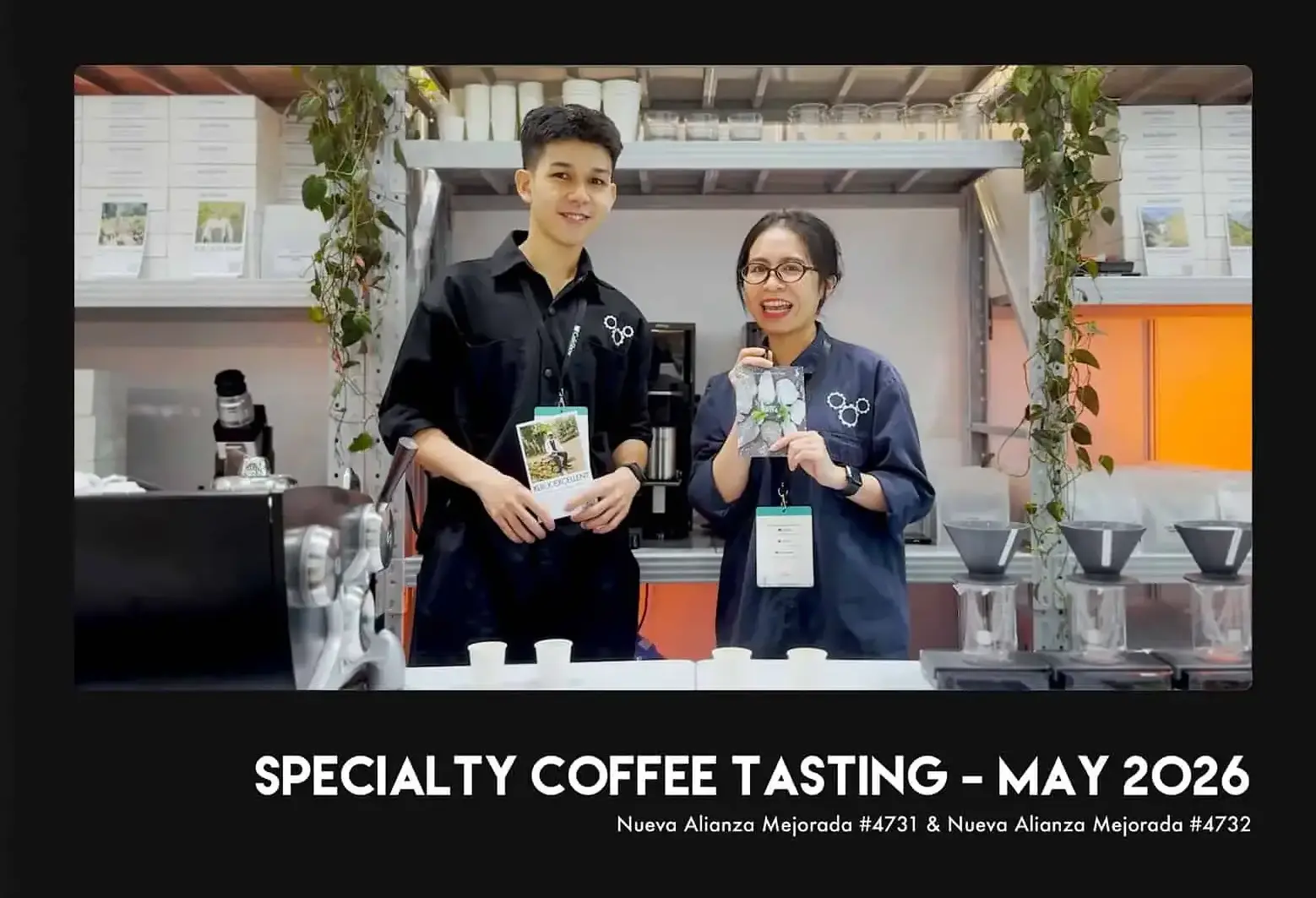
Unveiling May Discovery Subscription: Nueva Alianza Mejorada #4731 & Nueva Alianza Mejorada #4732
The Discovery Subscription is a silent dialogue, a place where the soul of the connoisseur finds a harmonious beat with distant lands. Like a transparent lens, we become storytellers, meticulously peeling back layers of cultural sediment, the breath of the soil, and the human philosophies hidden within every coffee bean.
May arrives with brilliant streaks of golden sunlight, a time when we long to hide beneath the lush, dew-drenched canopies of Santa Teresa. Amidst the silence of the Andes, when compassion touches Mother Earth, what will we hear? Perhaps it is a sweet response that nature reserves solely for souls who know how to wait patiently.

- Taste the Origin
Nueva Alianza Pacamara #4733 – The essence of Cusco with elegant jasmine notes
Nueva Alianza Pacamara #4733 is a testament to the miraculous terroir and dedicated cultivation of the renowned Cusco region. The combination of the characteristic Pacamara bean size and ideal altitude has forged a flavor profile of immense sophistication and depth. From the very first moment, this lot captivates with its elegant jasmine notes, radiating a gentle, pure fragrance akin to a flower blooming in the morning dew.

- Taste the Origin
Nueva Alianza Orange Gesha #4737 – An expedition of recessive genetic traits into the sensory realm
In a world of authenticity, Nueva Alianza Orange Gesha #4737 represents the proud emergence of rare biological traits often obscured by nature’s universality. Carrying a recessive genetic code, Lot #4737 embarks on an “expedition” into the connoisseur’s mind, where record-breaking fructose concentrations are released to perfectly fill every sensory gap with absolute smoothness and purity.
Through washed processing and extremely-light roasting, vibrant citrus nuances and ethereal floral notes, once hidden deep within the genetic structure, now manifest with power, transforming the tasting experience into a journey of ontological completion, where the rarity of recessive genes finally reigns supreme in flavor.

Specialty Coffee in Vietnam
BRAND VALUE
YOU SHOULD HAVE KNOWN
XLIII Coffee has been aiming to become a big, impactful company with social responsibilities,
have access to high-quality raw materials and convey the complete original values of coffee to our customer
