
Is the Central Coffee Research Institute (CCRI) India’s Leading Scientific Center?
The Central Coffee Research Institute (CCRI) is India’s premier coffee research institution, located in Chikmagalur district, Karnataka state. Established in 1925 as the Mysore Coffee Experimental Station, CCRI has evolved over nearly 100 years to become a vital contributor to the coffee industry not only in India but throughout Southeast Asia.
I. Research focus and mission of CCRI
In 1946, the institute officially came under the management of the Coffee Board of India and was renamed CCRI.

With its ideal geographical location in the heart of India’s traditional coffee-growing region, CCRI has become a symbol of cutting-edge coffee science research.
CCRI operates with a multidisciplinary research scope, focusing on addressing the complex challenges facing the modern coffee industry. The institute applies a holistic approach from basic research to practical applications.
Core Research Areas
CCRI operates across seven main scientific disciplines, each focused on improving coffee quality and yield:
| Field | Research Focus |
| Agronomy | Cultivation techniques, soil management |
| Soil Science & Agricultural Chemistry | Soil analysis, plant nutrition |
| Botany | Variety breeding, genetics |
| Entomology/Nematology | Pest and disease control |
| Plant Physiology | Growth and development processes |
| Biotechnology | Tissue culture, molecular biology |
| Post-Harvest Technology | Processing, quality control |
Strategic Mission
CCRI’s mission centers on three primary objectives:
- Developing high-yielding, disease-resistant coffee varieties with superior quality
- Standardizing production technologies to enhance farming efficiency
- Promoting sustainable coffee cultivation methods that protect ecosystems
A notable achievement is CCRI’s development of numerous improved coffee varieties with resistance to major pests and diseases, helping Indian farmers cope with some of the world’s highest disease pressure. India has established itself as a producer of premium-quality coffee, thanks in part to CCRI’s groundbreaking research.
II. Infrastructure and research capabilities at CCRI
CCRI possesses a comprehensive and state-of-the-art infrastructure system designed to support multidisciplinary research from laboratory to field. This foundation is crucial for maintaining the institute’s leading position in coffee research.
Main Research Farm
CCRI operates a 130.94-hectare research farm, with 80.26 hectares dedicated to cultivating both major coffee species: Arabica and Robusta. This serves not only as an experimental site but also as a valuable gene bank featuring:
- Coffee variety collections from different coffee-producing countries
- Rare wild coffee varieties from Ethiopia – the birthplace of Arabica coffee
- Testing areas for new cultivation methods
- Diverse shade tree systems preserved to maintain natural ecosystems
Specialized Laboratory Systems
CCRI operates three main research centers:
- Tissue Culture and Biotechnology Laboratory (Mysore): Supports breeding programs using modern techniques, creating coffee varieties with superior characteristics
- Quality Control Division (Bangalore): Specializes in coffee quality analysis and evaluation, ensuring export standards
- Central Research Center (Chikmagalur): Conducts multidisciplinary research, from soil improvement to pest control


CCRI is equipped with modern laboratories and a central library housing an extensive collection of coffee-related books and journals, facilitating in-depth research. This advanced infrastructure serves not only internal research but also supports international collaboration, affirming CCRI’s position in the global coffee research community.
III. Research network and impact of CCRI
CCRI operates a sophisticated and systematic research network, extending its influence nationally and internationally. This approach ensures the institute’s research can be widely applied across different ecological conditions.
National Scope of Operations
CCRI extends its impact through a network of regional research stations in:
- Kerala: Adapting to tropical humid climate conditions
- Tamil Nadu: Highland coffee research
- Andhra Pradesh: Developing cultivation techniques for arid regions
- Assam: Specializing in Robusta coffee
This approach enables CCRI to customize research solutions for different ecological zones within India’s coffee-growing regions.
Expert Team
With a team of 130 scientists and technical specialists distributed across research locations, CCRI maintains strong research capacity. The main farm alone employs approximately 60 scientific and technical staff.
Training and Technology Transfer Services
CCRI not only conducts research but also:
- Organizes training courses for coffee farmers
- Provides technical guidance for plantation managers
- Disseminates research results through extension programs
- Offers technical consulting for industry enterprises


CCRI’s research directly impacts coffee farmers across India, helping improve yields, reduce costs, and promote environmentally friendly practices. The institute has proven its irreplaceable role in supporting India’s 330,000 coffee farmers in adapting to climate change while maintaining product quality.
In conclusion, CCRI plays a pivotal role in developing India’s coffee industry through scientific research, quality improvement, and promoting sustainable cultivation. Recognized by India’s Ministry of Science and Technology as a scientific research institute, CCRI continues to affirm its leading position in Southeast Asian coffee research.
Located 8km from Balehonnur town on the Balehonnur-Sringeri route, CCRI is not only a scientific center but also an attractive destination with stunning coffee plantation landscapes and diverse ecosystems. It’s an ideal location for those interested in learning about the science and technology behind coffee cultivation in India.
Images used in the article are collected from various sources.
IV. Related questions
1. Is CCRI open to visitors?
Yes, CCRI welcomes tourist groups and researchers for visits. However, advance contact is required to arrange schedules that align with the institute’s research activities.
2. Which coffee varieties developed by CCRI are currently widely cultivated?
CCRI has developed numerous disease-resistant coffee varieties such as the Selection and Cauvery lines. Notably, the institute’s improved Robusta varieties have helped India become the world’s highest-quality Robusta producer.
3. Does CCRI collaborate with international research organizations?
Yes, CCRI participates in the International Multilocation Variety Trial with World Coffee Research and maintains cooperative relationships with many coffee research institutes worldwide, particularly in Southeast Asia.
4. Why is India’s shade-grown coffee model considered exemplary?
The agroforestry system of shade-grown coffee not only protects coffee from pests and diseases but also creates sustainable ecosystems. CCRI has researched and perfected this model as a solution to climate crisis challenges.
5. How can one access CCRI’s research and results?
CCRI regularly publishes research reports and organizes conferences. Additionally, the institute provides training services and technical consulting for interested parties in the coffee industry.

Bài viết mới

- Taste the Origin
Nigussie Nare – Murago Outgrowers #03028: Cultivated from the Values of Sustainable Reciprocity
Nestled beneath the shade trees of Sidama, Bensa, the Nigussie Nare – Murago Outgrowers #03028 coffee lot serves as a living testament to the values of sustainable reciprocity. This symbiosis begins with the intimate bond between a rich indigenous ecosystem and the smallholder farmers of the Murago region. Each harvested bean is the culmination of a virtuous cycle: a stable environment produces exceptional bean quality, and sustainable economic growth, in turn, continues to protect the verdant canopy of the great forest.

- Taste the Origin
Rift Valley Coffee Caucus #03757 – A Testament to Western Kenya’s Collective Spirit
Turning our gaze to the Great Rift Valley of East Africa, the fertile volcanic landscapes are witnessing an inspiring transformation. Moving away from fierce, survival-driven competition, smallholder farmers in Western Kenya have chosen to join forces, forging a resilient and unified network. The Rift Valley Coffee Caucus #03757 lot stands as the ultimate testament to this remarkable collective synergy.

- Breaking News
Airworks Coffee & XLIII Coffee – A “handshake” that brings original flavors across borders
XLIII Coffee, alongside our key wholesale partner Airworks Coffee, officially announces the latest release of specialty coffee lots for the North American market. This event reaffirms our commitment to bringing original flavors across all geographical barriers to coffee enthusiasts.
Early access (for Subscribers of Airworks): 10:00 AM (PST) | Wednesday, April 29, 2026
General access: 10:00 AM (PST) | Friday, May 1, 2026
We invite our Customers and Partners to visit (airworkscoffee.com) for detailed information and to prepare for this special release!
- Taste the Origin
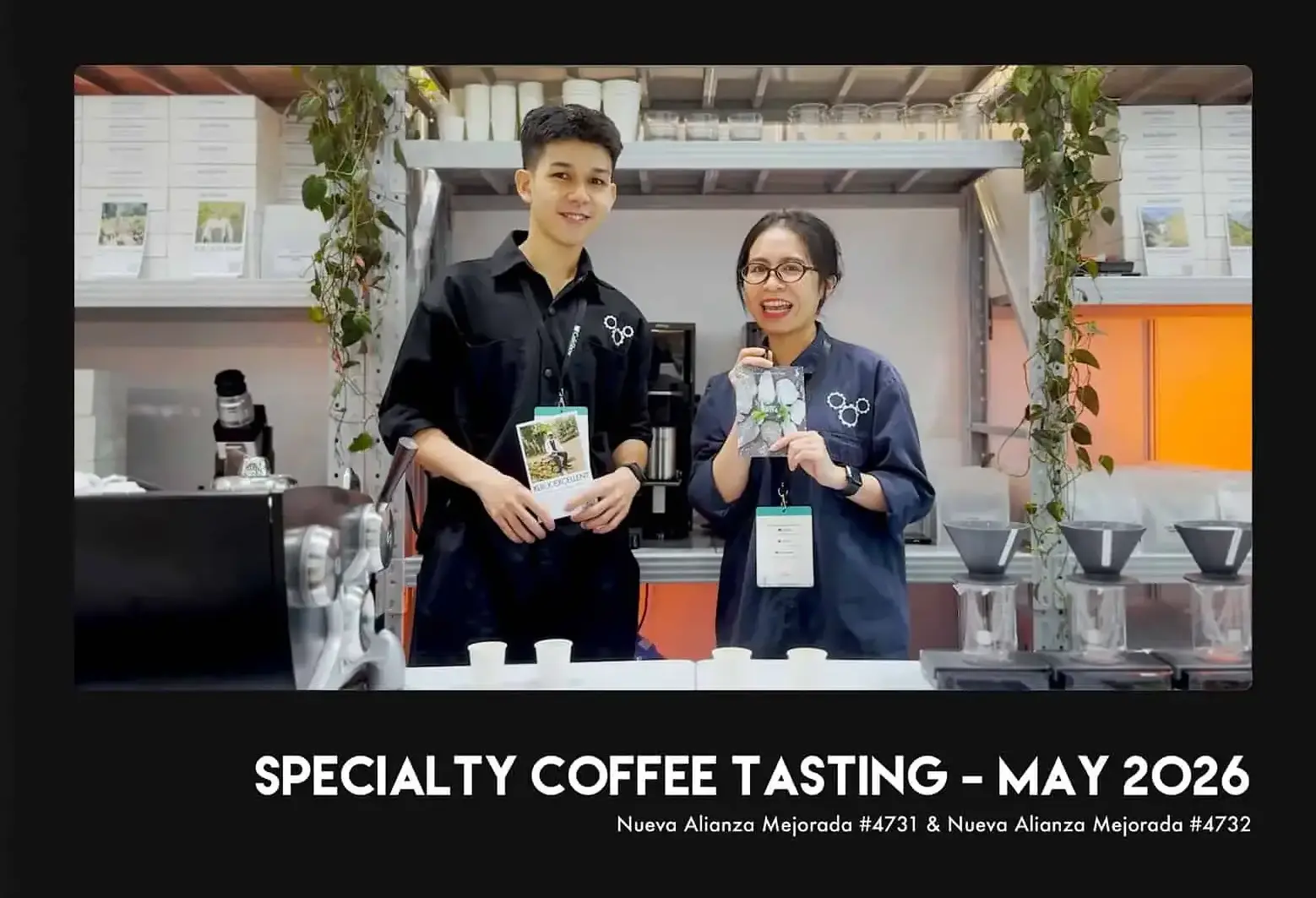
Unveiling May Discovery Subscription: Nueva Alianza Mejorada #4731 & Nueva Alianza Mejorada #4732
The Discovery Subscription is a silent dialogue, a place where the soul of the connoisseur finds a harmonious beat with distant lands. Like a transparent lens, we become storytellers, meticulously peeling back layers of cultural sediment, the breath of the soil, and the human philosophies hidden within every coffee bean.
May arrives with brilliant streaks of golden sunlight, a time when we long to hide beneath the lush, dew-drenched canopies of Santa Teresa. Amidst the silence of the Andes, when compassion touches Mother Earth, what will we hear? Perhaps it is a sweet response that nature reserves solely for souls who know how to wait patiently.

- Taste the Origin
Nueva Alianza Pacamara #4733 – The essence of Cusco with elegant jasmine notes
Nueva Alianza Pacamara #4733 is a testament to the miraculous terroir and dedicated cultivation of the renowned Cusco region. The combination of the characteristic Pacamara bean size and ideal altitude has forged a flavor profile of immense sophistication and depth. From the very first moment, this lot captivates with its elegant jasmine notes, radiating a gentle, pure fragrance akin to a flower blooming in the morning dew.

- Taste the Origin
Nueva Alianza Orange Gesha #4737 – An expedition of recessive genetic traits into the sensory realm
In a world of authenticity, Nueva Alianza Orange Gesha #4737 represents the proud emergence of rare biological traits often obscured by nature’s universality. Carrying a recessive genetic code, Lot #4737 embarks on an “expedition” into the connoisseur’s mind, where record-breaking fructose concentrations are released to perfectly fill every sensory gap with absolute smoothness and purity.
Through washed processing and extremely-light roasting, vibrant citrus nuances and ethereal floral notes, once hidden deep within the genetic structure, now manifest with power, transforming the tasting experience into a journey of ontological completion, where the rarity of recessive genes finally reigns supreme in flavor.

Specialty Coffee in Vietnam
BRAND VALUE
YOU SHOULD HAVE KNOWN
XLIII Coffee has been aiming to become a big, impactful company with social responsibilities,
have access to high-quality raw materials and convey the complete original values of coffee to our customer
