
Women in the Specialty coffee industry – Driving comprehensive sustainability
Meticulousness, carefulness, creativity, and a sense of responsibility—these traits allow women to contribute significantly to the high value of specialty coffee. However, the role of women in the specialty coffee industry is not always fairly acknowledged at some farms. To build a responsible and ethical specialty coffee industry, gender equality and the benefits for women must be thoroughly ensured.
1. The Role of women in Specialty coffee production
Women play a crucial role in the global specialty coffee industry, including planting and producing coffee beans.
Women participate in various coffee production stages
The specialty coffee industry relies heavily on women. They are involved in all stages, from planting to sorting and the essential manual work required to produce coffee.
According to “The Forward Report” released by The Partnership for Gender Equity (PGE) in 2015, women in smallholder farms typically handle most of the early stages of production on family farms, such as cultivation, pruning, harvesting, and sorting. Meanwhile, men, as the heads of the family farms, usually control the later stages: transporting coffee and bringing it to market.

Women are involved in all stages, from planting to sorting and the essential manual work required to produce coffee
Especially in East Africa—a region renowned for its high-quality specialty coffee—the role of women is even more significant. According to USAID, a leading international development agency, women make up a large portion of the workforce in these areas: 96% in Burundi, 76% in Kenya, 84% in Rwanda, 71% in Tanzania, and 77% in Uganda.
Not only do they make up the majority, but East African women also often take on the most labor-intensive tasks. In East African coffee farms, they perform all the stages from planting, pruning, weeding, fertilizing, to replacing old trees. Lorraine Girinka, Communications Director of KALICO, a woman-founded coffee company in Burundi, stated: “In Burundi, women play a crucial role in the entire coffee production process. Whether the farm belongs to them or their husbands, women are primarily responsible for nurturing the coffee trees from planting to harvest.”

In East Africa, women often take on the most labor-intensive tasks on coffee farms
Women strive to elevate their position in the Specialty coffee industry
Traditionally dominated by men, the coffee industry has seen women standing up for their rights and proving their significant role. Over the years, female laborers on farms have shown remarkable progress when provided with opportunities, resources, and support from various organizations. Women have seized opportunities to improve their skills and expertise, participating in international competitions and winning high accolades.
Historically, the World Barista Championship (WBC)—a global competition for professional baristas—had not seen a female champion. In the first six years of the competition, only 10% of finalists were women. However, this changed when a woman won the championship. Although only two women have won in the past seven years, this indicates that women have achieved certain successes in asserting their roles.

In recent years, female workers on farms have shown remarkable progress when provided with opportunities, resources, and support from various organizations
2. Challenges faced by women in the Specialty coffee industry
Despite comprising a significant portion of the workforce and contributing substantially to production, women do not enjoy equal rights with men.
Economic barriers
Women have less access to the final business activities in the supply chain, such as certification, trade, marketing, and transportation. They often cannot join cooperatives to market their coffee due to lack of land ownership, inability to pay fees, or facing prejudices. As a result, while women do more work, men have greater control over business and financial decisions, leading to men usually holding a larger share of profits.
A 2018 study on East African coffee-producing countries highlights this issue. The average wage gap between men and women is 39%, raising alarms for the responsible specialty coffee industry. Producers, along with related organizations and agencies, need to implement appropriate solutions to protect women’s rights and eliminate gender gaps on farms.

Women have less access to the final business activities in the supply chain, such as certification, trade, marketing, and transportation
Lack of voice
Women are often restricted from making decisions about production and consumption. In Africa, economic and social barriers and strong negative prejudices make it difficult for women to pursue careers and businesses. Max Peters, a coffee expert in Tanzania, noted that most coffee farms in Tanzania are owned by men, but women do the main work. They also have no voice in making decisions on the farms.
Additionally, female entrepreneurs and farm owners are often denied participation in workshops, information-sharing events, and access to funding and technical support. This injustice results in the average productivity of women-led farms being reduced by 25%. Moreover, their proposals are often dismissed and unacknowledged.

Women are often restricted from making decisions about production and consumption
Bearing a double burden
Besides working on farms, women are also responsible for raising children and performing other household chores. They seem to have no rest time as they shift from fieldwork to housework and child care.
Lack of access to education and culture
High-quality specialty coffee thrives in high-altitude growing regions where living and working conditions are not as assured as in urban areas. In these places, many women do not go to school and do not receive appropriate education. The high illiteracy rate among female workers is one of the reasons they find it difficult to protect their own rights.

Many women do not go to school and do not receive appropriate education
3. Opportunities and potential development for women in the Specialty coffee industry
The gender gap is dragging down the profits and value of specialty coffee. If this situation persists, it will create many instabilities within the farms. Promoting women’s development is a challenge that the responsible and ethical specialty coffee industry needs to address in the future.
The ethical Specialty coffee industry creates opportunities for women’s development
Many organizations in the coffee industry have stepped up to protect and provide opportunities for women to access education programs, coffee programs, financial support, and new techniques. With numerous positive activities, the International Women’s Coffee Alliance (IWCA) has helped thousands of female workers on coffee farms improve their career opportunities and elevate their roles.
The IWCA has:
– Empowered women: IWCA seeks to empower women in coffee-growing communities by providing them access to resources, training, education, and networking opportunities. This empowerment often leads to improved livelihoods, increased incomes, and enhanced decision-making power for women within their families and communities.
– Advocacy: IWCA advocates for gender equality in the coffee industry, addressing issues such as women’s access to land, credit, and technology. By raising awareness about the importance of gender equality, IWCA encourages stakeholders in the coffee industry to adopt policies and practices that support women’s rights and opportunities.

Many organizations in the coffee industry have stepped up to protect and provide opportunities for women to access education programs, coffee programs, financial support, and new techniques
– Connecting and collaborating: IWCA serves as a platform for women in the coffee industry to connect, share experiences, and collaborate on initiatives that benefit their communities. Through regional chapters and international conferences, IWCA members exchange knowledge, best practices, and strategies to overcome challenges.
– Market access: IWCA helps female coffee producers access international markets by providing them with market information, trade opportunities, and connections with buyers who value gender equality and sustainable sourcing practices.
– Capacity building: IWCA provides training programs and technical support for women involved in coffee production, processing, and marketing. These capacity-building efforts focus on agronomy, quality control, business management, and other skills necessary for success in the coffee industry.

Women in the coffee industry need to connect, share experiences, and collaborate on initiatives that benefit their communitie
Potential development for women in the Specialty coffee industry
The specialty coffee industry has grown significantly globally in recent years. It is a field that demands quality, technical expertise, consumer experience, and values of ethics and social responsibility, creating many development opportunities for female workers. Viewing from multiple angles, the industry presents many potential opportunities for women’s development, including:
Diverse career opportunities
The specialty coffee industry encompasses more than traditional roles like planting and harvesting, extending into fields such as:
– Processing and roasting: Coffee roasting requires finesse and high skill levels. Many women are establishing themselves as excellent roasters.
– Q-Grader (Quality Grader): This job requires the ability to differentiate and assess coffee quality, a field where women can leverage their refined taste.
– Management and business: Managing coffee chains or small businesses, specialty coffee shops, also provides great opportunities for women.

The specialty coffee industry has significant potential for the development of female workers
Access to education and training
Many ethical specialty coffee organizations and schools have implemented training programs for everyone, providing the knowledge and skills needed to confidently enter the coffee industry. These courses cover everything from cultivation techniques, coffee plant care, and processing techniques, to brewing artistry. This empowers both men and women to learn, develop, and grow.
Holding roles in the value chain
Women can participate and contribute to every aspect of the responsible specialty coffee value chain:
– Cultivation and production: Women can play important roles in implementing sustainable farming practices and managing farms.
– Processing and distribution: Engaging in processing, sorting, packaging, and distributing products.
– Marketing and sales: Using communication and management skills to build brands and expand markets.

Many ethical specialty coffee organizations and schools have implemented training programs for everyone, providing the knowledge and skills needed to confidently enter the coffee industry
Participating in gender equality promotion initiatives
Many global ethical specialty coffee initiatives and projects are being implemented to support and encourage women to participate in the specialty coffee industry. Non-profit organizations, fair trade alliances, and government support programs focus on empowering women, providing them with career development opportunities, and increasing their income.
The specialty coffee industry offers an environment that promotes gender equality, where women can confidently showcase their abilities. Success stories of women in this industry not only inspire but also change social perceptions about women’s roles in agriculture and business.

Many global initiatives and projects on ethical specialty coffee are being implemented to support and encourage women to participate in the specialty coffee industry
Conclusion
The specialty coffee industry is not just a business opportunity but a platform for women to develop and assert themselves. Through activities aimed at equality, fairness in empowerment, welfare, and opportunities, women can achieve self-reliance, develop.
skills, and gain financial independence. Despite the vast potential, women in the specialty coffee industry also face many challenges, such as lack of investment, training opportunities, and discrimination in some communities. Focusing on improving working conditions, providing financial support, and expanding support networks will help them overcome these challenges. With support from communities, organizations, and governments, female workers in the specialty coffee industry can contribute to and create sustainable values for society.
Image source collected by XLIII coffee
FAQs
Q1: What is the role of women in the production of specialty coffee?
Women play a vital role in many stages of specialty coffee production, from planting, pruning, and harvesting to sorting and processing. They participate in tasks requiring meticulousness and care, contributing to the production of high-quality coffee.
Q2: Why is the role of women in the specialty coffee industry not fairly evaluated?
Although women take on many important and laborious tasks, they often lack decision-making power in production and business. They are frequently restricted from accessing economic opportunities, training, and cooperatives, mainly due to social prejudices about gender, the dual burden of farm work, and family responsibilities.
Q3: How can working conditions and support for women in the specialty coffee industry be improved?
Improving working conditions and supporting women can include providing financial support, expanding training opportunities, promoting gender equality, enhancing access to resources and business opportunities, and raising awareness of women’s critical roles in the industry.
Q4: What are the benefits of promoting gender equality in the specialty coffee industry?
Promoting gender equality helps improve livelihoods, increase income, enhance decision-making power for women, and contribute to a more sustainable, responsible, and ethical specialty coffee industry.
Q5: What diverse career opportunities can develop for women in the specialty coffee industry?
Women can develop in roles such as coffee processing and roasting, Q-grading (Quality Grader), managing and running coffee chains or small businesses, and specialty coffee shops.

Bài viết mới

- Taste the Origin
Rift Valley Coffee Caucus #03757 – A Testament to Western Kenya’s Collective Spirit
Turning our gaze to the Great Rift Valley of East Africa, the fertile volcanic landscapes are witnessing an inspiring transformation. Moving away from fierce, survival-driven competition, smallholder farmers in Western Kenya have chosen to join forces, forging a resilient and unified network. The Rift Valley Coffee Caucus #03757 lot stands as the ultimate testament to this remarkable collective synergy.

- Breaking News
Airworks Coffee & XLIII Coffee – A “handshake” that brings original flavors across borders
XLIII Coffee, alongside our key wholesale partner Airworks Coffee, officially announces the latest release of specialty coffee lots for the North American market. This event reaffirms our commitment to bringing original flavors across all geographical barriers to coffee enthusiasts.
Early access (for Subscribers of Airworks): 10:00 AM (PST) | Wednesday, April 29, 2026
General access: 10:00 AM (PST) | Friday, May 1, 2026
We invite our Customers and Partners to visit (airworkscoffee.com) for detailed information and to prepare for this special release!
- Taste the Origin
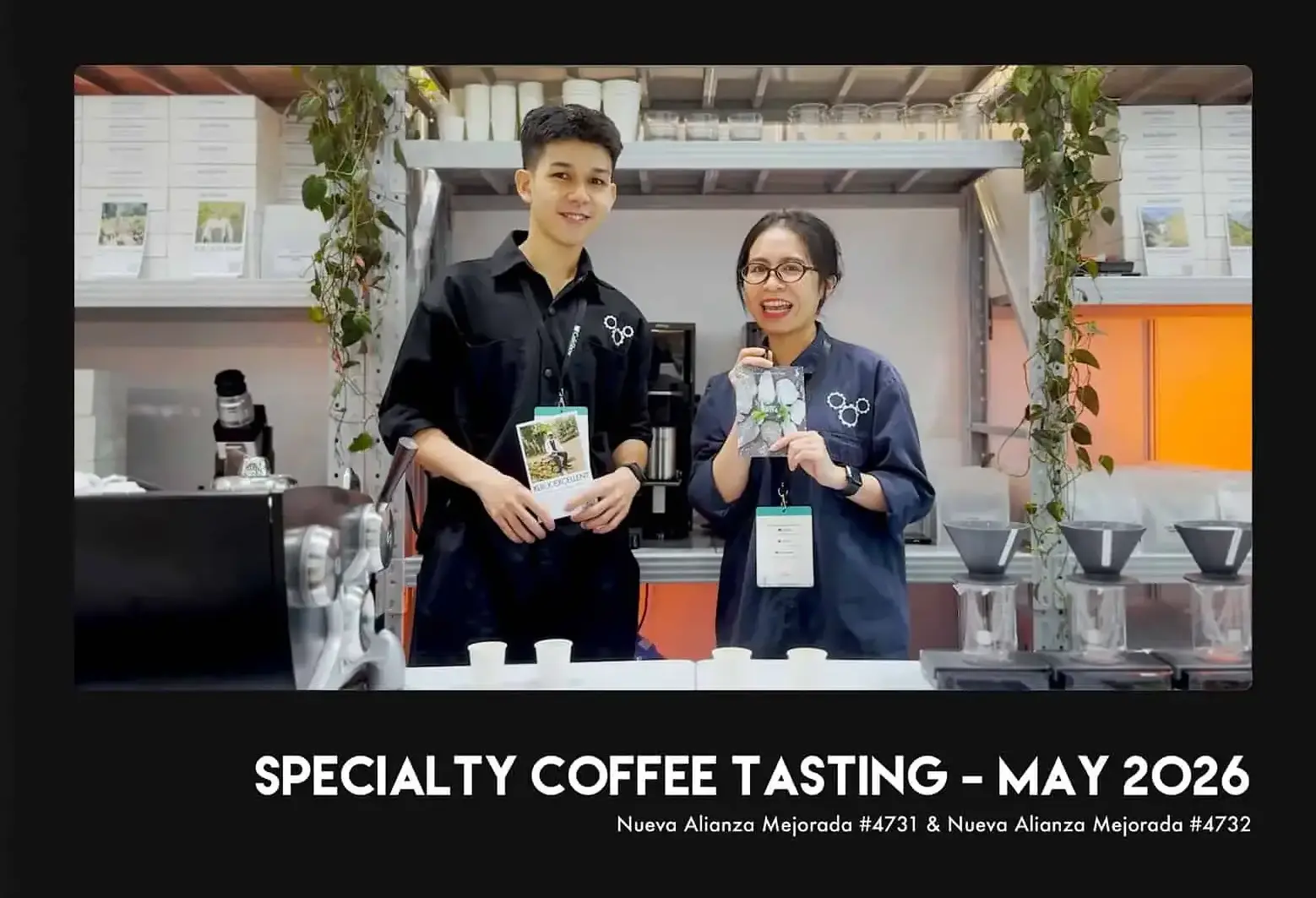
Unveiling May Discovery Subscription: Nueva Alianza Mejorada #4731 & Nueva Alianza Mejorada #4732
The Discovery Subscription is a silent dialogue, a place where the soul of the connoisseur finds a harmonious beat with distant lands. Like a transparent lens, we become storytellers, meticulously peeling back layers of cultural sediment, the breath of the soil, and the human philosophies hidden within every coffee bean.
May arrives with brilliant streaks of golden sunlight, a time when we long to hide beneath the lush, dew-drenched canopies of Santa Teresa. Amidst the silence of the Andes, when compassion touches Mother Earth, what will we hear? Perhaps it is a sweet response that nature reserves solely for souls who know how to wait patiently.

- Taste the Origin
Nueva Alianza Pacamara #4733 – The essence of Cusco with elegant jasmine notes
Nueva Alianza Pacamara #4733 is a testament to the miraculous terroir and dedicated cultivation of the renowned Cusco region. The combination of the characteristic Pacamara bean size and ideal altitude has forged a flavor profile of immense sophistication and depth. From the very first moment, this lot captivates with its elegant jasmine notes, radiating a gentle, pure fragrance akin to a flower blooming in the morning dew.

- Taste the Origin
Nueva Alianza Orange Gesha #4737 – An expedition of recessive genetic traits into the sensory realm
In a world of authenticity, Nueva Alianza Orange Gesha #4737 represents the proud emergence of rare biological traits often obscured by nature’s universality. Carrying a recessive genetic code, Lot #4737 embarks on an “expedition” into the connoisseur’s mind, where record-breaking fructose concentrations are released to perfectly fill every sensory gap with absolute smoothness and purity.
Through washed processing and extremely-light roasting, vibrant citrus nuances and ethereal floral notes, once hidden deep within the genetic structure, now manifest with power, transforming the tasting experience into a journey of ontological completion, where the rarity of recessive genes finally reigns supreme in flavor.

- Taste the Origin
Nueva Alianza Maragogipe #4735 – The “Giant” at the center of attention
Amidst a world of countless specialty coffee beans, Nueva Alianza Maragogipe #4735 emerges as a symbol of grandeur, instantly commanding attention with its distinct appearance. Affectionately dubbed the “Giant” for its impressively mutated “Elephant Bean” size, lot #4735 from Nueva Alianza stands as a testament to nature’s wonders in the Cusco region. Yet, its true allure extends far beyond its imposing exterior; hidden within these colossal beans lies a gentle “soul” blooming with pure floral and crystalline fruit notes.

Specialty Coffee in Vietnam
BRAND VALUE
YOU SHOULD HAVE KNOWN
XLIII Coffee has been aiming to become a big, impactful company with social responsibilities,
have access to high-quality raw materials and convey the complete original values of coffee to our customer
