
From administrative consolidation to coffee supply chain simplification in the new era
If the “new era” of specialty coffee demands ecosystem thinking and value chain transformation, then learning from these “boundary consolidations” – both in administration and agriculture – is key to understanding the art of intelligent restructuring.
I. Vietnam's administrative consolidation context and applications in coffee
Why does consolidation symbolize minimalism and sustainability?
During 2023-2025, Vietnam plans to consolidate 49 districts and 1,247 communes, reducing the total by 13 districts and 624 communes. These statistics demonstrate the “less is more” philosophy – from Ho Chi Minh City merging 80 wards into 41 wards effective January 1, 2025, to Hanoi implementing commune-level administrative reorganization during 2023-2025.
The objectives of these consolidations are clear:
- Streamline bureaucracy: Reduce functional and personnel overlaps
- Optimize resources: Concentrate investment in core strengths
- Increase operational efficiency: Shorten decision-making processes
Applying Minimalist Principles to Specialty Coffee Chains
The specialty coffee industry is adopting similar logic. Instead of maintaining dozens of small suppliers, leading roasteries are shifting to “streamlined supply chain” models:
- XLIII Coffee: Supplier partnerships refined to approximately “12 core selections”
- Fincas Mierisch: Optimized from 15+ micro-lots to 8-10 signature profiles
- Ratnagiri Estate: Focused on 3 main processing methods instead of the previous 7


Farms like Ratnagiri Estate in India have transitioned from producing 15 different coffee varieties to concentrating on 3 flagship product lines with unique monsoon processing. The result? They’ve not only saved 30% in operational costs but also improved coffee quality scores from 82 to 86 points on the SCA scale.
Similarly, in Ecuador, Fincas Putushio abandoned cultivating 8 coffee varieties to focus entirely on Typica and the hybrid variety Mejorada – varieties that maximize the advantages of their altitude and climate. This decision helped them increase high-quality productivity by 45% within 2 years.
What Are the Sustainability Lessons Through Simplification?
Sustainability in specialty coffee extends beyond environmental concerns to operational sustainability. Supply chain simplification has brought positive impacts:
- Reduced waste: Fewer products mean less inventory, reducing spoilage and waste risks
- Enhanced traceability: Easier quality control from farm to final cup
- Improved expertise: Focusing on fewer products allows teams to develop deeper mastery
Thus, both administrative consolidation and coffee industry restructuring aim for the same goal: creating systems that are simpler yet more effective, less complex yet higher quality.
II. Successful "geographic consolidation" models in Specialty Coffee
Fincas Mierisch Pioneers the Multi-National Model
The Mierisch family began growing coffee in Nicaragua in 1908, but the real turning point came when they decided to expand to Honduras in 2011.

This decision wasn’t merely about finding new farmland but a smart restructuring strategy to unite communities and redefine identity.
Fincas Mierisch’s model clearly demonstrates the principle of “unity in diversity,” including:
- Nicaragua (since 1908) with Limoncillo and Escondida farms, characterized by chocolate and caramel flavor notes. They specialize in natural and honey processing methods, leveraging altitudes of 1,200-1,400m.
- Honduras (since 2011) owns Guama and Agua Dulce farms with fresh fruit flavor profiles. They utilize different climates for supplementary harvest seasons at altitudes up to 1,600m, creating distinct bright acidity.
Preserving identity within unity
Fincas Mierisch never “homogenized” the two growing regions. Instead, they applied the philosophy of “same family, different personalities”:
- Maintaining local names: Limoncillo remains Limoncillo, Guama remains Guama
- Respecting traditional methods: Each farm maintains its distinctive processing procedures
- Telling individual stories: Each coffee carries the history and culture of its region
The results are impressive: 6 consecutive Cup of Excellence awards and recognition as one of Central America’s most respected specialty coffee producers.
Cross-Regional Cooperative Groups in Ethiopia – From Fragmentation to Ecosystem
Ethiopia – coffee’s birthplace – is witnessing a revolution from small-scale farming to systematic cooperative networks.
Shakiso Tero Outgrowers exemplifies the transition from fragmented to ecosystem approach. Instead of 847 small farmers operating and selling coffee independently, this model unites them into a cohesive organization with clear benefits:
| Metric | Before Cooperation | After Cooperation | Improvement |
| Coffee selling price | 12-15 birr/kg | 22-28 birr/kg | +75% |
| Cupping quality | 84-86 points | 87-89 points | +3 points |
| Transportation costs | 100% self-funded | 60% shared | 40% saving |
| Market access | Through 3-4 intermediaries | Direct | 45% profit increase |
* (birr is Ethiopia’s primary currency)

Tokuma Farmers Group in the Sidama region applies a different approach – specialization focus. The 156 farmers in the group have clear divisions:
- 45 households specialize in traditional Heirloom varieties
- 67 households focus on organic cultivation
- 44 households handle processing and drying procedures
Kenya’s Art of Vertical and Horizontal Integration
Kenya’s model showcases the subtle combination of Factory (processing facilities) and Cooperative (cooperatives) – a form of “functional consolidation” rather than geographic boundary consolidation.
Two typical XLIII Coffee suppliers – Gatina Factory and Muburi Factory – though only 12km apart in Nyeri County, operate as complementary entities:
- Gatina: Specializes in processing coffee from 1,700-1,800m altitude, fcharacterized by bright acidity and floral aromas
- Muburi: Focuses on coffee from 1,500-1,650m altitude, famous for intense blackcurrant flavors

Both participate in the Nairobi Coffee Exchange – an auction system creating collective strength for Kenya’s entire coffee industry. This is the “network effect” model – each member maintains individual characteristics while benefiting from the collective “Kenya AA” brand.
Privam Estate represents a different approach – complete vertical integration from cultivation, processing, export to roasting. This model enables absolute quality control but requires high resources and expertise.
Is “Unity in Diversity” the core principle of all successful restructuring?
From Nicaragua-Honduras of Fincas Mierisch to Ethiopia and Kenya networks, all demonstrate the same principle: consolidation doesn’t mean losing identity.
These models succeed because they understand that:
- Diversity is a source of strength, not a weakness to overcome
- Cooperation doesn’t mean uniformity, but leveraging each member’s strengths
- Large scale only matters when quality is guaranteed
These lessons are valuable not only for the coffee industry but serve as guidelines for all restructuring efforts – from administrative consolidation to corporate reorganization.
III. Global supply chain restructuring strategies
While Vietnam’s administrative consolidations aim to optimize resources within fixed geographic boundaries, the specialty coffee industry applies “temporal consolidation” strategies – connecting growing regions with different harvest seasons to create year-round continuous supply chains.
Optimizing Transportation and Supply Chains by Season
Ratnagiri Estate in India exemplifies seasonal optimization through monsoon winds. Instead of competing with other suppliers during peak season (October-March), they utilize the Southwest Monsoon (June-September) to produce Monsoon Malabar – coffee naturally “aged” by sea winds.
This strategy helps Ratnagiri avoid direct competition while creating unique products:
- Supply timing: June-September (global off-season)
- Product characteristics: High moisture content, distinctive earthy flavors
- Value addition: 60% higher than regular Indian coffee


Logistics Hub Model and Strategic Location Optimization
Fincas Putushio in Ecuador demonstrates “strategic geographic consolidation” by choosing a location just 180km from Guayaquil port. This position is not only convenient for exports but also a perfect intersection between tropical and subtropical climates.
Another XLIII Coffee partner, Kinini washing station in Rwanda, has developed into a natural logistics hub for East Africa. From their strategic location, they not only export Rwandan coffee but also support logistics for neighboring countries:
| Nation | Distance to Kinini | Transportation time | Savin cost |
| Burundi | 120km | 3-4 hours | 35% |
| Đông Congo | 200km | 6-8 hours | 28% |
| Ugand | 380km | 12-15 hours | 15% |
Risk Management Through Supply Diversification
In the context of climate change and political instability, “risk consolidation” becomes a crucial survival strategy. Instead of depending on a single source, smart roasters are building balanced investment portfolios across growing regions.
XLIII Coffee’s risk distribution model through their supplier network works as follows:
Weather Risk Scenarios:
- Drought in Ethiopia → Backup from Kenya (Gatina, Muburi producers)
- Storms in Nicaragua → Backup from Honduras via Fincas Mierisch
- El Niño in Ecuador → Supplement from India’s Ratnagiri Estate
Political Instability:
- Unrest in Ethiopia → Supply can shift to Rwanda’s Kinini
- Export policy changes → Diversified sourcing
Price Risk Management:
- Futures contracts for 40% of coffee volume
- Spot market for 35% to capitalize on opportunities
- Direct trade for 25% to ensure quality

Blockchain Technology and Origin Traceability
The digital revolution is creating unprecedented “information consolidation” in the coffee industry. Instead of farms, processors, and roasters maintaining separate information systems, blockchain is connecting everything into a unified network.
Benefits of information consolidation:
- Minimize fraud and counterfeit coffee
- Enhance consumer trust
- Optimize supply chains based on real data
- Increase brand value through transparency
Thus, global supply chain restructuring isn’t just about cost reduction but the art of comprehensive optimization – from time, space, technology to information, all aimed at the ultimate goal: creating sustainable value for the entire coffee ecosystem.
IV. Impact and lessons for the Vietnamese market
Vietnam, with 4 main coffee-growing regions from North to South, stands before a great opportunity to apply lessons from successful restructuring models worldwide. Instead of internal competition, regions can develop in complementary and mutually supportive directions.
Potential inter-regional cooperation model for Vietnam:
| Region | Product Characteristics | Chain Role | Main Season |
| Northwest (Sơn La, Điện Biên) | Premium Arabica, distinctive aromas | Premium products | October-February |
| Central Highlands (Đắk Lắk, Gia Lai) | High-quality Robusta (Fine Robusta) | Volume foundation | November-March |
| South Central (Lâm Đồng) | Diverse Arabica and Robusta | Processing hub | November-April |
| Southeast (Đồng Nai, Bà Rịa) | Specialty coffee, branding | Export center | December-April |
Similar to Ethiopia’s 847 farmers in Shakiso Tero Outgrowers, Vietnam can learn to reorganize millions of small households into effective cooperative networks.
From Small Farmers to Ecosystem
Current reality: 600,000 coffee-growing households on average 0.8 ha/household. Most sell raw materials at low prices, lacking connections and vulnerable to price manipulation.
Following the Shakiso model, Vietnam could organize into geographic clusters:
- Each cluster of 50-100 households within the same commune/district
- Shared branding, distinct product characteristics
- Shared processing and drying equipment
- Common quality standards, different flavor profiles

Expected benefits: Increase selling prices from 35,000 VND/kg to 55,000-70,000 VND/kg, reduce transportation and logistics costs by 40%, improve quality from commercial grade to specialty faster, and access export markets directly.
Supply Chain Optimization Following Kenya’s Model
Kenya’s Factory-Cooperative system and Nairobi Coffee Exchange demonstrate the importance of creating complete ecosystems. Vietnam could learn to build specialty coffee trading centers such as:
- Specialty coffee auction floors in Ho Chi Minh City or Buon Ma Thuot
- International standard classification and scoring systems
- Direct connections between producers and global roasters
Applying successful restructuring models could bring fundamental changes to Vietnam’s coffee industry. However, challenges include traditional small-scale thinking, farmers’ resistance to change, lack of investment capital for technology and equipment, competition from other coffee-producing countries, and climate change impacts on quality.
Vietnam’s coffee industry stands at a crossroads. The first path is continuing to compete with low prices and large volumes – an approach that has revealed many limitations. The second path is learning from global success stories, applying restructuring artistry to create sustainable value. Which choice will shape the future of Vietnam’s 600,000 coffee-growing households?
The answer lies in our ability to change mindset – from “more and cheap” to “less but better,” from internal competition to strategic cooperation, from selling raw materials to building brands. The question isn’t whether we participate, but whether we lead or follow in this revolution.
The “streamlining” revolution in both administration and specialty coffee aims for the same goal:
systems that are simpler yet stronger, more synchronized yet more diverse, more efficient yet more sustainable.
Geographic consolidation in specialty coffee isn’t about “swallowing up” but the art of intelligent integration – “unity in diversity” where each component maintains its unique identity while working toward a common vision, creating sustainable value for the entire ecosystem.
Images used in this article are owned by XLIII Coffee and collected.
V. Related question
1. Why can Ethiopian coffee sell for double the price after farmer “consolidation”?
Instead of 847 small farmers selling independently at 12-15 birr/kg, the Shakiso Tero Outgrowers model united them into one organization. Result? Selling prices increased to 22-28 birr/kg (+75%) through collective bargaining power and consistent quality. This exemplifies “unity in diversity” – strength through unity.
2. What is Monsoon Malabar that helps India avoid competing with the entire world?
Ratnagiri Estate turned weakness into strength by utilizing the Southwest Monsoon (June-September) – the global off-season. Coffee is naturally “aged” by sea winds, creating distinctive earthy flavors and 60% higher value than regular Indian coffee. This is the art of “temporal consolidation” instead of direct competition.
3. How does the Mierisch family manage growing regions in both Nicaragua and Honduras simultaneously?
The secret isn’t “homogenization” but “same family, different personalities.” They maintain local names (Limoncillo remains Limoncillo), respect traditional methods, and tell individual stories for each region. Result: 6 consecutive Cup of Excellence awards with two completely different flavor profiles but equally outstanding quality.
4. Why has blockchain become a “miracle cure” for the coffee industry?
Blockchain creates “information consolidation” – connecting everything from farm to final cup into a unified network. Instead of each stage keeping separate information, consumers can now trace origins completely, reducing fraud and increasing brand value through transparency.
5. Vietnam has 600,000 coffee-growing households – is it too late to “consolidate”?
Absolutely not! Ethiopia succeeded with 847 farmers, Kenya with thousands of Factory-Cooperatives. Vietnam could group 50-100 households into clusters, increasing selling prices from 35,000 to 55,000-70,000 VND/kg. The question isn’t “is it too late” but “will we lead or be led” in this “less is more” revolution.

Bài viết mới

- Taste the Origin
Nigussie Nare – Murago Outgrowers #03028: Cultivated from the Values of Sustainable Reciprocity
Nestled beneath the shade trees of Sidama, Bensa, the Nigussie Nare – Murago Outgrowers #03028 coffee lot serves as a living testament to the values of sustainable reciprocity. This symbiosis begins with the intimate bond between a rich indigenous ecosystem and the smallholder farmers of the Murago region. Each harvested bean is the culmination of a virtuous cycle: a stable environment produces exceptional bean quality, and sustainable economic growth, in turn, continues to protect the verdant canopy of the great forest.

- Taste the Origin
Rift Valley Coffee Caucus #03757 – A Testament to Western Kenya’s Collective Spirit
Turning our gaze to the Great Rift Valley of East Africa, the fertile volcanic landscapes are witnessing an inspiring transformation. Moving away from fierce, survival-driven competition, smallholder farmers in Western Kenya have chosen to join forces, forging a resilient and unified network. The Rift Valley Coffee Caucus #03757 lot stands as the ultimate testament to this remarkable collective synergy.

- Breaking News
Airworks Coffee & XLIII Coffee – A “handshake” that brings original flavors across borders
XLIII Coffee, alongside our key wholesale partner Airworks Coffee, officially announces the latest release of specialty coffee lots for the North American market. This event reaffirms our commitment to bringing original flavors across all geographical barriers to coffee enthusiasts.
Early access (for Subscribers of Airworks): 10:00 AM (PST) | Wednesday, April 29, 2026
General access: 10:00 AM (PST) | Friday, May 1, 2026
We invite our Customers and Partners to visit (airworkscoffee.com) for detailed information and to prepare for this special release!
- Taste the Origin
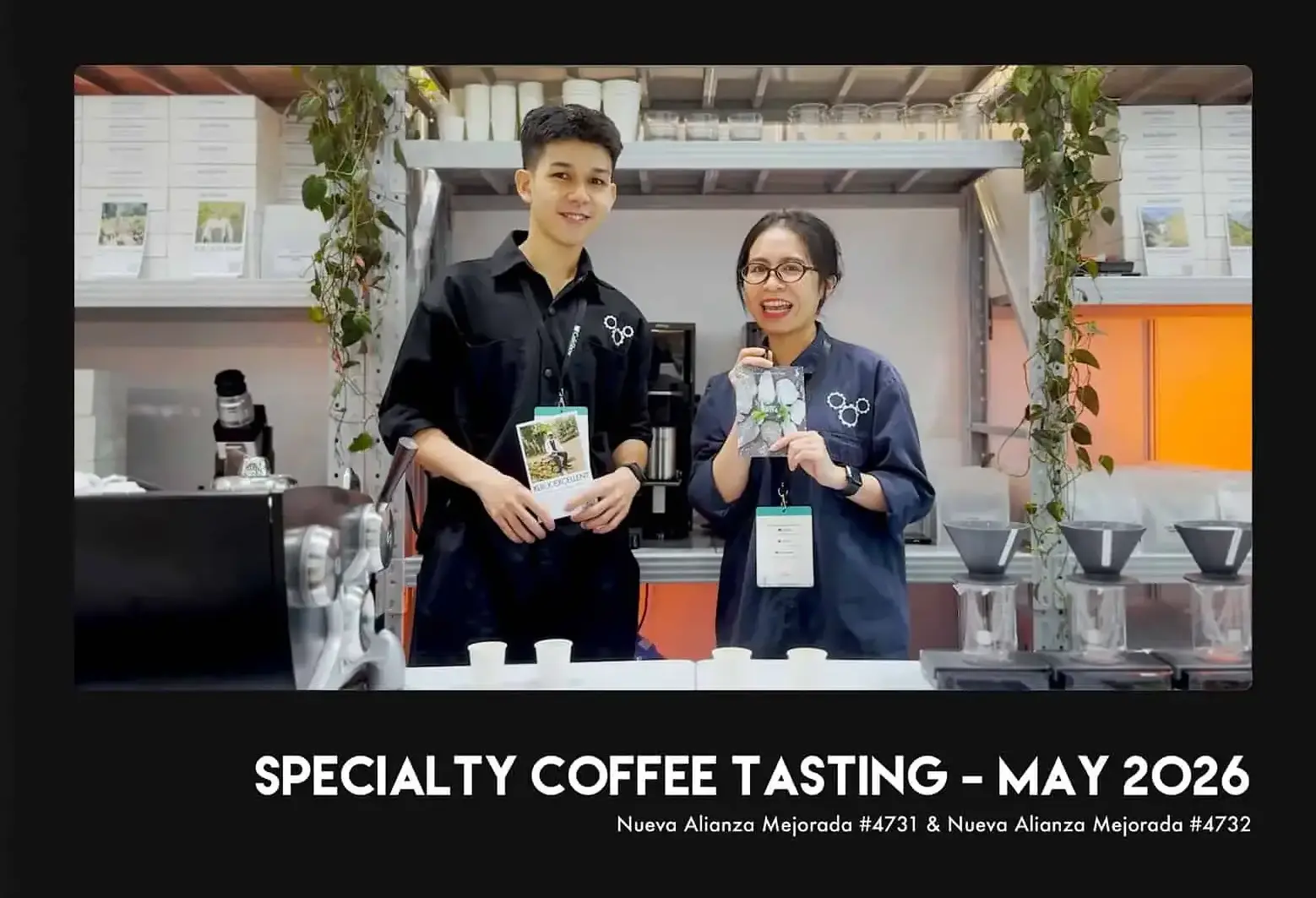
Unveiling May Discovery Subscription: Nueva Alianza Mejorada #4731 & Nueva Alianza Mejorada #4732
The Discovery Subscription is a silent dialogue, a place where the soul of the connoisseur finds a harmonious beat with distant lands. Like a transparent lens, we become storytellers, meticulously peeling back layers of cultural sediment, the breath of the soil, and the human philosophies hidden within every coffee bean.
May arrives with brilliant streaks of golden sunlight, a time when we long to hide beneath the lush, dew-drenched canopies of Santa Teresa. Amidst the silence of the Andes, when compassion touches Mother Earth, what will we hear? Perhaps it is a sweet response that nature reserves solely for souls who know how to wait patiently.

- Taste the Origin
Nueva Alianza Pacamara #4733 – The essence of Cusco with elegant jasmine notes
Nueva Alianza Pacamara #4733 is a testament to the miraculous terroir and dedicated cultivation of the renowned Cusco region. The combination of the characteristic Pacamara bean size and ideal altitude has forged a flavor profile of immense sophistication and depth. From the very first moment, this lot captivates with its elegant jasmine notes, radiating a gentle, pure fragrance akin to a flower blooming in the morning dew.

- Taste the Origin
Nueva Alianza Orange Gesha #4737 – An expedition of recessive genetic traits into the sensory realm
In a world of authenticity, Nueva Alianza Orange Gesha #4737 represents the proud emergence of rare biological traits often obscured by nature’s universality. Carrying a recessive genetic code, Lot #4737 embarks on an “expedition” into the connoisseur’s mind, where record-breaking fructose concentrations are released to perfectly fill every sensory gap with absolute smoothness and purity.
Through washed processing and extremely-light roasting, vibrant citrus nuances and ethereal floral notes, once hidden deep within the genetic structure, now manifest with power, transforming the tasting experience into a journey of ontological completion, where the rarity of recessive genes finally reigns supreme in flavor.

Specialty Coffee in Vietnam
BRAND VALUE
YOU SHOULD HAVE KNOWN
XLIII Coffee has been aiming to become a big, impactful company with social responsibilities,
have access to high-quality raw materials and convey the complete original values of coffee to our customer
