
Giling Basah – A Processing Method Born from Indonesia’s Agricultural Practice
Giling Basah is a unique coffee processing technique developed in response to Indonesia’s cultivation conditions and humid climate. This practical method helps farmers process coffee efficiently in regions with heavy rainfall, high humidity, and limited storage infrastructure. This smart adaptation has created a distinctive flavor profile, making Sumatran coffee renowned on the global coffee map.
I. Overview of the Giling Basah Method
Around the world, there are many coffee processing methods, but the most common are Natural, Washed (also called Wet-processed), and Honey. However, when it comes to Indonesia, there is a distinct technique often confused with wet processing: Wet Hulling, known locally as Giling Basah.
Giling Basah is a traditional and characteristic processing method of Indonesia, especially popular in Sumatra. Although its name sounds similar to “wet processing,” the flavors it produces are significantly different. In Bahasa Indonesia, “Giling Basah” literally means “wet-hulled,” and this is the key factor that sets it apart from other processes.
Wet Process vs. Wet Hulling: Similar Name, Different Nature
At first glance, wet-processed (washed) and wet-hulled (giling basah) might seem almost identical, but in reality, they produce coffees with opposite flavor profiles and structures. Washed processing is the most common method for specialty coffee worldwide. Most coffees from Latin America, such as Colombia, Guatemala, Peru, and African regions like Kenya, Rwanda, and Burundi, use this method.

In contrast, in Sumatra and Sulawesi, Indonesia, wet-hulled processing is almost the “native language” of coffee.
Image source: collected from Kopi Denver.
This choice is driven not only by tradition but also by natural conditions and centuries of cultivation history. Thus, although both approaches involve water processing, they produce coffees with very different “personalities”: one is bright, clean, and precise; the other is deep, heavy, and wild, strongly marked by local characteristics.
Why Indonesia Uses the Giling Basah Method
To understand why Giling Basah became Indonesia’s dominant method, we must consider two factors: history and geography. These forces have shaped Indonesian coffee practices and made them nearly irreplaceable.
History: The Dutch Economic Choice
Coffee was introduced to Indonesia by the Dutch in 1699, primarily for commercial purposes. From a profit perspective, the time coffee spent drying on farms meant frozen capital. Therefore, a method that shortened drying time from several weeks to just a few days was highly valuable. Giling Basah, which hulled beans while still wet, met this need perfectly: shorter drying time, less labor, and faster returns. This pragmatic approach quickly spread and became the standard.


Image source: collected from Degayo Coffee.
Geography: Humid Climate Necessitates Adaptation
Even without Dutch influence, Indonesian farmers would likely have sought a method like Giling Basah. The region’s year-round warm and humid climate, high rainfall, and persistent moisture make traditional washed drying extremely challenging. Beans need 2-3 weeks to dry, but high humidity encourages microbial growth, mold, and fermentation defects before reaching safe moisture levels.
In washed processing, coffee is kept in its parchment layer to protect the bean during drying, but this slows the drying process – unsuitable for Indonesia’s climate. By removing the parchment while beans are still wet, Giling Basah allows direct sunlight and heat to penetrate, drying beans 2-3 times faster. This is the key to enabling farmers to “beat the humidity” without losing the harvest.
II. The Giling Basah Process
The Giling Basah process starts with ripe cherries and involves a series of specialized steps to shorten drying time, adapt to Indonesia’s humid climate, and produce a distinctive flavor profile. Let’s go through each step in detail.
Step 1. Pulping
Every coffee cherry contains a bean covered by fruit, mucilage, and a parchment layer. Giling Basah begins with removing the fruit using a pulping machine. In small farms, this is done immediately after harvest. The beans, still sticky with mucilage, are placed in plastic bins or sacks to ferment naturally. Some smallholders without pulping equipment transport whole cherries to processing stations.
Step 2. Fermentation
During storage or transport to collection points, mucilage naturally ferments due to microorganisms. This process breaks down pectin, softening the mucilage for easier washing. At this stage, beans retain 35-50% moisture, remaining soft and water-rich. This spontaneous, minimally controlled fermentation reflects smallholder production conditions in Indonesia.
Step 3. Washing
At processing stations, beans are washed to remove residual mucilage. In farms with sufficient water, this can occur immediately after overnight fermentation. In remote areas with limited water, farmers may sell beans with mucilage intact to larger collection points for further processing. The result is wet parchment coffee, a characteristic state before short drying.


Image source: collected from Cafe Imports, Kilimanjaro Specialty Coffees, Sweet Maria’s Coffee, Matahari Global Trading, Deeper Roots Coffee.
Step 4. Short Drying
Unlike washed coffee, which dries to ~11-12% moisture, Giling Basah requires beans to dry only 2-3 days, reaching 20-24% moisture.
At this stage,
- Parchment is partially dry.
- Beans inside are still wet and soft.
- Beans appear “inflated” due to water content.
This is the hallmark of Giling Basah: hulling beans while still wet, considered “unorthodox” elsewhere.
Step 5. Wet Hulling
At 20-24% moisture, beans are put through a special huller to remove semi-dry parchment. Because beans are soft and water-rich, this process is challenging and requires more friction than dry hulling.
Consequences include,
- Residual parchment on beans.
- Pale green, moist beans.
- Split or damaged bean tips called kuku kambing (goat’s nail).
This is one of the riskiest stages, as beans are highly vulnerable.
Step 6. Final Drying
After hulling, beans are dried further to 12-13% moisture, the export standard. During the day, beans dry under the sun; at night, they are collected in sacks for mild anaerobic fermentation.
Final Giling Basah beans are recognizable by:
- Dark green or slightly bluish color.
- Uneven surfaces.
- Slightly cracked tips.
Aroma reminiscent of silt, moist earth, or mild tobacco, a hallmark of Indonesia’s strong coffee character.
III. Advantages and Limitations of the Giling Basah Method
As XLIII Coffee explored Giling Basah more deeply, we realized that this method exists more as an inevitable choice shaped by history and climate rather than a strategy designed to enhance flavor quality. Nevertheless, like any method, it carries both strengths and limitations – an interplay that ultimately creates the uniquely recognizable “flavor portrait” of Indonesian coffee.
Advantages
The most evident advantage of Giling Basah is its complete adaptability to Indonesia’s humid climate. In many regions of Sumatra or Sulawesi, where rainfall can persist throughout the harvest season, drying coffee according to washed standards becomes an almost impossible task.

Bar chart of monthly rainfall (blue columns) and average number of rainy days (yellow line) in Bandar Lampung, Indonesia.
Image source: collected from Deeper Roots Coffee.
Giling Basah allows farmers to significantly shorten drying time, reduce the risk of mold, and maintain stable production rhythms even under unfavorable weather conditions. For smallholder farmers who operate on modest scales and short processing cycles (often no more than a month), Giling Basah enables them to sell their coffee quickly and keep their cash flow rotating, even if profits are not exceptionally high.
Limitations
Yet alongside its convenience come inevitable drawbacks. Hulling the beans while they are still wet means the natural protective parchment layer is removed early, making the beans more susceptible to scratches, deformation, and inconsistency. The accelerated drying phase also directly impacts the structure of organic acids, resulting in significantly lower acidity compared to traditionally washed coffees.


Image source: collected from Sweet Maria’s Coffee.
In addition, when the bean is exposed directly to the environment, the risk of fungal or microbial contamination increases, especially in areas where beans are dried on dirt patios, concrete yards, or even roadside surfaces, as still commonly seen in many Indonesian coffee villages. These factors combine to create variability in quality and make wet-hulled coffee occasionally less clean than one might expect.
IV. Opportunities for Specialty Coffee Industry
Despite its challenges, Giling Basah carries a distinctive potential. When looking at each Indonesian coffee bean processed with this method, we see not just an agricultural product but a reflection of climate, culture, and the skill of local farmers. This is where the artistry of coffee processing meets the realities of agricultural practice, opening the door to some of the most unique cups in the world of specialty coffee.
Flavor Potential

From a flavor perspective, wet-hulled coffees often evoke impressions of boldness, density, and a certain wildness. Their body is typically so thick it can feel “syrupy,” while acidity is low, sweetness is subdued, and subtle nuances of tobacco or damp earth may appear. Inconsistency is common, and there is good reason for that: Giling Basah is inherently fast and harsh, equipment is often rudimentary, and drying conditions may be poorly controlled.
While many producing countries are evolving to meet the increasingly demanding specialty market, Indonesia still maintains Giling Basah largely due to commercial realities. Much of its coffee is destined for blends or large commercial chains, where buyers do not require a high level of refinement in the cup.
However, this does not mean Giling Basah cannot reach excellence. In Sumatra and Sulawesi, some farms are investing seriously in their processes: patios cleaned to laboratory standards, greenhouse-style shelters that protect against sudden rain, and strict moisture control. When handled properly, Giling Basah reveals layers of deep, resonant flavors – muscovado sugar, brown sugar, dark cocoa, roasted nuts, along with herbal or sweet spice notes.
Image source: collected from Sweet Maria’s Coffee.
Development Potential
Beyond flavor, the evolution of this method is entering a new phase. Historically, Sumatra and Sulawesi have been associated with wet-hulling, while Java, Bali, and Flores traditionally produced clean washed coffees. Yet shifting market dynamics, from Japanese buyers who prefer clean cups to a segment of American buyers who enjoy the “classic Indo” dark-roast profile have encouraged certain regions without a wet-hulling tradition to begin producing Giling Basah.
At the same time, a new trend called “dry-hulled” is emerging in West Java, Sulawesi, and Sumatra, aimed at distinguishing itself from wet-hulling and offering a brighter, more balanced cup. However, this method exposes the shortcomings of low-quality varieties like Ateng or TimTim—cultivars widely planted for disease resistance but known for woody, metallic, or coarse flavor traits. Consequently, many projects are encouraging farmers to shift toward better varieties such as Jember, S-linea, or heirloom Typica to improve cup quality at the source. Sustainable development in Indonesian coffee therefore depends not only on processing methods but also on increasingly selective buying practices – rejecting lots with excessive defects and roasting in ways that honor the bean’s true character.

Image source: collected from Kilimanjaro Specialty Coffees.
It is important to emphasize that not all Giling Basah is the same. Some processors have demonstrated that wet-hulling can indeed produce exceptional coffees. They dry beans on patios clean enough to “eat off”, use greenhouse structures to shield against Sumatra’s unpredictable weather, and manage the process with great care.
To identify an outstanding Giling Basah lot, experts look not only for sweetness, from muscovado and molasses to rice syrup, but also for a “clean-earth” quality: humus-like aromas, fresh moss, or green herbs without bitterness. Metrics such as bean density, water activity, moisture, and defect count are assessed, but ultimately, cupping reveals the truth. In light roasts, purity emerges; in deeper roasts, the signature sweetness and density that only Giling Basah can offer become more pronounced.
In general,
Giling Basah, or wet-hulling, is a vivid example of how Indonesian coffee has adapted to its climate, culture, and economic realities. This method provides practical benefits to farmers while producing dense, distinctive flavors unmatched by other processes. Although it carries limitations and risks, Giling Basah offers creative opportunities for meticulous producers, from choosing better varieties to controlling processing and thoughtful drying. Understanding and appreciating this method, while knowing how to unlock its potential, allows us to enjoy Indonesian coffee through both flavor and the rich stories of land, people, and longstanding tradition.
V. FAQs
1. What is Giling Basah, and how does it differ from washed or natural processing?
Giling Basah is Indonesia’s “wet-hulled” method in which coffee is hulled at 45-50% moisture, unlike washed processing (drying beans in parchment to ~11% moisture) and natural processing (drying whole cherries).
2. Why is Giling Basah popular in Indonesia?
It adapts well to the humid climate, shortens drying time, reduces mold risk, and allows smallholders in islands like Sumatra and Sulawesi to earn income quickly.
3. What are the characteristic flavors of Giling Basah coffee?
Wet-hulled coffee has a thick body, low acidity, and notes of molasses, brown sugar, dark cocoa, roasted nuts, and herbs; sometimes earthy or tobacco-like, yielding a dense, complex profile.
4. Is dry-hulled similar to Giling Basah, and how do they differ?
Both involve hulling, but Giling Basah hulls at 45-50% moisture (producing dense body and low acidity), while dry-hulled coffee is hulled at ~11% moisture, resulting in a brighter cup, lighter body, and lower risk of bean contamination or breakage.
5. How do Indonesian farms improve Giling Basah quality?
They use clean drying patios, rain-protected shelters, moisture control, better varieties like Typica, Jember, or S-linea, and thorough sorting before export.

Bài viết mới

- Taste the Origin
Nigussie Nare – Murago Outgrowers #03028: Cultivated from the Values of Sustainable Reciprocity
Nestled beneath the shade trees of Sidama, Bensa, the Nigussie Nare – Murago Outgrowers #03028 coffee lot serves as a living testament to the values of sustainable reciprocity. This symbiosis begins with the intimate bond between a rich indigenous ecosystem and the smallholder farmers of the Murago region. Each harvested bean is the culmination of a virtuous cycle: a stable environment produces exceptional bean quality, and sustainable economic growth, in turn, continues to protect the verdant canopy of the great forest.

- Taste the Origin
Rift Valley Coffee Caucus #03757 – A Testament to Western Kenya’s Collective Spirit
Turning our gaze to the Great Rift Valley of East Africa, the fertile volcanic landscapes are witnessing an inspiring transformation. Moving away from fierce, survival-driven competition, smallholder farmers in Western Kenya have chosen to join forces, forging a resilient and unified network. The Rift Valley Coffee Caucus #03757 lot stands as the ultimate testament to this remarkable collective synergy.

- Breaking News
Airworks Coffee & XLIII Coffee – A “handshake” that brings original flavors across borders
XLIII Coffee, alongside our key wholesale partner Airworks Coffee, officially announces the latest release of specialty coffee lots for the North American market. This event reaffirms our commitment to bringing original flavors across all geographical barriers to coffee enthusiasts.
Early access (for Subscribers of Airworks): 10:00 AM (PST) | Wednesday, April 29, 2026
General access: 10:00 AM (PST) | Friday, May 1, 2026
We invite our Customers and Partners to visit (airworkscoffee.com) for detailed information and to prepare for this special release!
- Taste the Origin
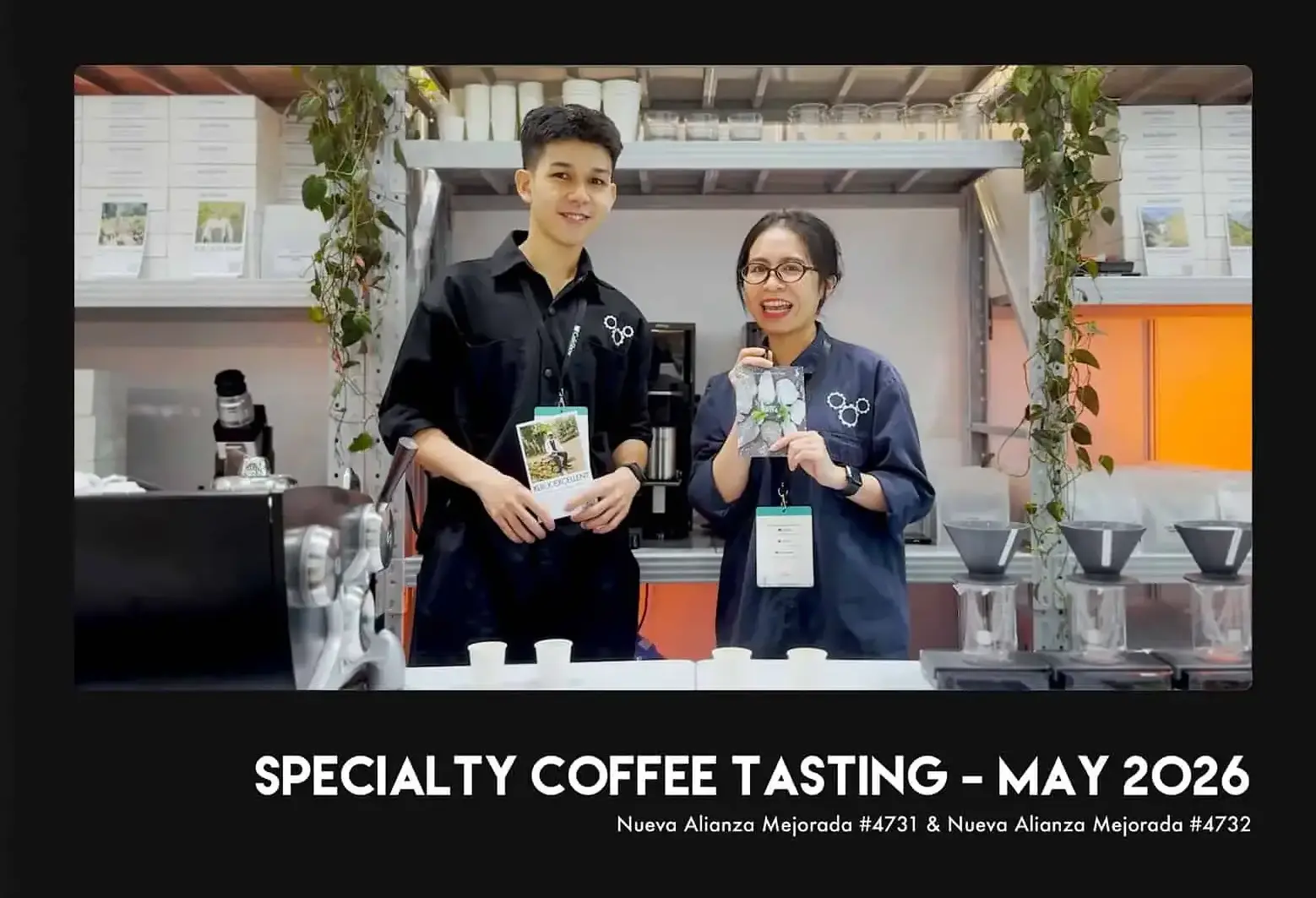
Unveiling May Discovery Subscription: Nueva Alianza Mejorada #4731 & Nueva Alianza Mejorada #4732
The Discovery Subscription is a silent dialogue, a place where the soul of the connoisseur finds a harmonious beat with distant lands. Like a transparent lens, we become storytellers, meticulously peeling back layers of cultural sediment, the breath of the soil, and the human philosophies hidden within every coffee bean.
May arrives with brilliant streaks of golden sunlight, a time when we long to hide beneath the lush, dew-drenched canopies of Santa Teresa. Amidst the silence of the Andes, when compassion touches Mother Earth, what will we hear? Perhaps it is a sweet response that nature reserves solely for souls who know how to wait patiently.

- Taste the Origin
Nueva Alianza Pacamara #4733 – The essence of Cusco with elegant jasmine notes
Nueva Alianza Pacamara #4733 is a testament to the miraculous terroir and dedicated cultivation of the renowned Cusco region. The combination of the characteristic Pacamara bean size and ideal altitude has forged a flavor profile of immense sophistication and depth. From the very first moment, this lot captivates with its elegant jasmine notes, radiating a gentle, pure fragrance akin to a flower blooming in the morning dew.

- Taste the Origin
Nueva Alianza Orange Gesha #4737 – An expedition of recessive genetic traits into the sensory realm
In a world of authenticity, Nueva Alianza Orange Gesha #4737 represents the proud emergence of rare biological traits often obscured by nature’s universality. Carrying a recessive genetic code, Lot #4737 embarks on an “expedition” into the connoisseur’s mind, where record-breaking fructose concentrations are released to perfectly fill every sensory gap with absolute smoothness and purity.
Through washed processing and extremely-light roasting, vibrant citrus nuances and ethereal floral notes, once hidden deep within the genetic structure, now manifest with power, transforming the tasting experience into a journey of ontological completion, where the rarity of recessive genes finally reigns supreme in flavor.

Specialty Coffee in Vietnam
BRAND VALUE
YOU SHOULD HAVE KNOWN
XLIII Coffee has been aiming to become a big, impactful company with social responsibilities,
have access to high-quality raw materials and convey the complete original values of coffee to our customer
