
Soil quality – Prerequisite for development of regenerative agriculture in coffee production
The unpredictable developments of climate change and its impact on life and the economy are currently leading to many innovations in the coffee industry. One of the visible changes is the increasing demand for sustainable, environmentally and socially responsible coffee. Coffee production also focuses on regenerative agriculture to both improve quality and restore natural ecosystems. In particular, soil quality is considered a determining factor in overall coffee quality, as well as a premise for the development of regenerative agriculture. Why is it so important? Explore details with XLIII Coffee!
Understand regenerative agriculture in coffee production
The concept of regenerative agriculture in coffee production currently has no official explanation. However, according to the Rodale Institute in 1980, regenerative agriculture is used to describe the more comprehensive aspects of organic farming. In particular, farming methods used include: Restoring soil health; Protecting the local environment and wildlife; Promoting biodiversity; and saving water.
In addition, regenerative agriculture is also understood as a systematic way of farm management. In particular, Maria Silvia Tonti – Vice President of the RA and Carbon Competence Center at Yara said that the regenerative agriculture model will be based on the results to consider applying the best sustainable farming practices that have the highest impact. Positively impact nature through five themes: climate, soil health, resource use, biodiversity, and sustainable development.

The importance of soil quality for regenerative agriculture in coffee production
Soil quality is an essential factor for plants to grow and develop. It is directly related to the success of regenerative agriculture in coffee production. Specifically, Victor Hugo Ramirez Builes – Science & Coffee Expert said, good soil quality can be defined as soil conditions that allow the root system to grow and develop healthily. This can be achieved if the soil is fertile, has low acidity, and has good water-holding and drainage capacity. If the soil has low fertility, pH (high acidity), and low water-holding capacity will limit the growth of coffee. Fertile soil quality also allows for easier mineralization of all nutrients added, such as green manure. Healthy soils also can sequester more carbon, improving the resilience of coffee farms to climate change.

Therefore, it can be said that soil quality is closely correlated with crop productivity, affecting usage and development practices in regenerative agriculture. Improving soil quality is one of the most effective ways to maintain crop productivity over the long term and increase plant adaptation to climate change.

What can farmers do to improve soil quality?
One of the most effective ways to improve soil quality and health is to use high-quality fertilizers. However, fertilizer content and fertilization cycle should be well controlled. Because using too much fertilizer or using fertilizer at the wrong time can reduce quality or damage soil structure and pollute the farm’s water.

In addition, soil quality will be improved and regenerated naturally thanks to sustainable agricultural practices. For example, organic techniques or enhancing plant and animal diversity or factors related to the terroir of the growing area to create a sustainable ecosystem and nutrient circulation. From there, the soil can enhance natural biological activity, increase porosity, moisture retention, drainage as well as enhance nutrition. Specific ways such as using compost produced from farm waste (cattle manure, coffee grounds, straw,…). Maintain nurseries to maintain native tree populations and reforest the banks of local streams and streams interspersed with and around coffee growing areas. The manufacturer also provides workers with reasonable wages, learning opportunities and accommodation to improve their qualifications and understanding of their own mission for a sustainable coffee industry.

Good soil means soil with enough nutrients and healthy bacteria. Maintaining soil quality can increase both productivity and coffee quality. Theoretically, this means manufacturers can receive more money and invest more in their business. Roasters can provide higher quality coffee, ensuring demand for more sustainable specialty coffee is met. However, maintaining and enhancing soil health in a sustainable way is not easy. Farmers need to be supported with knowledge, skills, resources and finances to effectively implement regenerative agriculture methods.

As a sustainable coffee business, XLIII Coffee is one of the businesses that always cares and finds more sustainable ways to adapt and minimize the impact of the coffee industry on the environment. We always research and select producers who practice regenerative agriculture to promote the “green” development of the coffee production industry. We choose recyclable, biodegradable packaging when transporting green coffee beans and packaging them to consumers to limit waste. We choose the ultra-light roasting method to optimize energy and reduce greenhouse gas emissions to the maximum level.

Furthermore, all information related to the product from the manufacturer, farming method, transportation, preliminary processing, etc. must be transparently disclosed to ensure the full flavor value and message from the supply chain’s sustainable response to customers. If you want to experience and contribute to sustainable development, visit and choose specialty coffee beans at XLIII Coffee!
Don’t forget to follow the Journal channel every day to update useful coffee news!
Articles you may be interested in:
– Terroir in coffee – Factor that shapes flavor
– Are environmental issues in the specialty coffee industry really changing positively?

Bài viết mới

- Taste the Origin
Nigussie Nare – Murago Outgrowers #03028: Cultivated from the Values of Sustainable Reciprocity
Nestled beneath the shade trees of Sidama, Bensa, the Nigussie Nare – Murago Outgrowers #03028 coffee lot serves as a living testament to the values of sustainable reciprocity. This symbiosis begins with the intimate bond between a rich indigenous ecosystem and the smallholder farmers of the Murago region. Each harvested bean is the culmination of a virtuous cycle: a stable environment produces exceptional bean quality, and sustainable economic growth, in turn, continues to protect the verdant canopy of the great forest.

- Taste the Origin
Rift Valley Coffee Caucus #03757 – A Testament to Western Kenya’s Collective Spirit
Turning our gaze to the Great Rift Valley of East Africa, the fertile volcanic landscapes are witnessing an inspiring transformation. Moving away from fierce, survival-driven competition, smallholder farmers in Western Kenya have chosen to join forces, forging a resilient and unified network. The Rift Valley Coffee Caucus #03757 lot stands as the ultimate testament to this remarkable collective synergy.

- Breaking News
Airworks Coffee & XLIII Coffee – A “handshake” that brings original flavors across borders
XLIII Coffee, alongside our key wholesale partner Airworks Coffee, officially announces the latest release of specialty coffee lots for the North American market. This event reaffirms our commitment to bringing original flavors across all geographical barriers to coffee enthusiasts.
Early access (for Subscribers of Airworks): 10:00 AM (PST) | Wednesday, April 29, 2026
General access: 10:00 AM (PST) | Friday, May 1, 2026
We invite our Customers and Partners to visit (airworkscoffee.com) for detailed information and to prepare for this special release!
- Taste the Origin
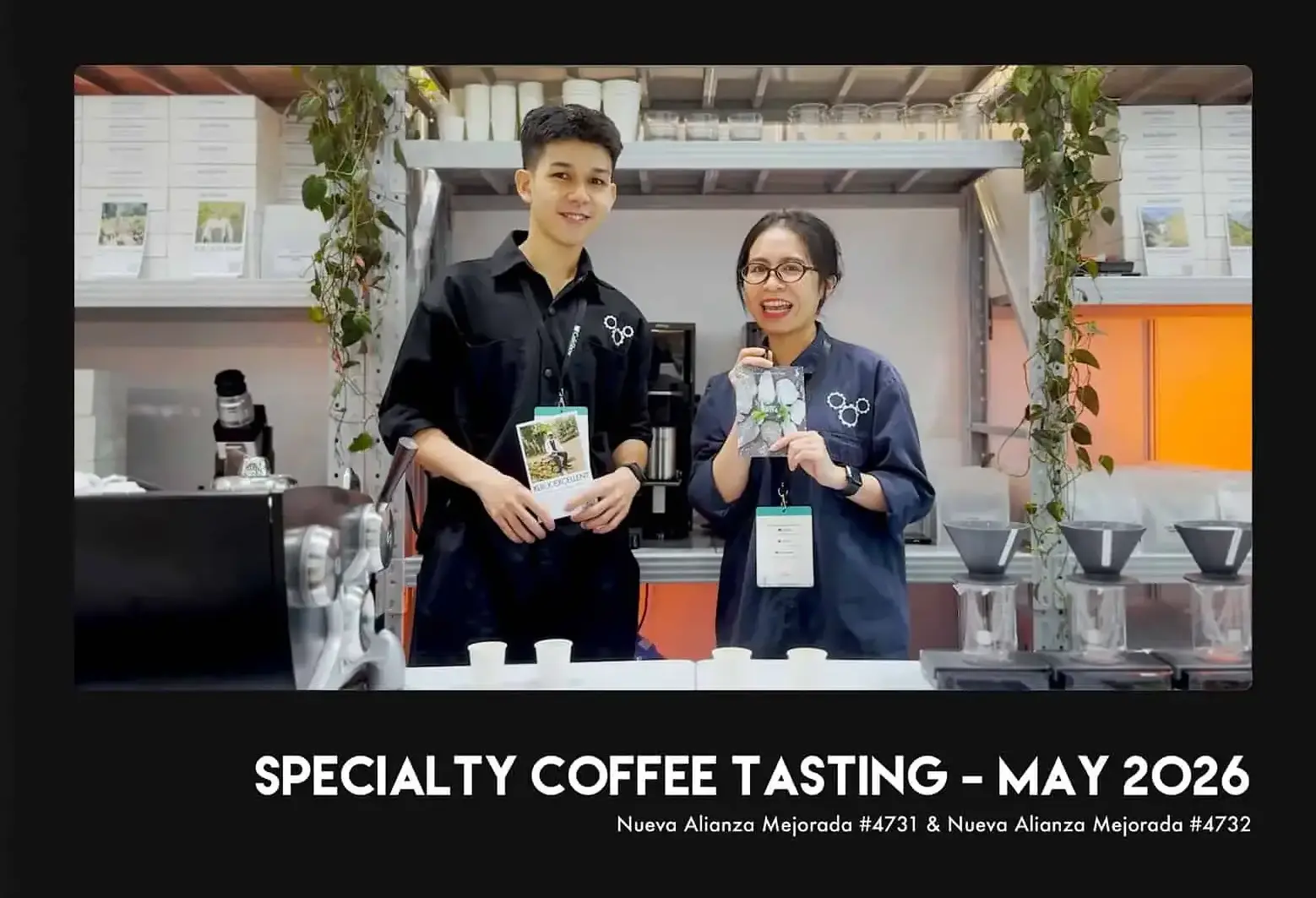
Unveiling May Discovery Subscription: Nueva Alianza Mejorada #4731 & Nueva Alianza Mejorada #4732
The Discovery Subscription is a silent dialogue, a place where the soul of the connoisseur finds a harmonious beat with distant lands. Like a transparent lens, we become storytellers, meticulously peeling back layers of cultural sediment, the breath of the soil, and the human philosophies hidden within every coffee bean.
May arrives with brilliant streaks of golden sunlight, a time when we long to hide beneath the lush, dew-drenched canopies of Santa Teresa. Amidst the silence of the Andes, when compassion touches Mother Earth, what will we hear? Perhaps it is a sweet response that nature reserves solely for souls who know how to wait patiently.

- Taste the Origin
Nueva Alianza Pacamara #4733 – The essence of Cusco with elegant jasmine notes
Nueva Alianza Pacamara #4733 is a testament to the miraculous terroir and dedicated cultivation of the renowned Cusco region. The combination of the characteristic Pacamara bean size and ideal altitude has forged a flavor profile of immense sophistication and depth. From the very first moment, this lot captivates with its elegant jasmine notes, radiating a gentle, pure fragrance akin to a flower blooming in the morning dew.

- Taste the Origin
Nueva Alianza Orange Gesha #4737 – An expedition of recessive genetic traits into the sensory realm
In a world of authenticity, Nueva Alianza Orange Gesha #4737 represents the proud emergence of rare biological traits often obscured by nature’s universality. Carrying a recessive genetic code, Lot #4737 embarks on an “expedition” into the connoisseur’s mind, where record-breaking fructose concentrations are released to perfectly fill every sensory gap with absolute smoothness and purity.
Through washed processing and extremely-light roasting, vibrant citrus nuances and ethereal floral notes, once hidden deep within the genetic structure, now manifest with power, transforming the tasting experience into a journey of ontological completion, where the rarity of recessive genes finally reigns supreme in flavor.

Specialty Coffee in Vietnam
BRAND VALUE
YOU SHOULD HAVE KNOWN
XLIII Coffee has been aiming to become a big, impactful company with social responsibilities,
have access to high-quality raw materials and convey the complete original values of coffee to our customer
