
Will WCR’s coffee seed and nursery development initiative help Uganda achieve its ambitions?
According to a report from the Uganda Coffee Development Authority (UCDA), the Ugandan coffee industry has set ambitious goals. The target is production growth of up to 20 million bags in 2025-2030, four times the output in the period 2019-2021. To achieve this result, relevant organizations have cooperated and implemented the coffee seed and nursery development plan of the World Coffee Research (WCR) research institute. Will this WCR initiative help Uganda achieve its ambitions? Explore with XLIII Coffee!
Goals and challenges of Uganda's coffee industry
In UCDA’s Coffee Roadmap, the Organization clearly states the expected progress in the new period. Prominent are big goals such as developing and improving productivity and expanding production land area by 20%. Growth in coffee output is also expected to reach 20 million bags in the period 2025-2030. According to expert analysts, these are ambitious numbers given the situation of Uganda’s coffee industry. Because coffee contributes nearly 1/3 of the country’s export income, but more than 90% is produced by small-scale farmers. Farmers’ access to high-quality beans, modern equipment, and advanced techniques is still weak. The farm is also not heavily invested in due to limited capital.

Uganda’s coffee industry targets output growth of 20 million bags in the period 2025-2030
WCR advances Uganda's goals with its seed and nursery development initiatives
To achieve this goal, Ugandan departments have collaborated with organizations around the world to develop initiatives to promote transformation. In particular, WCR coordinates with the Uganda Coffee Development Authority (UCDA) and the Uganda National Coffee Research Institute (NaCORI) to develop initiatives to develop coffee nurseries and varieties throughout all regions of Uganda. The project aims to actively strengthen the nursery and seed sector, a concerted effort aimed at quadrupling coffee production to 20 million bags by 2030. Nursery training materials, WCR said, and workshops for incubator operators will be initiated and implemented. Quality seeds and equipment will be distributed to growing areas in Uganda to improve access to resources and increase production efficiency. Specifically, they will deliver 100,000 healthy NARO Kituza Robusta (KR) to farmers, while supporting an increase in the supply of high-quality planting material in the future.

WCR, UCDA and NaCORI develop an initiative to develop coffee nurseries and varieties in Uganda
Will the nursery and seed development initiative meet expectations?
According to Sjaak De Bloois, Head of Agronomy & Sustainability at UGACOF, the initial steps of the project have quickly brought positive signals. Nearly 50,000 KR plants have been supplied to commercial farmers in the Greater Masaka region. Coffee farmers are now able to manage and maintain their nurseries. The remaining 50,000 plants will be made available to farmers by 2024. Additionally, more than 2,000 farmers in Uganda are being supported with resources to set up and manage micro-nurseries. WCR conducted a five-day training course in Masaka to educate 393 nursery operators, who are responsible for producing more than 2 million plants each year, on best agricultural practices to optimize establish, and manage Robusta coffee nurseries.

Nearly 50,000 KR plants have been supplied to farmers in the Greater Masaka region
Dr Gerald Kyalo, UCDA Director of Agricultural Development Services, said that nursery training has contributed significantly to improving the skills of operators in the Masaka region. This has improved quality and productivity for most growing regions in the country. The technologies provided by the training courses are very useful in improving and renovating coffee gardens, and can also be applied to replace varieties and improve production and productivity. Through that, experts believe that when WCR’s nursery project is completed, achieving a 4-fold increase in output in the period 2025 – 2030 is completely possible.

According to the plan, Uganda is likely to soon achieve its set growth target
With the joint action of organizations, WCR’s nursery and seed development initiative can help Uganda’s coffee industry reach promising growth levels. If you are looking forward to the results of this project, follow XLIII Coffee’s Journal updates to update the latest coffee industry news!
Articles you may be interested in:
– What determines the color of coffee?
– How does drinking coffee help reduce blood pressure?
– Brazil’s naturally decaffeinated coffee beans may be coming soon after 20 years of research!

Bài viết mới

- Taste the Origin
Rift Valley Coffee Caucus #03757 – A Testament to Western Kenya’s Collective Spirit
Turning our gaze to the Great Rift Valley of East Africa, the fertile volcanic landscapes are witnessing an inspiring transformation. Moving away from fierce, survival-driven competition, smallholder farmers in Western Kenya have chosen to join forces, forging a resilient and unified network. The Rift Valley Coffee Caucus #03757 lot stands as the ultimate testament to this remarkable collective synergy.

- Breaking News
Airworks Coffee & XLIII Coffee – A “handshake” that brings original flavors across borders
XLIII Coffee, alongside our key wholesale partner Airworks Coffee, officially announces the latest release of specialty coffee lots for the North American market. This event reaffirms our commitment to bringing original flavors across all geographical barriers to coffee enthusiasts.
Early access (for Subscribers of Airworks): 10:00 AM (PST) | Wednesday, April 29, 2026
General access: 10:00 AM (PST) | Friday, May 1, 2026
We invite our Customers and Partners to visit (airworkscoffee.com) for detailed information and to prepare for this special release!
- Taste the Origin
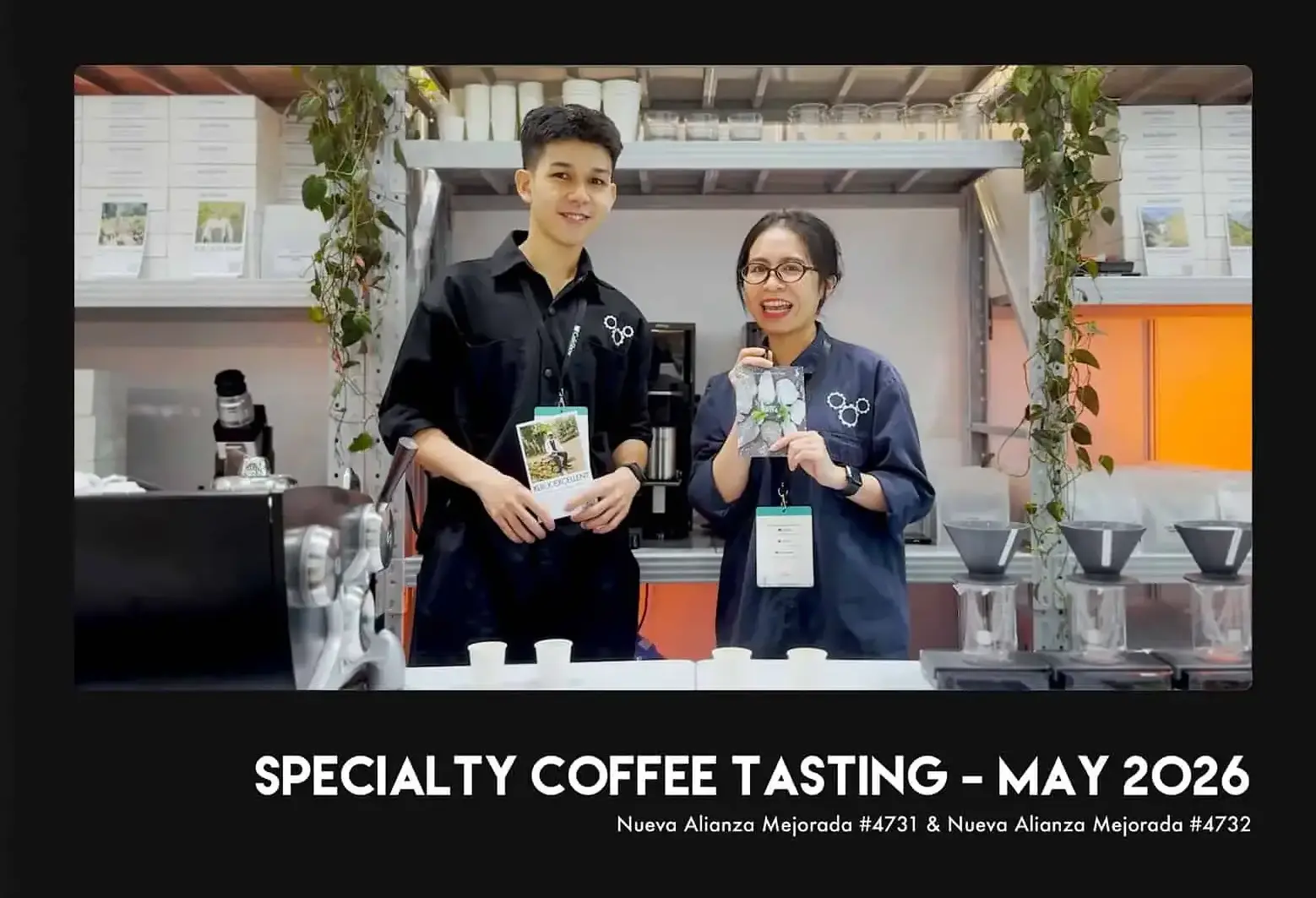
Unveiling May Discovery Subscription: Nueva Alianza Mejorada #4731 & Nueva Alianza Mejorada #4732
The Discovery Subscription is a silent dialogue, a place where the soul of the connoisseur finds a harmonious beat with distant lands. Like a transparent lens, we become storytellers, meticulously peeling back layers of cultural sediment, the breath of the soil, and the human philosophies hidden within every coffee bean.
May arrives with brilliant streaks of golden sunlight, a time when we long to hide beneath the lush, dew-drenched canopies of Santa Teresa. Amidst the silence of the Andes, when compassion touches Mother Earth, what will we hear? Perhaps it is a sweet response that nature reserves solely for souls who know how to wait patiently.

- Taste the Origin
Nueva Alianza Pacamara #4733 – The essence of Cusco with elegant jasmine notes
Nueva Alianza Pacamara #4733 is a testament to the miraculous terroir and dedicated cultivation of the renowned Cusco region. The combination of the characteristic Pacamara bean size and ideal altitude has forged a flavor profile of immense sophistication and depth. From the very first moment, this lot captivates with its elegant jasmine notes, radiating a gentle, pure fragrance akin to a flower blooming in the morning dew.

- Taste the Origin
Nueva Alianza Orange Gesha #4737 – An expedition of recessive genetic traits into the sensory realm
In a world of authenticity, Nueva Alianza Orange Gesha #4737 represents the proud emergence of rare biological traits often obscured by nature’s universality. Carrying a recessive genetic code, Lot #4737 embarks on an “expedition” into the connoisseur’s mind, where record-breaking fructose concentrations are released to perfectly fill every sensory gap with absolute smoothness and purity.
Through washed processing and extremely-light roasting, vibrant citrus nuances and ethereal floral notes, once hidden deep within the genetic structure, now manifest with power, transforming the tasting experience into a journey of ontological completion, where the rarity of recessive genes finally reigns supreme in flavor.

- Taste the Origin
Nueva Alianza Maragogipe #4735 – The “Giant” at the center of attention
Amidst a world of countless specialty coffee beans, Nueva Alianza Maragogipe #4735 emerges as a symbol of grandeur, instantly commanding attention with its distinct appearance. Affectionately dubbed the “Giant” for its impressively mutated “Elephant Bean” size, lot #4735 from Nueva Alianza stands as a testament to nature’s wonders in the Cusco region. Yet, its true allure extends far beyond its imposing exterior; hidden within these colossal beans lies a gentle “soul” blooming with pure floral and crystalline fruit notes.

Specialty Coffee in Vietnam
BRAND VALUE
YOU SHOULD HAVE KNOWN
XLIII Coffee has been aiming to become a big, impactful company with social responsibilities,
have access to high-quality raw materials and convey the complete original values of coffee to our customer
