
Conilon Coffee: A Promising Contender in Global Coffee Trade
Amid rising trade tensions and new tariff policies introduced under the Trump administration, coffee roasters in the United States are actively seeking alternative sources to Vietnamese Robusta in order to maintain business continuity. In this context, Brazil’s Conilon coffee—subject to lower tariffs—is emerging as a potential substitute. Let’s explore the origin, characteristics, and flavor profile of this distinctive coffee variety.
I. An Overview of Conilon Coffee
What is Conilon Coffee?
Conilon is a coffee variety belonging to the Coffea canephora species, derived from a genetic group known as SG1. It is closely related to Robusta, which belongs to a broader genetic group called SG2. According to botanical records, Conilon was first discovered by the French in 1880 in the wild, in the region between Gabon and the Congo River, along the Kouilou River in Central Africa. From Africa, the Conilon variety was introduced to Brazil, where it quickly became popular, especially in the state of Espírito Santo.

Origin and Development History
As mentioned, Conilon coffee traces its roots back to Africa. Initially known as “Koillou,” the variety was officially named Coffea canephora by botanist Louis Pierre in 1895, based on specimens collected by Reverend Théophile Klaine.
During the late 19th century, coffee leaf rust devastated many Arabica plantations in Southeast Asia. In response, seeds labeled as “Robusta” from Congo were sent to Java, Indonesia, where Conilon proved to be high-yielding and resistant to disease—laying the groundwork for global breeding and cultivation efforts.
In 1912, the variety was introduced to Espírito Santo, Brazil, where its name evolved into “Conilon” due to linguistic adaptation during its migration. Between 1930 and 1935, the plant also made its way to Central American countries such as Guatemala. From domestication centers in Cameroon, Côte d’Ivoire, Madagascar, and India, Robusta lines continued to be exchanged and refined to enhance both productivity and resistance.
Today, Conilon plays a crucial role in Brazil’s industrial coffee sector, primarily used in the production of instant coffee and high-caffeine blends.
II. Distinctive Characteristics of Conilon Coffee
Although Conilon and Robusta both belong to the Coffea canephora species, Conilon exhibits unique agronomic traits.
The Conilon tree is typically shorter, with a wider canopy and smaller leaves. It has a shorter growth cycle compared to Arabica or “typical” Robusta varieties. Notably, Conilon is highly drought-tolerant, pest-resistant, and well-adapted to hot, humid tropical climates with abundant rainfall—similar to many coffee-growing regions in Vietnam. This makes it a strong candidate for cultivation in the face of climate change, which increasingly threatens global coffee yields.
Conilon is known for its consistently high productivity. Thanks to ongoing breeding and selection efforts in Brazil, both the quality and resilience of Conilon have improved significantly. The plant recovers well after exposure to adverse conditions such as drought or pest outbreaks.
In terms of physical characteristics, Conilon beans are denser and contain more caffeine than Arabica. Their quality is becoming more standardized and has seen notable enhancement through Brazil’s selective breeding programs.

III. Flavor Profile of Conilon Coffee
The flavor of Conilon is often reminiscent of wood, cocoa, and herbs, with very low acidity but a distinct and strong bitterness. The aftertaste may have earthy tones, pinewood, and occasionally raw cocoa. The body of the coffee is thick and full, providing a heavy, round mouthfeel, making it ideal for espresso brewing or as a blend to add depth to coffee products.
In recent years, the quality of Conilon’s flavor has significantly improved in Brazil through new processing methods such as semi-washed and honey processing. These improvements not only help retain more layers of flavor but also open up great potential for Conilon in demanding markets such as the US and Europe, where consumers are becoming increasingly interested in the origin and processing methods of coffee.

IV. Can Conilon Coffee Replace Vietnamese Robusta?
Previously, the Vietnamese coffee industry was abuzz with news that the US was considering imposing a 46% tariff on goods imported from Vietnam, including coffee. Although the US President later postponed the decision for 90 days for negotiations, the tariff disparity still forced US roasters to rethink their sourcing strategies. Many experts began to question: could Brazil’s Conilon coffee gradually replace Vietnamese Robusta in the eyes of international roasters?

From a genetic standpoint, both Conilon and Robusta belong to the Coffea canephora species and share many characteristics in terms of bean structure, caffeine content, and biological resilience. However, Conilon has distinct traits, such as a shorter growing cycle, better drought resistance, a fuller body, and lower acidity, making it particularly suitable for instant coffee or mainstream blend formulas.
Moreover, with the advantages of large-scale cultivation, improved processing technology, and more stable tariffs in the US market, Conilon could gradually emerge as a viable alternative when roasters need a safer option amid market fluctuations.
Conilon is proving its strength through its stability, high yield, and flexibility in commercial applications—features that global roasters cannot overlook. While Vietnamese Robusta still holds an advantage in terms of production volume, this position could be challenged if Vietnam does not prioritize improving quality and expanding markets through trade negotiations or value-added strategies.

Conclusion
Although Conilon may not be a household name to most people, it is gradually asserting its position on the global coffee map with superior yield, resilience, and quality improvement potential. In the short term, Conilon may not completely replace Vietnamese Robusta, but its increasing presence, especially amid global trade fluctuations, is something that cannot be ignored.
V. FAQs
1. Is Conilon the same as Robusta?
Not exactly. Conilon belongs to the Coffea canephora species, the same as Robusta, but is a different genetic group (SG1 instead of SG2). While they share many similarities, Conilon has distinct traits in terms of morphology, growth, and flavor.
2. Where is Conilon mainly grown?
Conilon is predominantly cultivated in the state of Espírito Santo in Brazil, which has a hot, humid climate with abundant rainfall, ideal for this variety.
3. Why is Conilon being mentioned more lately?
Due to trade tensions between the US and Vietnam, US roasters are considering shifting from Vietnamese Robusta to Brazilian Conilon—a coffee of nearly equivalent quality but with lower tariffs.
4. What is the flavor profile of Conilon?
Conilon has a strong, bold flavor with low acidity and a wood or cocoa aftertaste. Its thick body makes it ideal for espresso blends and instant coffee.
5. Can Conilon fully replace Vietnamese Robusta?
Functionally, it could replace Robusta in certain applications like instant coffee or espresso blends. However, Vietnamese Robusta still has an edge in production volume, production expertise, and distinct flavor, making it unlikely to be fully replaced in the short term.

Bài viết mới

- Taste the Origin
Nigussie Nare – Murago Outgrowers #03028: Cultivated from the Values of Sustainable Reciprocity
Nestled beneath the shade trees of Sidama, Bensa, the Nigussie Nare – Murago Outgrowers #03028 coffee lot serves as a living testament to the values of sustainable reciprocity. This symbiosis begins with the intimate bond between a rich indigenous ecosystem and the smallholder farmers of the Murago region. Each harvested bean is the culmination of a virtuous cycle: a stable environment produces exceptional bean quality, and sustainable economic growth, in turn, continues to protect the verdant canopy of the great forest.

- Taste the Origin
Rift Valley Coffee Caucus #03757 – A Testament to Western Kenya’s Collective Spirit
Turning our gaze to the Great Rift Valley of East Africa, the fertile volcanic landscapes are witnessing an inspiring transformation. Moving away from fierce, survival-driven competition, smallholder farmers in Western Kenya have chosen to join forces, forging a resilient and unified network. The Rift Valley Coffee Caucus #03757 lot stands as the ultimate testament to this remarkable collective synergy.

- Breaking News
Airworks Coffee & XLIII Coffee – A “handshake” that brings original flavors across borders
XLIII Coffee, alongside our key wholesale partner Airworks Coffee, officially announces the latest release of specialty coffee lots for the North American market. This event reaffirms our commitment to bringing original flavors across all geographical barriers to coffee enthusiasts.
Early access (for Subscribers of Airworks): 10:00 AM (PST) | Wednesday, April 29, 2026
General access: 10:00 AM (PST) | Friday, May 1, 2026
We invite our Customers and Partners to visit (airworkscoffee.com) for detailed information and to prepare for this special release!
- Taste the Origin
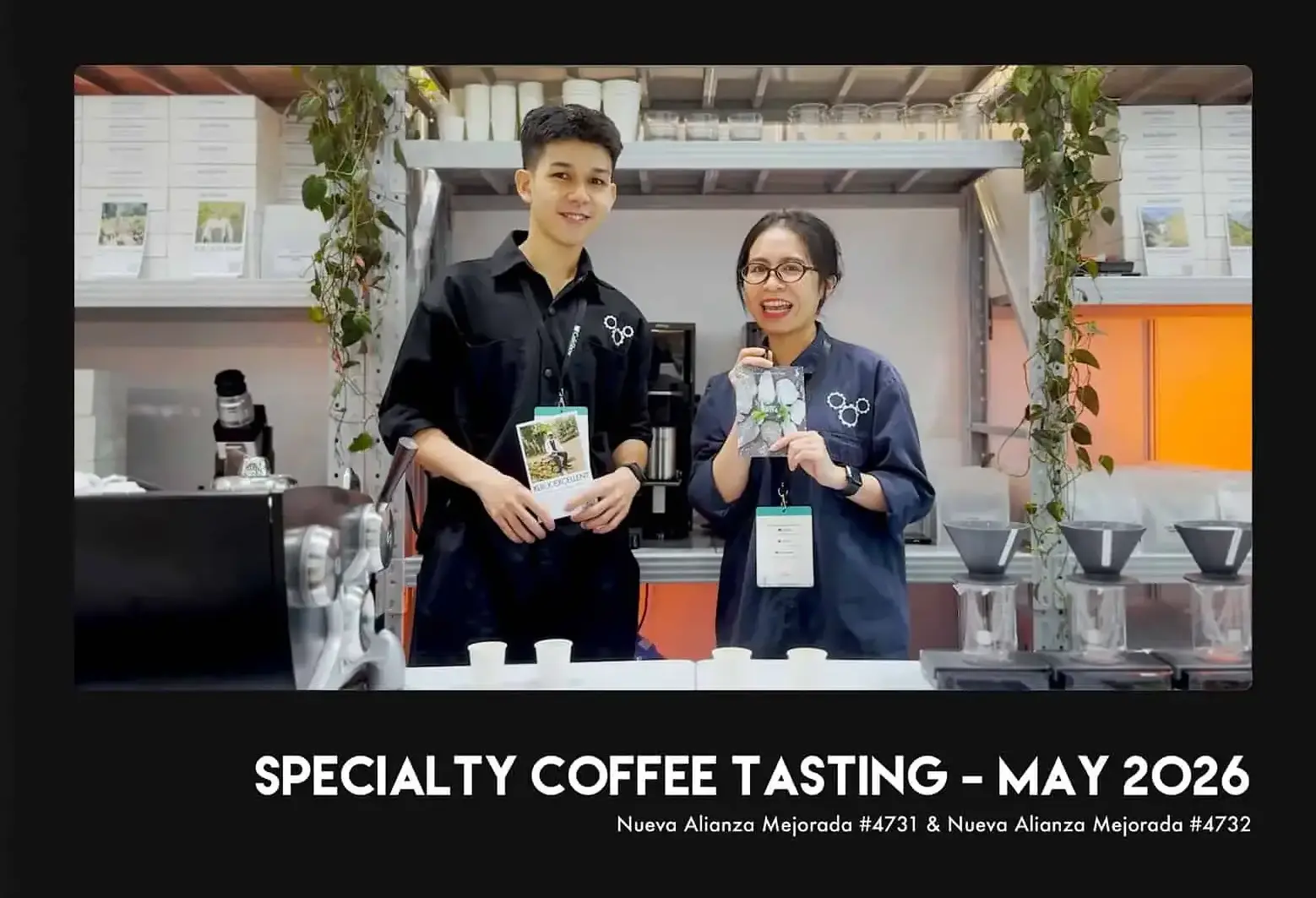
Unveiling May Discovery Subscription: Nueva Alianza Mejorada #4731 & Nueva Alianza Mejorada #4732
The Discovery Subscription is a silent dialogue, a place where the soul of the connoisseur finds a harmonious beat with distant lands. Like a transparent lens, we become storytellers, meticulously peeling back layers of cultural sediment, the breath of the soil, and the human philosophies hidden within every coffee bean.
May arrives with brilliant streaks of golden sunlight, a time when we long to hide beneath the lush, dew-drenched canopies of Santa Teresa. Amidst the silence of the Andes, when compassion touches Mother Earth, what will we hear? Perhaps it is a sweet response that nature reserves solely for souls who know how to wait patiently.

- Taste the Origin
Nueva Alianza Pacamara #4733 – The essence of Cusco with elegant jasmine notes
Nueva Alianza Pacamara #4733 is a testament to the miraculous terroir and dedicated cultivation of the renowned Cusco region. The combination of the characteristic Pacamara bean size and ideal altitude has forged a flavor profile of immense sophistication and depth. From the very first moment, this lot captivates with its elegant jasmine notes, radiating a gentle, pure fragrance akin to a flower blooming in the morning dew.

- Taste the Origin
Nueva Alianza Orange Gesha #4737 – An expedition of recessive genetic traits into the sensory realm
In a world of authenticity, Nueva Alianza Orange Gesha #4737 represents the proud emergence of rare biological traits often obscured by nature’s universality. Carrying a recessive genetic code, Lot #4737 embarks on an “expedition” into the connoisseur’s mind, where record-breaking fructose concentrations are released to perfectly fill every sensory gap with absolute smoothness and purity.
Through washed processing and extremely-light roasting, vibrant citrus nuances and ethereal floral notes, once hidden deep within the genetic structure, now manifest with power, transforming the tasting experience into a journey of ontological completion, where the rarity of recessive genes finally reigns supreme in flavor.

Specialty Coffee in Vietnam
BRAND VALUE
YOU SHOULD HAVE KNOWN
XLIII Coffee has been aiming to become a big, impactful company with social responsibilities,
have access to high-quality raw materials and convey the complete original values of coffee to our customer
