
Market Scenario for Coffee as the U.S. Imposes a 46% Retaliatory Tariff
According to CNBC, at 12:01 AM (Eastern Time) on April 9 (11:01 AM Hanoi time on April 10), the U.S. Customs and Border Protection (CBP) officially began collecting import duties under President Donald Trump’s retaliatory tariff order. The new tariffs apply to 86 countries and territories worldwide, with import duties on some Vietnamese products reaching up to 46%. As one of Vietnam’s strongest export categories to the U.S., how will Vietnamese coffee be affected?
Swift Reaction from Vietnam’s Domestic Market to the 2025 U.S. Tariffs
Until now, Vietnamese pepper and coffee exports to the U.S. have benefited from a 0% import tax, thanks to the U.S.’s preferential trade policies for developing countries and a stable bilateral relationship. This has been a key factor helping Vietnam become a leading supplier of pepper and coffee to the U.S., with export volumes in the hundreds of thousands of tons annually.
Following President Trump’s tariff announcement, Vietnam’s domestic coffee market reacted sharply.
Domestic coffee prices plummeted by nearly 7,000 VND/kg, dropping to around 127,000 VND/kg – the lowest level since the start of the 2024–2025 harvest season. Panic selling occurred in many major growing regions in the Central Highlands, reflecting anxiety and a lack of clear information among farmers.
Nguyen Van Thanh, Director of Hoa Trang Import-Export Co., Ltd., stated: “The market is reacting strongly to the tariff barrier, dragging down value across the entire supply chain.”
Meanwhile, many farmers are opting to stockpile coffee in hopes of a price rebound, temporarily disrupting supply-demand balance in the domestic market.

Numerous shipments en route or about to be delivered have been postponed as U.S. partners await clarification on the new tariff policy. Some importers are requesting price renegotiations or even suspending transactions to reassess costs. Facing the risk of losing the market, many Vietnamese businesses are being forced to slash prices and accept losses to retain customers — directly impacting profit margins, especially as production and logistics costs remain high.
According to the Ministry of Industry and Trade, in just the first week of April, coffee exports to the U.S. dropped by 18%, and pepper exports by up to 25% compared to the previous month.
Worse yet, competitors like Brazil, Indonesia, and India — unaffected by the tariffs or benefiting from favorable trade agreements — are quickly gaining competitive advantages, posing a direct threat to Vietnam’s longstanding market share in the U.S.
Domino Effect in the Global Market
According to an initial statement from Trump’s campaign office:
“Countries benefiting from free trade while harming American workers will have to pay the price.”
Vietnam, although a major trading partner, has been swept into this policy as part of Trump’s broader strategy to rebalance the global supply chain.
But the impact goes beyond Vietnam. On the international market, robusta coffee prices in London fell by 5.6%, while arabica in New York dropped over 5% during the trading session on April 4.
With robusta coffee currently priced at around $5,000/ton, a 46% tariff could raise the price to as high as $7,500/ton, making Vietnamese coffee significantly less competitive than Brazilian coffee, which is only subject to a 10% tariff.
However, many small businesses in the U.S., which rely heavily on imported coffee, now face bankruptcy risks due to rising costs and reduced competitiveness.
American consumers are also likely to pay more for their daily cup of coffee. This is part of a chain reaction from concerns that skyrocketing import costs will reduce consumption in the U.S. — the world’s largest coffee consumer.
Stock prices of major coffee chains like Starbucks have already dropped 20% following the tariff announcement.
Possible Scenarios in the Near Future

Scenario 1: The U.S. and Vietnam Reach a Tariff Reduction Agreement, Coffee Remains Exempt
Amid escalating trade tensions, the possibility of a bilateral agreement between the U.S. and Vietnam to reduce or eliminate the 46% retaliatory tariff is both reasonable and grounded in reality. Vietnam has clearly shown goodwill by expressing its willingness to lower tariffs on U.S. goods to create balance and pave the way for dialogue. On the U.S. side, the economic value of imported coffee is simply too significant to risk disruption.
According to the U.S. National Coffee Association (NCA), the coffee industry contributes up to $340 billion annually and supports over 2.2 million jobs. Meanwhile, the U.S. produces less than 1% of its coffee consumption, mainly in Hawaii and Puerto Rico—regions with high production costs and limited output.
Therefore, imposing tariffs on imported coffee—especially from Vietnam, the world’s second-largest supplier of robusta—would significantly increase consumer prices, directly impacting large coffee chains, instant coffee producers, and end consumers. In this scenario, if the U.S. government receives strong support from coffee industry associations and considers its long-term strategic relations with Vietnam, it could very well exempt coffee from the tariff list as a strategic exception. This would be the most positive outcome, helping to stabilize the supply chain, protect consumers, and foster expanded trade cooperation between the two countries. However, this possibility depends on the goodwill and mutual interests of both parties.
Scenario 2: Tariffs Remain Unchanged, Coffee Faces High Import Duties
If the U.S. government insists on maintaining high retaliatory tariffs without making an exception for coffee, Vietnam’s coffee industry could face a severe shock in terms of market share in the U.S.
A 46% tariff would significantly raise the price of imported robusta from Vietnam—a type favored by instant coffee manufacturers and major coffee chains in the U.S. for its low cost and bold flavor. Current FOB prices hover around $5,000/ton; with the additional tariff, import costs could rise by more than $2,000/ton, forcing importers to seek alternative sources.
At the same time, the U.S. has virtually no capacity to expand domestic coffee production efficiently. Coffee output from Hawaii and Puerto Rico meets less than 0.5% of total demand and cannot compete with imported coffee in terms of cost. Supply from neighboring countries such as Mexico and Canada is also insufficient to replace Vietnam’s role.
Facing both price and tariff pressure, U.S. companies may shift orders to Brazil, Indonesia, or Uganda—countries not subject to high tariffs and with competitive production scales. If this scenario persists, Vietnam could lose a significant portion of its market share in the U.S.
Scenario 3: Vietnam Proactively Restructures the Coffee Sector for Long-Term Adaptation
If the 46% tariff remains in place over the medium to long term, Vietnam’s coffee sector cannot rely on “waiting for negotiations” but must instead proactively adapt. Losing its competitive edge in the U.S.—the world’s largest coffee-consuming market (estimated at 26.7 million bags/year according to ICO 2024)—would be a wake-up call, prompting businesses and regulators to restructure the sector by reducing dependence on the U.S. market, improving quality, and diversifying the value chain.
Firstly, Vietnam should boost exports to markets with tariff advantages such as the EU (via EVFTA) and Asia—particularly China, South Korea, and Japan—where specialty coffee consumption is rapidly growing. This requires a strategic marketing reorientation and serious investment in national branding and transparent traceability.
Secondly, product restructuring is key: Vietnam should move towards deep processing, shifting from exporting raw green coffee to value-added products such as premium instant coffee, specialty roasted coffee, cold brew concentrate, or unique products made from local varieties like Fine Robusta or Fully Washed Catimor. This not only helps Vietnam escape the label of “cheap raw material supplier” but also enhances profit margins and long-term competitiveness.
Thirdly, a focus on sustainability is essential: U.S. and EU consumers increasingly prioritize environmentally friendly, fair-trade, and organic products. Expanding certifications such as Rainforest Alliance, Organic, and Fairtrade will be the key to gaining non-tariff competitive advantages. If done successfully, Vietnam could retain the U.S. market in the premium segment (even with tariffs) and open up more opportunities in other markets that value responsible consumption.
Although this scenario presents initial difficulties, it could serve as a pivotal moment for Vietnam’s coffee sector in the coming decade—if the opportunity is well leveraged.
In all scenarios, close monitoring of market developments, proactive negotiations, and the pursuit of new opportunities are essential to mitigate the negative impact of the U.S.’s new tariff policy.
This article is for informational purposes only and does not constitute legal or professional advice. The information herein is sourced from government, industry, and other public domains and may be subject to change.

Bài viết mới

- Taste the Origin
Rift Valley Coffee Caucus #03757 – A Testament to Western Kenya’s Collective Spirit
Turning our gaze to the Great Rift Valley of East Africa, the fertile volcanic landscapes are witnessing an inspiring transformation. Moving away from fierce, survival-driven competition, smallholder farmers in Western Kenya have chosen to join forces, forging a resilient and unified network. The Rift Valley Coffee Caucus #03757 lot stands as the ultimate testament to this remarkable collective synergy.

- Breaking News
Airworks Coffee & XLIII Coffee – A “handshake” that brings original flavors across borders
XLIII Coffee, alongside our key wholesale partner Airworks Coffee, officially announces the latest release of specialty coffee lots for the North American market. This event reaffirms our commitment to bringing original flavors across all geographical barriers to coffee enthusiasts.
Early access (for Subscribers of Airworks): 10:00 AM (PST) | Wednesday, April 29, 2026
General access: 10:00 AM (PST) | Friday, May 1, 2026
We invite our Customers and Partners to visit (airworkscoffee.com) for detailed information and to prepare for this special release!
- Taste the Origin
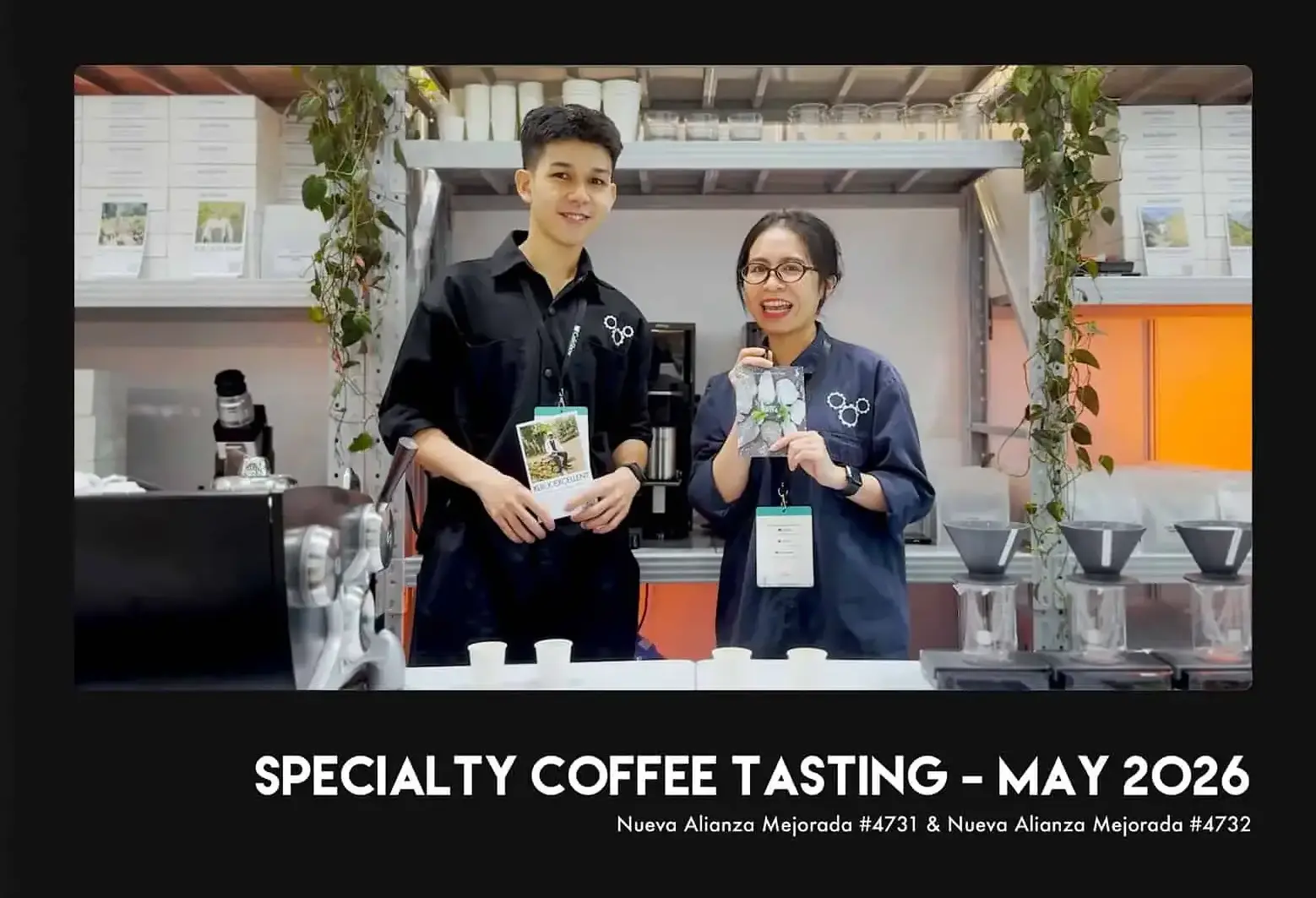
Unveiling May Discovery Subscription: Nueva Alianza Mejorada #4731 & Nueva Alianza Mejorada #4732
The Discovery Subscription is a silent dialogue, a place where the soul of the connoisseur finds a harmonious beat with distant lands. Like a transparent lens, we become storytellers, meticulously peeling back layers of cultural sediment, the breath of the soil, and the human philosophies hidden within every coffee bean.
May arrives with brilliant streaks of golden sunlight, a time when we long to hide beneath the lush, dew-drenched canopies of Santa Teresa. Amidst the silence of the Andes, when compassion touches Mother Earth, what will we hear? Perhaps it is a sweet response that nature reserves solely for souls who know how to wait patiently.

- Taste the Origin
Nueva Alianza Pacamara #4733 – The essence of Cusco with elegant jasmine notes
Nueva Alianza Pacamara #4733 is a testament to the miraculous terroir and dedicated cultivation of the renowned Cusco region. The combination of the characteristic Pacamara bean size and ideal altitude has forged a flavor profile of immense sophistication and depth. From the very first moment, this lot captivates with its elegant jasmine notes, radiating a gentle, pure fragrance akin to a flower blooming in the morning dew.

- Taste the Origin
Nueva Alianza Orange Gesha #4737 – An expedition of recessive genetic traits into the sensory realm
In a world of authenticity, Nueva Alianza Orange Gesha #4737 represents the proud emergence of rare biological traits often obscured by nature’s universality. Carrying a recessive genetic code, Lot #4737 embarks on an “expedition” into the connoisseur’s mind, where record-breaking fructose concentrations are released to perfectly fill every sensory gap with absolute smoothness and purity.
Through washed processing and extremely-light roasting, vibrant citrus nuances and ethereal floral notes, once hidden deep within the genetic structure, now manifest with power, transforming the tasting experience into a journey of ontological completion, where the rarity of recessive genes finally reigns supreme in flavor.

- Taste the Origin
Nueva Alianza Maragogipe #4735 – The “Giant” at the center of attention
Amidst a world of countless specialty coffee beans, Nueva Alianza Maragogipe #4735 emerges as a symbol of grandeur, instantly commanding attention with its distinct appearance. Affectionately dubbed the “Giant” for its impressively mutated “Elephant Bean” size, lot #4735 from Nueva Alianza stands as a testament to nature’s wonders in the Cusco region. Yet, its true allure extends far beyond its imposing exterior; hidden within these colossal beans lies a gentle “soul” blooming with pure floral and crystalline fruit notes.

Specialty Coffee in Vietnam
BRAND VALUE
YOU SHOULD HAVE KNOWN
XLIII Coffee has been aiming to become a big, impactful company with social responsibilities,
have access to high-quality raw materials and convey the complete original values of coffee to our customer
