
Understanding “sensory language” in the new era of coffee
“Bergamot zest,” “dark chocolate undertones,” or “floral jasmine finish” – what exactly are these experiences? This represents the biggest paradox in today’s specialty coffee industry: while coffee quality becomes increasingly refined and diverse, the descriptive language for taste – sensory language – has become so complex that it creates a gap between experts and consumers.
I. Training sensory language from experts to the general public
The phenomenon described above reflects a deeper crisis regarding the creation of a “taste elite,” where enjoying high-quality coffee becomes the privilege of those who understand specialized terminology. The question arises: can taste language be democratized so that everyone can access and fully appreciate specialty coffee?
The history of taste language in coffee began with tools designed for professionals. The SCAA Flavor Wheel was introduced in 1995 with 85 basic terms, primarily serving Q-graders and coffee professionals.
Development timeline of sensory training tools:
| Year | Tool | Target audience | Features |
| 1995 | SCAA Flavor Wheel | Professionals | Basic flavor classification tool |
| 2016 | Scentone Coffee Aroma Kit | Professionals trainings | 100-114 international standard aromas |
| 2016 | Coffee Taster’s Flavor Wheel (update) | Consumers | Visual design |
| 2017 | World Coffee Research Sensory LexiconScientì | Scientific research | 110 standardized terms |
The real revolution began when training tools were designed with accessibility in mind. The Scentone Coffee Aroma Kit from South Korea is a prime example – with 100 international standard aromas in the T100 version (and 144 aromas in the T144 version), packaged in small vials, allowing anyone to systematically “learn” the language of aroma.

Modern training tools don’t simply list terminology but focus on building taste memory. The 2016 Coffee Taster’s Flavor Wheel was designed with enhanced visual support:
- Color hierarchy: From main flavor groups to specific details
- Circular structure: Helps users easily navigate from general to specific
- Visual coding: Uses colors to distinguish flavor groups
Cupping forms have undergone similar simplification. From the complex evaluations of Cup of Excellence with detailed scoring systems, the industry has developed simplified versions for consumers, focusing on the most basic attributes that ordinary people can recognize.
II. Standardization and localization in taste language
This remains a significant limitation in popularizing taste language in the new era of specialty coffee. The World Coffee Research Sensory Lexicon represents an effort to standardize taste language on a global scale. Its 110 scientifically defined terms with specific reference standards create a “common vocabulary” for the entire industry.
Achievements of Standardization:
- SCA Cupping Protocol with 10 unified evaluation criteria
- Q-Grader program with approximately 6,000 certifications issued globally
- Consistent scoring system for coffee quality assessment
However, this success also creates a problem: the standardized language is primarily based on Western perspectives, using flavor references unfamiliar to many other cultures.
Cultural flavor references create significant communication challenges, for example in translation difficulties:
- “Bergamot” – this citrus fruit is very familiar to Europeans but foreign to Asian consumers
- “Brown sugar” – different core meanings between American culture (refined sugar) and Asian culture (unrefined sugar)
- “Stone fruit” – a concept that doesn’t exist in many local languages
Some roasters have begun experimenting with local adaptation, using flavor references familiar to local markets. For example, describing coffee taste using “tamarind sourness” or “wild betel leaf aroma” instead of Western-standard terminology.
However, this approach creates the opposite problem: how to maintain consistency and communicate with the international community?


Leading coffee chains like Blue Bottle and Intelligentsia have pioneered bringing sensory training into the retail experience through customer cupping classes.
Their consumer cupping session structure might look like this:
- Basic introduction to coffee history and production processes, possibly explaining specialty coffee vs. commodity coffee
- Sensory training guidance through aroma evaluation, tasting and flavor assessment techniques, and basic vocabulary introduction
- Cupping practice comparing 3-4 different coffee types, followed by discussion and sharing impressions, connecting with tasting notes on packaging
- Q&A and consultation to answer questions and help consumers choose suitable coffee
In Vietnam’s context, XLIII Coffee is pioneering the most thorough understanding and interpretation of international standards like the Scentone Aroma Kit, World Coffee Research Lexicon, and Coffee Taster’s Flavor Wheel through a unique approach: maintaining strict scientific rigor while making concepts accessible to Vietnamese consumers.
In the future, XLIII Coffee hopes to apply taste language concepts more widely to direct product experiences in stores. They also aim to combine familiar Vietnamese cultural aromas to develop a “Vietnamese Flavor Reference Chart” alongside international standards.

XLIII Coffee envisions a future where customers have both elevated taste perception and the ability to express what they taste using both global and local references.
III. The digital future of "Sensory Language"
Coffee apps like Beanhunter are changing how consumers interact with taste language, allowing users to evaluate and describe coffee using standardized vocabulary while building personal taste profiles.
Benefits of digitalizing sensory training:
- Collecting preference data from thousands of users
- Analyzing patterns to optimize communication strategies
- Personalizing recommendations based on evaluation history
- Connecting communities of people with similar tastes
The pandemic has accelerated the development of virtual cupping platforms, enabling remote taste training and evaluation. These tools not only expand accessibility but also enable unprecedented collaboration between producers, roasters, and consumers.
Virtual cupping session model:
- Pre-session: Send coffee samples and brewing guides to participants
- Live session: Cup together via video call with expert guidance
- Discussion: Discuss and compare impressions in real-time
- Follow-up: Digital cupping forms and feedback collection


The revolution in democratizing taste language represents a fundamental shift in how the coffee industry approaches education and customer engagement. Instead of creating barriers through complexity, the industry is learning to build bridges through thoughtful simplification and cultural adaptation.
When customers can confidently describe what they taste and communicate their preferences to baristas, the entire coffee experience becomes more meaningful and satisfying.
In the new coffee era, success will belong to those who can master the art of communication:
Converting complexity into clarity, expertise into accessibility, and technical knowledge into shared appreciation
Taste language needs radical transformation to create a coffee culture where quality appreciation is a universal right, not an exclusive privilege.
Images used in this article are owned by XLIII Coffee and are collected
IV. Related question
1. Why is coffee terminology so complex?
Coffee taste language evolved from tools designed for professionals – like doctors using medical terminology. The 1995 SCAA Flavor Wheel with 85 terms was created for Q-graders to communicate precisely with each other, not for customer understanding.
2. Can you “learn” how to taste coffee?
Absolutely! Smell and taste are trainable skills. The Scentone Coffee Aroma Kit T100 with 100 standard aromas proves that the brain can be “programmed” to recognize specific flavors through repetition and memorization.
3. Why do people taste the same coffee differently?
Beyond biological factors (different numbers of taste buds), the most important factor is personal “reference library.” Someone who grew up with lychee will more easily recognize “floral lychee notes” than someone who’s never eaten lychee. Asians tend to be more sensitive to umami and bitter compounds, while Westerners tend to recognize sweet and sour more clearly – directly affecting how they describe the same cup of coffee.
4. Do coffee apps actually help improve tasting ability?
Apps like Beanhunter create a “gym for taste buds” – allowing regular practice and progress tracking. The important thing isn’t scoring but recording and comparing taste experiences over time. Data from thousands of reviews on these apps is helping roasters better understand regional preference patterns, leading to coffee blends “customized” for specific markets.
5. Will there ever be a day when everyone understands coffee terminology?
The goal isn’t to make everyone an expert, but to create multiple “layers” of language – from basic to advanced. Like music: you don’t need to know theory to enjoy it, but knowledge enriches the experience. Japanese coffee shops are experimenting with “flavor intensity bars” instead of tasting notes – a simple visual system showing the levels of acidity, bitterness, sweetness, and aroma of each coffee type, helping customers choose without needing to understand complex terminology. hiểu thuật ngữ phức tạp.

Bài viết mới

- Taste the Origin
Rift Valley Coffee Caucus #03757 – A Testament to Western Kenya’s Collective Spirit
Turning our gaze to the Great Rift Valley of East Africa, the fertile volcanic landscapes are witnessing an inspiring transformation. Moving away from fierce, survival-driven competition, smallholder farmers in Western Kenya have chosen to join forces, forging a resilient and unified network. The Rift Valley Coffee Caucus #03757 lot stands as the ultimate testament to this remarkable collective synergy.

- Breaking News
Airworks Coffee & XLIII Coffee – A “handshake” that brings original flavors across borders
XLIII Coffee, alongside our key wholesale partner Airworks Coffee, officially announces the latest release of specialty coffee lots for the North American market. This event reaffirms our commitment to bringing original flavors across all geographical barriers to coffee enthusiasts.
Early access (for Subscribers of Airworks): 10:00 AM (PST) | Wednesday, April 29, 2026
General access: 10:00 AM (PST) | Friday, May 1, 2026
We invite our Customers and Partners to visit (airworkscoffee.com) for detailed information and to prepare for this special release!
- Taste the Origin
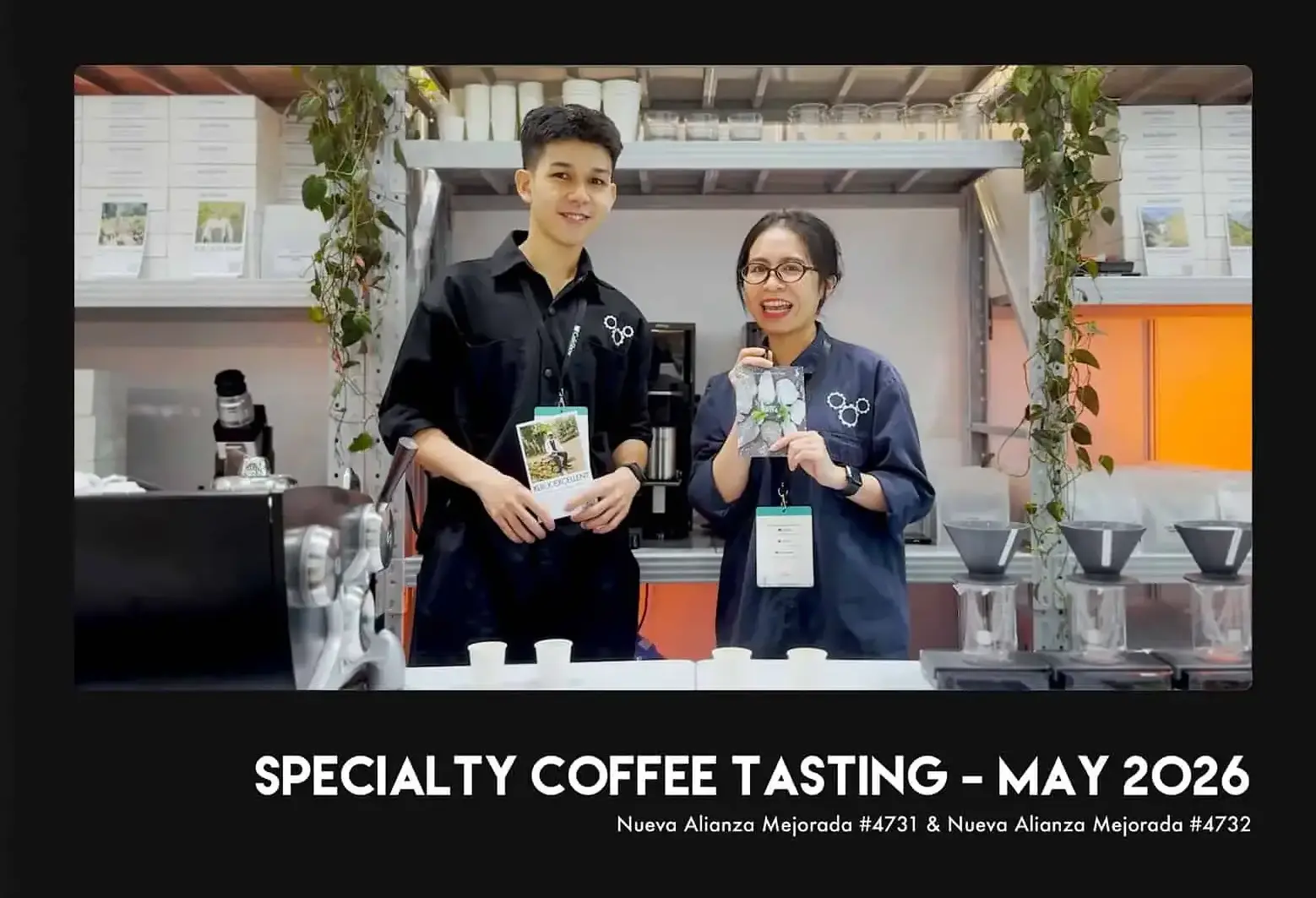
Unveiling May Discovery Subscription: Nueva Alianza Mejorada #4731 & Nueva Alianza Mejorada #4732
The Discovery Subscription is a silent dialogue, a place where the soul of the connoisseur finds a harmonious beat with distant lands. Like a transparent lens, we become storytellers, meticulously peeling back layers of cultural sediment, the breath of the soil, and the human philosophies hidden within every coffee bean.
May arrives with brilliant streaks of golden sunlight, a time when we long to hide beneath the lush, dew-drenched canopies of Santa Teresa. Amidst the silence of the Andes, when compassion touches Mother Earth, what will we hear? Perhaps it is a sweet response that nature reserves solely for souls who know how to wait patiently.

- Taste the Origin
Nueva Alianza Pacamara #4733 – The essence of Cusco with elegant jasmine notes
Nueva Alianza Pacamara #4733 is a testament to the miraculous terroir and dedicated cultivation of the renowned Cusco region. The combination of the characteristic Pacamara bean size and ideal altitude has forged a flavor profile of immense sophistication and depth. From the very first moment, this lot captivates with its elegant jasmine notes, radiating a gentle, pure fragrance akin to a flower blooming in the morning dew.

- Taste the Origin
Nueva Alianza Orange Gesha #4737 – An expedition of recessive genetic traits into the sensory realm
In a world of authenticity, Nueva Alianza Orange Gesha #4737 represents the proud emergence of rare biological traits often obscured by nature’s universality. Carrying a recessive genetic code, Lot #4737 embarks on an “expedition” into the connoisseur’s mind, where record-breaking fructose concentrations are released to perfectly fill every sensory gap with absolute smoothness and purity.
Through washed processing and extremely-light roasting, vibrant citrus nuances and ethereal floral notes, once hidden deep within the genetic structure, now manifest with power, transforming the tasting experience into a journey of ontological completion, where the rarity of recessive genes finally reigns supreme in flavor.

- Taste the Origin
Nueva Alianza Maragogipe #4735 – The “Giant” at the center of attention
Amidst a world of countless specialty coffee beans, Nueva Alianza Maragogipe #4735 emerges as a symbol of grandeur, instantly commanding attention with its distinct appearance. Affectionately dubbed the “Giant” for its impressively mutated “Elephant Bean” size, lot #4735 from Nueva Alianza stands as a testament to nature’s wonders in the Cusco region. Yet, its true allure extends far beyond its imposing exterior; hidden within these colossal beans lies a gentle “soul” blooming with pure floral and crystalline fruit notes.

Specialty Coffee in Vietnam
BRAND VALUE
YOU SHOULD HAVE KNOWN
XLIII Coffee has been aiming to become a big, impactful company with social responsibilities,
have access to high-quality raw materials and convey the complete original values of coffee to our customer
