
What makes Batian Coffee variety so captivating?
Batian Coffee variety is a relatively young coffee variety in the Specialty Coffee category, officially introduced in 2010. Despite its youth, Batian has quickly established itself as a high-quality coffee. This success is due to several factors, including its genetic characteristics and ideal growing conditions.
I. Origin and characteristics of Batian Coffee
Batian originated in Kenya, named after the country’s highest peak. The Coffee Research Institute (CRI) officially introduced it on September 8, 2010. Genetically, Batian is a hybrid, selectively bred from reverse crosses of SL-28 and SL-34, along with other Specialty Coffee varieties like SL4, N39, N30, Timor Hybrid, Rume Sudan, and K7.
Batian’s development was influenced by the successful breeding of Ruiru 11, a rust-resistant variety introduced in 1985. As a result, Batian inherited many of the desirable traits of SL-28.
Key biological traits:
- Tall, deep-rooted trees with a conical to cylindrical shape.
- Large, elliptical red cherries.
- High yield potential with a planting density of 1,900 trees per hectare.
- Strong resistance to diseases like CBD and CLR.
Environmental factors:
- Temperature: Kenya’s moderate temperatures are ideal for coffee cultivation.
- Rainfall: Evenly distributed rainfall throughout the year.
- Soil: Fertile volcanic soils on slopes, providing excellent drainage.

The Coffee Research Institute (CRI) officially introduced Batian coffee on September 8, 2010.
II. Batian’s sweet flavor profile
Batian has quickly gained a solid position in the competitive Specialty Coffee market. Its flavor profile is a well-balanced blend of sweet ripe fruit and mild citrus acidity, with good acidity, a complex flavor profile, and a thick body. When tasting Batian coffee, one can experience a harmonious and vibrant symphony of aromas.
III. Strengths and challenges in Batian cultivation:
Strengths:
- High yield: Batian can produce up to 5 tons of clean coffee per hectare and is resistant to diseases like CBD and leaf rust. It’s adaptable to various growing regions due to its deep, wide root system and excellent resilience.
- Superior quality: Despite its young age, Batian is already classified as a Specialty Coffee, which is a clear testament to its exceptional quality.
Additional advantages:
- Easier seed production due to true breeding.
- Faster production: Farmers can start harvesting by the second year, compared to the third year for traditional varieties.
- Lower costs: Farmers spend less on disease control.
- Versatile cultivation: Suitable for all coffee-growing ecological zones.

Despite its young age, Batian has already been classified as a Specialty Coffee due to its quality.
Challenges:
Currently, Batian is often mixed with SL and Ruiru 11 varieties, making it difficult to find pure Batian seeds. This blending, combined with the small scale of farming operations, limits the ability to accurately assess Batian’s quality and flavor in isolation.
IV. The promising future of Batian Coffee:
Potential:
Batian is viewed as a promising variety with significant potential, especially in the context of climate change and increasing demand for high-quality coffee. Its disease resistance, high yield, and superior flavor make it an attractive option for farmers and consumers alike.
Achievements:
- Batian coffees produced in Kenya have received high recognition in international competitions, such as the World Coffee Championships.
- Sustainable coffee development organizations, like Rainforest Alliance, have begun including Batian in their programs due to its disease resistance and support for sustainable farming practices.
- Batian has started being exported outside Kenya, reaching markets in the U.S. and Europe.

Batian has the potential to become a significant choice in the Specialty Coffee industry, especially in the context of climate change and the growing demand for high-quality coffee.
Conclusion:
Batian has made a strong impression in the global coffee industry due to its combination of disease resistance and outstanding flavor quality. Developed from high-quality coffee varieties and grown in Kenya’s favorable climate, Batian offers high yields and promises sustainability in cultivation. Although challenges remain in developing and sourcing pure Batian seeds, its potential has been proven through international recognition and sustainable development projects. Looking to the future, with the support of experts and global markets, Batian has the potential to become a key player in the Specialty Coffee industry, opening up significant opportunities for both farmers and consumers.
Related Questions (FAQs)
Question 1: When was Batian coffee first introduced?
Answer: Batian coffee was first introduced on September 8, 2010, by the Coffee Research Institute (CRI) through the selective breeding of varieties such as SL4, N39, N30, Timor Hybrid, Rume Sudan, and K7, which were reverse-crossed with SL28 and SL34.
Question 2: What are the key flavor characteristics of Batian coffee?
Answer: The flavor of Batian coffee is described as rich and balanced, combining the sweetness of ripe fruit with the mild acidity of citrus like oranges and lemons. It also features good acidity, a complex flavor profile, and a thick body.
Question 3: What are the main challenges in cultivating Batian coffee?
Answer: The main challenges in cultivating Batian coffee include the difficulty of sourcing pure Batian seeds, as it is often mixed with other varieties like SL and Ruiru 11. Additionally, the small scale of farming operations makes it challenging to cultivate Batian in isolation, which complicates the accurate assessment of its quality and flavor.
Question 4: Why is Batian coffee considered to have potential in the Specialty Coffee industry?
Answer: Batian coffee is considered to have potential in the Specialty Coffee industry due to its strong disease resistance, high yield, excellent flavor quality, and suitability for sustainable farming practices. These characteristics make it a promising option, especially in the context of climate change and the growing demand for high-quality coffee.
Question 5: What are some notable achievements of Batian coffee?
Answer: Notable achievements of Batian coffee include receiving high recognition in international coffee competitions, being included in sustainable coffee development programs by organizations like Rainforest Alliance, and starting to be exported to international markets such as the U.S. and Europe. These accomplishments highlight Batian’s exceptional quality and growing popularity in the global coffee industry.

Bài viết mới

- Taste the Origin
Rift Valley Coffee Caucus #03757 – A Testament to Western Kenya’s Collective Spirit
Turning our gaze to the Great Rift Valley of East Africa, the fertile volcanic landscapes are witnessing an inspiring transformation. Moving away from fierce, survival-driven competition, smallholder farmers in Western Kenya have chosen to join forces, forging a resilient and unified network. The Rift Valley Coffee Caucus #03757 lot stands as the ultimate testament to this remarkable collective synergy.

- Breaking News
Airworks Coffee & XLIII Coffee – A “handshake” that brings original flavors across borders
XLIII Coffee, alongside our key wholesale partner Airworks Coffee, officially announces the latest release of specialty coffee lots for the North American market. This event reaffirms our commitment to bringing original flavors across all geographical barriers to coffee enthusiasts.
Early access (for Subscribers of Airworks): 10:00 AM (PST) | Wednesday, April 29, 2026
General access: 10:00 AM (PST) | Friday, May 1, 2026
We invite our Customers and Partners to visit (airworkscoffee.com) for detailed information and to prepare for this special release!
- Taste the Origin
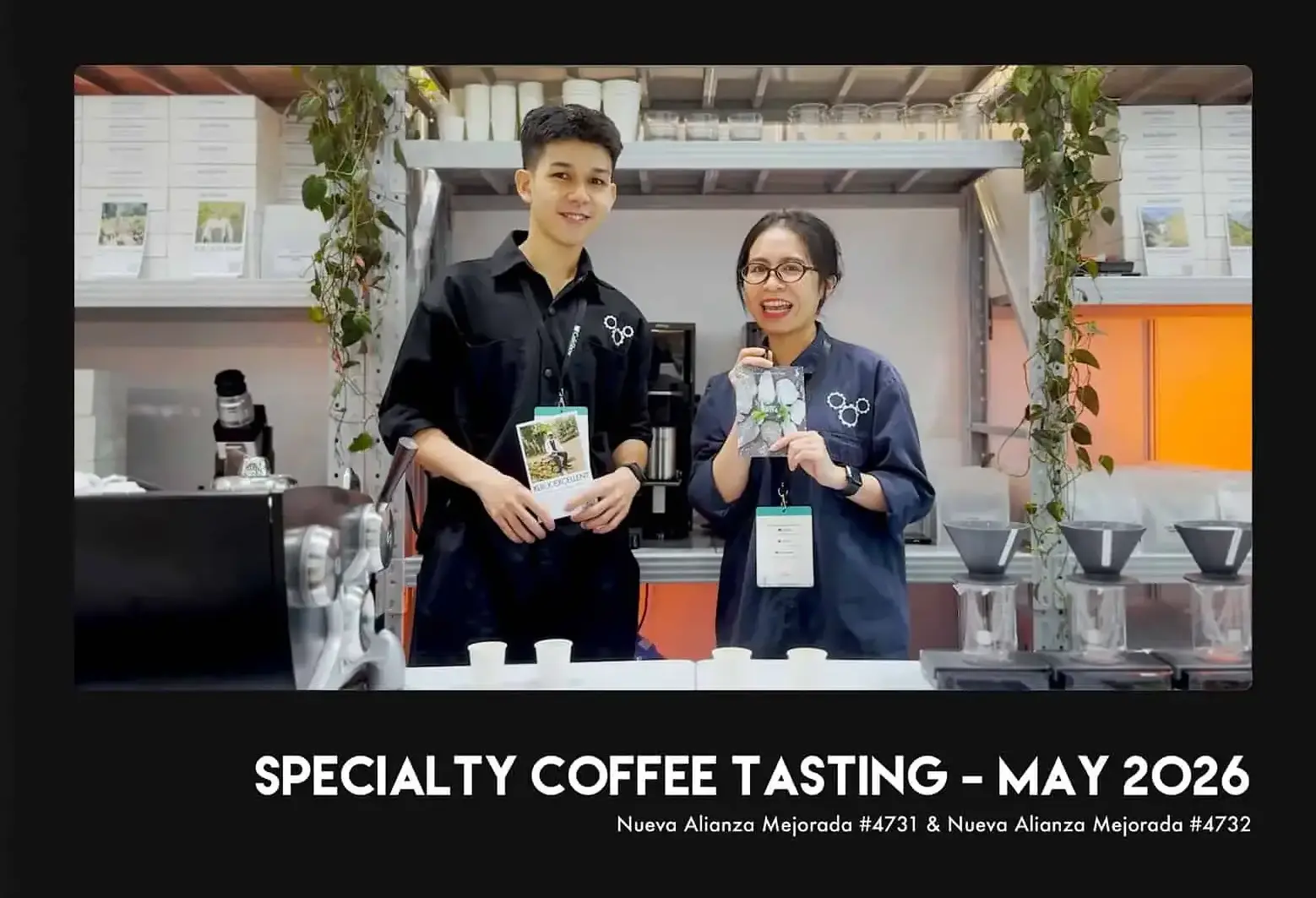
Unveiling May Discovery Subscription: Nueva Alianza Mejorada #4731 & Nueva Alianza Mejorada #4732
The Discovery Subscription is a silent dialogue, a place where the soul of the connoisseur finds a harmonious beat with distant lands. Like a transparent lens, we become storytellers, meticulously peeling back layers of cultural sediment, the breath of the soil, and the human philosophies hidden within every coffee bean.
May arrives with brilliant streaks of golden sunlight, a time when we long to hide beneath the lush, dew-drenched canopies of Santa Teresa. Amidst the silence of the Andes, when compassion touches Mother Earth, what will we hear? Perhaps it is a sweet response that nature reserves solely for souls who know how to wait patiently.

- Taste the Origin
Nueva Alianza Pacamara #4733 – The essence of Cusco with elegant jasmine notes
Nueva Alianza Pacamara #4733 is a testament to the miraculous terroir and dedicated cultivation of the renowned Cusco region. The combination of the characteristic Pacamara bean size and ideal altitude has forged a flavor profile of immense sophistication and depth. From the very first moment, this lot captivates with its elegant jasmine notes, radiating a gentle, pure fragrance akin to a flower blooming in the morning dew.

- Taste the Origin
Nueva Alianza Orange Gesha #4737 – An expedition of recessive genetic traits into the sensory realm
In a world of authenticity, Nueva Alianza Orange Gesha #4737 represents the proud emergence of rare biological traits often obscured by nature’s universality. Carrying a recessive genetic code, Lot #4737 embarks on an “expedition” into the connoisseur’s mind, where record-breaking fructose concentrations are released to perfectly fill every sensory gap with absolute smoothness and purity.
Through washed processing and extremely-light roasting, vibrant citrus nuances and ethereal floral notes, once hidden deep within the genetic structure, now manifest with power, transforming the tasting experience into a journey of ontological completion, where the rarity of recessive genes finally reigns supreme in flavor.

- Taste the Origin
Nueva Alianza Maragogipe #4735 – The “Giant” at the center of attention
Amidst a world of countless specialty coffee beans, Nueva Alianza Maragogipe #4735 emerges as a symbol of grandeur, instantly commanding attention with its distinct appearance. Affectionately dubbed the “Giant” for its impressively mutated “Elephant Bean” size, lot #4735 from Nueva Alianza stands as a testament to nature’s wonders in the Cusco region. Yet, its true allure extends far beyond its imposing exterior; hidden within these colossal beans lies a gentle “soul” blooming with pure floral and crystalline fruit notes.

Specialty Coffee in Vietnam
BRAND VALUE
YOU SHOULD HAVE KNOWN
XLIII Coffee has been aiming to become a big, impactful company with social responsibilities,
have access to high-quality raw materials and convey the complete original values of coffee to our customer
