
Coffea stenophylla – The sleeping coffee treasure and its journey of return
Dubbed the “sleeping treasure” of the coffee world, Coffea stenophylla vanished from commercial cultivation for decades. Today, with its sweet, refined flavor and remarkable climate resilience, this rare coffee species is making a comeback, promising to inspire a new chapter for the global coffee industry.
Table of Contents
- I. Historical footprints and the origins of Coffea stenophylla
- II. The journey to rediscover Coffea stenophylla
- III. Biological structure and sensory value of Coffea stenophylla
- IV. Coffea stenophylla in today's economic landscape
- V. The revival journey and future prospects of Coffea stenophylla
- VI. FAQs
I. Historical footprints and the origins of Coffea stenophylla
In the centuries-long journey of coffee’s development, the name Coffea stenophylla has often been overshadowed by the fame of Arabica and Robusta. Yet, a closer look at history reveals that this species once played a visible role in coffee cultivation and trade across West Africa.
From its earliest scientific records in the 19th century to export reports to Europe, C. stenophylla embodies a unique legacy: both a gift of wild nature and evidence of humanity’s efforts to expand the global coffee frontier.
Origins and scientific identification
Calling Coffea stenophylla a “new” species would be inaccurate, as it was first identified by Swedish botanist Adam Afzelius in Sierra Leone at the end of the 18th century, during a period when botany flourished and wild coffee species attracted growing interest.

The plant grows naturally in the tropical rainforests of West Africa, particularly in Sierra Leone, Guinea, and Côte d’Ivoire. It was here, in these humid forests, that C. stenophylla thrived as part of the local ecosystem before catching the attention of European scientists.
Image collected from Sprudge.
By 1834, C. stenophylla was officially described in scientific literature. The name “stenophylla” derives from Greek, meaning “narrow leaf”, a reference to its distinctive morphology. According to Professor Jeremy Haggar (University of Greenwich, London), the plant was already being cultivated in Sierra Leone at this time, with records also noting its export.
A source of hope for the coffee world
Reports from the Royal Botanic Gardens, Kew, and British authorities in Freetown confirm that Coffea stenophylla was cultivated and exported from Sierra Leone until the late 19th century. In fact, Kew once purchased a farm in Freetown where the species was grown, from which specimens were sent to several countries including Trinidad, Uganda, and Costa Rica.
By the late 19th century, C. stenophylla had become an internationally traded commodity, even marketed under the trade name “Sierra Leone Highland Coffee”. The French in particular prized Stenophylla, paying premium prices for imports. Local people in Sierra Leone praised its taste, while Kew declared that it had the potential to compete with Arabica.
Beyond Sierra Leone and Guinea, Stenophylla spread through trade into Ghana, Senegal (where it was called “Senegal coffee”), Côte d’Ivoire, Uganda, and even parts of East Africa’s coastal regions, likely through early Portuguese trade routes.

Image collected from Rikolto.
Despite having such great potential, why was Coffea stenophylla forgotten?
Despite its promise, Coffea stenophylla gradually disappeared from the commercial stage. The primary reason lay in its biology: the plant matured slowly, required more time to bear fruit, and yielded less than Arabica and especially less than Robusta.
By the early 20th century, with colonial administrations promoting Robusta, the tide turned decisively. Robusta’s disease resistance, ease of cultivation, and high productivity quickly dominated the market. C. stenophylla was pushed aside. By the 1920s, its commercial production had nearly ceased.
From a coffee once hailed as Arabica’s rival, Stenophylla became the “lost coffee” or “forgotten coffee” of Sierra Leone. Many believed it had become a rarity, even endangered, due to deforestation, disease, and human encroachment. After 1954, virtually no records documented its survival in the wild.
As Professor Jeremy Haggar concluded: “The natural competition in the coffee market, particularly from Robusta, was the reason Coffea stenophylla was forgotten”.
The legacy that remains

The history of Coffea stenophylla reflects the harsh rules of agricultural markets: exceptional taste alone is not enough to secure survival if a species cannot meet yield and commercial demands. Yet its story, from discovery and recognition in science, to cultivation and export, to its eventual disappearance from trade, remains a unique chapter in global coffee history.
Today, as climate change threatens Arabica, revisiting the roots and history of Stenophylla offers vital insight into why this once-forgotten species is again viewed with hope as a potential “savior” for coffee’s future.
Image collected.
II. The journey to rediscover Coffea stenophylla
After being supplanted by Robusta and vanishing from commercial plantations, Coffea stenophylla became so rare that many believed it extinct in the wild. By the mid-20th century, its cultivation had ceased entirely, surviving only as dried specimens in herbaria. From then on, it bore the somber label “the forgotten coffee”.
Clues from the past
Though absent in farming, Coffea stenophylla left scattered traces in history. Herbarium specimens preserved at botanical gardens, especially at Kew, offered vital scientific evidence. Old records from Sierra Leone, Guinea, and Côte d’Ivoire hinted that the species once grew wild, though no one knew whether it had survived decades of deforestation, pests, and climate pressures.
The expedition back to West Africa
By the end of 2018, a door of hope was opened. Led by Dr. Aaron Davis and Professor Jeremy Haggar, along with local development expert Daniel Sarmu, a research team decided to return to Sierra Leone to trace the coffee species that had been missing for over half a century.
The team used historical specimens from Kew Gardens itself to determine the last known location of the Stenophylla species. They also received support from the NGO Welthungerhilfe and the Sierra Leone Forestry Department to access the target forests.
This was the first time in over 60 years that a large-scale survey was conducted to answer the question:
Does Coffea stenophylla still exist, or is it extinct in the wild?


Images collected from Perfect Daily Grind.
A breakthrough discovery
The search journey was far from easy. The dense rainforest terrain, the harsh climate, and the lack of modern documentation turned the survey trip into an arduous challenge. Davis even launched a community campaign, printing flyers with the question, “Have you seen this plant?”, hoping local farmers might be able to identify it. However, the common answer was that they had not.
When this approach failed, the team decided to push deeper into the forest, the place where they put their last hope. At the Kasewe Reserve, after many hours of climbing hills, they discovered a small bush, without flowers or fruit. At first glance, it looked like an ordinary wild plant. But with his experience, Davis immediately recognized it as Coffea stenophylla. It was the first time since 1954 that stenophylla had been seen in the wild.
Their joy was overwhelming but mixed with regret: the plant was only a single, lone individual, with no fruit from which to harvest seeds. The research team immediately cleared the surrounding undergrowth and marked the spot with stones for protection. Professor Haggar described the moment as “both exhilarating and disappointing” because they could not yet propagate the species from a single tree.

Not stopping there, the team continued the survey eastward. After many hours of trekking through the forest, they were fortunate to discover a healthy population of C. stenophylla, including trees that were flowering and fruiting. This time, they managed to collect seeds, a crucial turning point for research and propagation trials.
Image collected from BeanScene Magazine.
III. Biological structure and sensory value of Coffea stenophylla
If history gave Coffea stenophylla a journey full of ups and downs, it is the biological characteristics and flavor that make this coffee species distinct. From the unique narrow-leaf morphology and a growth cycle tied to the sun and rain rhythms of the tropical forest, to the refined flavor comparable to high-end Arabica, C. stenophylla carries the imprint of wild nature while unlocking great potential for the future of the coffee industry.
Ecological characteristics and habitat
-
Natural distribution: Stenophylla is endemic to Guinea, Sierra Leone, and Côte d’Ivoire, often growing wild at altitudes between 200 and 700 m (on average lower than Arabica). In Côte d’Ivoire, the species is found on dry, high hills, while Robusta and Liberica occupy humid valleys.
-
Climate conditions: Climate analysis shows that Stenophylla thrives in hot and humid conditions, similar to Robusta, but has a higher average annual temperature threshold, around which is higher than Robusta and higher than Arabica.
-
Ecological adaptation: The species has good drought tolerance (although further research is needed) and natural resistance to the coffee leaf miner pest (perileucoptera coffeella). However, Stenophylla cannot survive where temperatures drop below , thus limiting it to tropical areas.
Plant morphology
-
Trunk and Canopy: Evergreen tree, reaching in height in the wild, with a dense canopy.
-
Leaves: Long, narrow, dark green, slightly glossy, with an elongated pointed tip – the source of the name stenophylla (“narrow leaf”).
-
Flowers: White, fragrant, growing in clusters, with 7-9 small star-shaped petals (more than Arabica and Robusta, which usually have only 5). Pollination is mainly by wind and wild bees.
-
Cherry: When ripe, it has a characteristic purplish-black color, distinctly different from the red or yellow of Arabica and Robusta. Each fruit usually contains two seeds, sometimes only a single rounded peaberry, which is rare and prized in specialty coffee.


Images collected from Wikipedia, Global Coffee Report, E.Couturon.
Life cycle and growth cycle
After pollination, the Stenophylla fruit develops slowly in the initial stage: growth almost ceases for the first 6-8 weeks. After this “dormancy” period, the fruit accelerates, accumulating water and mass, sometimes reaching 85% water content. The entire process from flowering to ripening lasts about 30-35 weeks, much longer than Arabica and Robusta. This is one of the reasons C. stenophylla was less efficient commercially in terms of yield, but it demonstrates a special ecological adaptation.
Flavor and sensory experience
For almost 100 years, there were no sensory evaluations of Coffea stenophylla due to its rarity. It was not until 2020 that bean samples from Sierra Leone and Côte d’Ivoire were introduced into taste testing sessions by an international panel of experts.
-
Taste testing in London (2020): The sample from Sierra Leone scored 80.25 points on the SCA scale, surpassing the “specialty coffee” threshold. The panel noted that the Stenophylla coffee had a flavor comparable to high-end Arabica – a surprising result.
-
Taste testing in Montpellier (CIRAD, 2020): The sample from Côte d’Ivoire was blindly evaluated alongside Arabica and Robusta. 81% of judges mistook Stenophylla for Arabica, and nearly half considered it a promising “new species.”
-
Flavor profile: Notes of peach, blackcurrant, mandarin, honey, jasmine, spice, chocolate, caramel, light black tea, and elderflower syrup. Combining natural sweetness, balanced acidity, and a full body – rare in a coffee species outside of Arabica.
Dr. Delphine Mieulet of the French Agricultural Research Centre for International Development (CIRAD) concluded: “This is the first reliable sensory evaluation of , confirming historical reports that it has a superior flavor. As a breeder, I believe this species is full of hope, opening a bright future for quality coffee in the context of climate change”.
IV. Coffea stenophylla in today's economic landscape
Currently, Coffea stenophylla has almost disappeared from commercial farms, existing only in a few research collections. In the early 20th century, the species was exported from Sierra Leone and Guinea with an output of 3,000-5,000 kg per year before declining due to falling coffee prices and replacement by more common varieties. By the 1980s, cultivation only occurred sparsely around homes, and today Sierra Leone accounts for only 0.04% of the global coffee market share.
In this context, C. stenophylla remains an “unknown quantity” for modern science. Research on its agronomic yield and sensory characteristics is incomplete; although historical reports praised its high-end flavor, recent records describe it as light and tea-like when brewed. The few remaining seeds primarily serve the goals of breeding and conservation, rather than commercial production.


Images collected from CIRAD, Sprudge.
The biggest obstacle to reviving Stenophylla lies in the socio-economic reality of Sierra Leone. The country has 36% arable land but poor infrastructure, with only 5% primary forest remaining, while farmers often receive less than $1/kg of coffee, giving them little incentive to experiment with a little-known species. Even the identification campaigns using posters and field surveys in 2018 failed to find any plants in cultivation.
According to scientists, it will take at least 5 years to establish the first pilot plantations, after which profitability and effectiveness can be assessed. Nevertheless, the existing evidence is sufficient to show that C. stenophylla is a valuable resource, both as a rare specialty coffee and as a “genetic bank” that can support the global coffee industry in adapting to climate change in the future.
V. The revival journey and future prospects of Coffea stenophylla
The rediscovery of Coffea stenophylla not only holds scientific significance but also opens up economic opportunities for local communities. In a context where over 60% of wild coffee species are threatened with extinction, stenophylla is seen as a “genetic key” for breeding new coffee varieties that are drought-tolerant, disease-resistant, and still retain superior flavor. Many experts consider this species a strong candidate to help the global coffee industry adapt to climate change.
However, that potential cannot immediately translate into reality. The current output of C. stenophylla is very low, its commercial-scale resistance to pests and diseases is unclear, and farmers lack the motivation to plant this little-known species. Dr. Aaron Davis calls it “a coffee for connoisseurs”, but he believes that pilot cultivation will provide the foundation for a full assessment of its yield and economic viability in the future.
To accelerate the revival process, several projects have been launched. In Sierra Leone, about 8,000 Stenophylla plants are being test-grown with the expectation of fruiting in the coming years. Simultaneously, research centers in Réunion Island (CIRAD) and Kew Gardens are also involved in propagation and evaluating the species’ agronomic potential under various conditions. Coffee companies like Sucafina, JDE, and Nespresso have expressed interest, showing positive signals from the market.


Images collected from Sucafina, Sprudge.
The noteworthy initial direction will focus on small scale and niche markets. With its rare characteristics, Stenophylla can become a specialty coffee sought after by pioneering roasters and cafes, creating higher value for farmers. In the long run, if its economic efficiency is proven, this species could help improve the livelihoods of millions of coffee farmers in hot, dry tropical regions where Arabica is difficult to sustain.
From a species that was thought to be lost, Coffea stenophylla is being revived as a symbol of hope: both an important scientific resource and an economic-cultural opportunity for its homeland, Sierra Leone. As one local expert shared, if successfully re-cultivated, C. stenophylla could become a major export crop, bringing prosperity to farmers and affirming the nation’s position in the global coffee industry.
In summary,
Coffea stenophylla is a rare coffee species, once lost from cultivation for nearly a century but rediscovered in Sierra Leone, carrying great potential in terms of ecology, economics, and flavor. This coffee is highly heat-tolerant, drought-resistant, and less susceptible to pests, while possessing a refined flavor nearly comparable to high-end Arabica. Although current production is limited, projects to revive Stenophylla open up opportunities to develop the specialty market, support farmers, and contribute to the creation of climate-resilient coffee varieties in the future.
VI. FAQs
1. Why did Coffea stenophylla once disappear from cultivation for nearly a century?
C. stenophylla was replaced by Robusta and Arabica because it had lower yield, required a longer maturation time, and struggled to compete commercially. These factors led to its gradual disappearance from plantations, with only samples preserved in research collections.
2. How was Coffea stenophylla rediscovered after more than 60 years of being lost?
In 2018, a research team led by Aaron Davis and Jeremy Haggar surveyed forests in Sierra Leone based on historical specimens and local information. They first found a single Stenophylla tree, then expanded the survey to identify more small, surviving populations in the wild.
3. Does Coffea stenophylla have the potential to replace Arabica in the context of climate change?
Stenophylla has a higher heat tolerance than Arabica and is better adapted to dry conditions. This is why researchers assess its potential as a crucial genetic resource for breeding new coffee varieties that can withstand climate change while maintaining distinct flavor.
4. Will Coffea stenophylla truly bring economic benefits to farmers?
Currently, the cultivation and production of Stenophylla are limited, so the direct economic benefit is not yet clear. However, if successfully test-grown and developed for the specialty market, it could bring high value to farmers, simultaneously supporting the restoration of sustainable agriculture in hot, dry tropical regions.
5. Is Stenophylla coffee suitable for a sustainable agriculture model?
With its characteristics of good adaptation, drought tolerance, and less susceptibility to pests, Stenophylla is considered suitable for sustainable agriculture, especially when combined with organic farming methods, biodiversity, and forest conservation.

Bài viết mới

- Find the Origin
Mandela coffee variety – A convergence of generations from a masterpiece breeding strategy
Amidst the constant fluctuations of the era, Mandela emerges as a gentle yet resilient response from the soil. Instead of attempting to alter or impose upon nature, this breeding strategy is, in essence, a profound act of listening. Each Mandela coffee bean carries the bloodline of multiple generations, possessing both the serene, steadfast nature of native trees and the sparkling elegance of premium varieties. It is a sacred continuation, where the flow of generations ultimate honors the original value of the species, imparting an intact and sustainable vitality into every cup.


- Taste the Origin
Nigussie Nare – Murago Outgrowers #03028: Cultivated from the Values of Sustainable Reciprocity
Nestled beneath the shade trees of Sidama, Bensa, the Nigussie Nare – Murago Outgrowers #03028 coffee lot serves as a living testament to the values of sustainable reciprocity. This symbiosis begins with the intimate bond between a rich indigenous ecosystem and the smallholder farmers of the Murago region. Each harvested bean is the culmination of a virtuous cycle: a stable environment produces exceptional bean quality, and sustainable economic growth, in turn, continues to protect the verdant canopy of the great forest.

- Taste the Origin
Rift Valley Coffee Caucus #03757 – A Testament to Western Kenya’s Collective Spirit
Turning our gaze to the Great Rift Valley of East Africa, the fertile volcanic landscapes are witnessing an inspiring transformation. Moving away from fierce, survival-driven competition, smallholder farmers in Western Kenya have chosen to join forces, forging a resilient and unified network. The Rift Valley Coffee Caucus #03757 lot stands as the ultimate testament to this remarkable collective synergy.

- Breaking News
Airworks Coffee & XLIII Coffee – A “handshake” that brings original flavors across borders
XLIII Coffee, alongside our key wholesale partner Airworks Coffee, officially announces the latest release of specialty coffee lots for the North American market. This event reaffirms our commitment to bringing original flavors across all geographical barriers to coffee enthusiasts.
Early access (for Subscribers of Airworks): 10:00 AM (PST) | Wednesday, April 29, 2026
General access: 10:00 AM (PST) | Friday, May 1, 2026
We invite our Customers and Partners to visit (airworkscoffee.com) for detailed information and to prepare for this special release!
- Taste the Origin
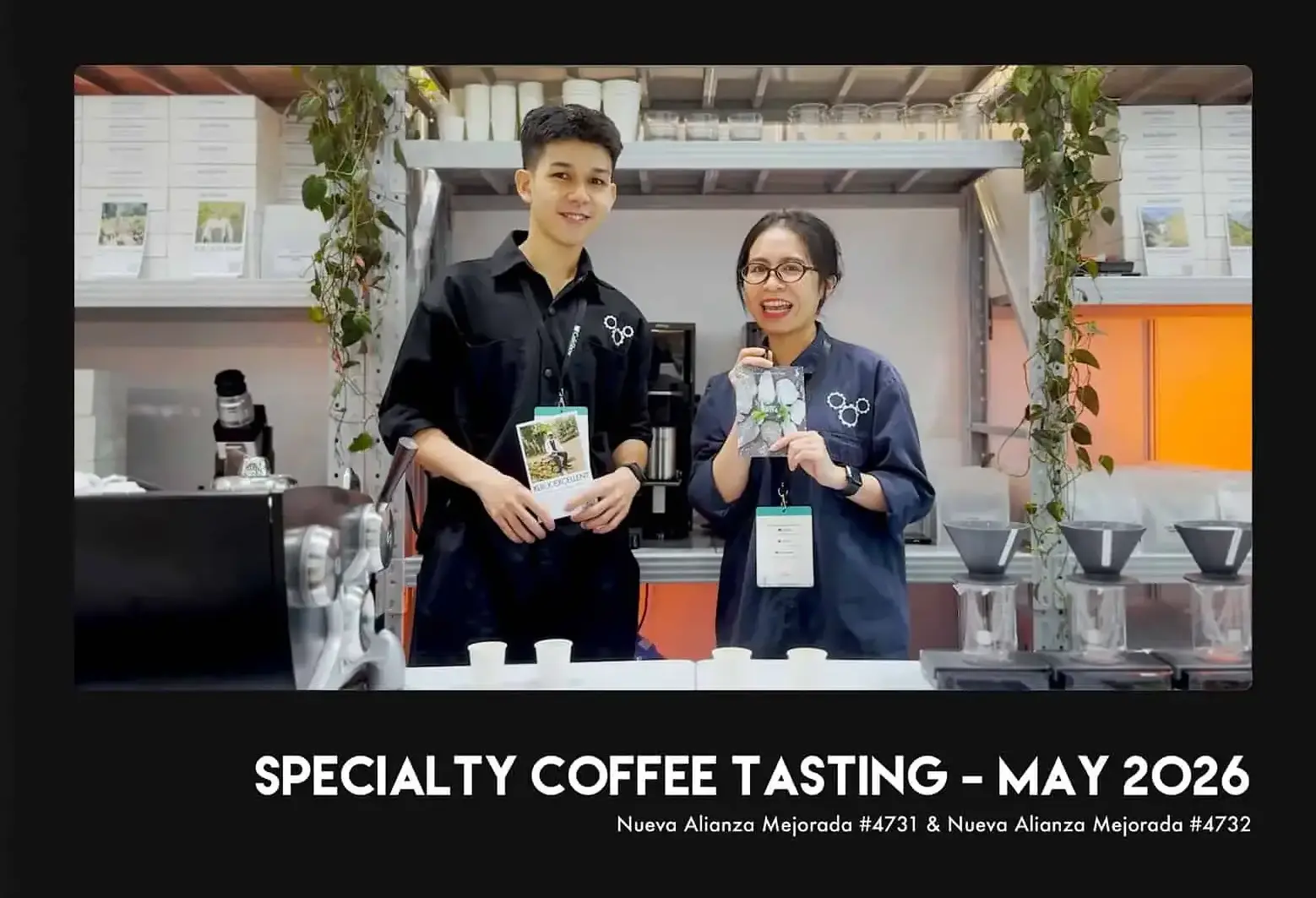
Unveiling May Discovery Subscription: Nueva Alianza Mejorada #4731 & Nueva Alianza Mejorada #4732
The Discovery Subscription is a silent dialogue, a place where the soul of the connoisseur finds a harmonious beat with distant lands. Like a transparent lens, we become storytellers, meticulously peeling back layers of cultural sediment, the breath of the soil, and the human philosophies hidden within every coffee bean.
May arrives with brilliant streaks of golden sunlight, a time when we long to hide beneath the lush, dew-drenched canopies of Santa Teresa. Amidst the silence of the Andes, when compassion touches Mother Earth, what will we hear? Perhaps it is a sweet response that nature reserves solely for souls who know how to wait patiently.

Specialty Coffee in Vietnam
BRAND VALUE
YOU SHOULD HAVE KNOWN
XLIII Coffee has been aiming to become a big, impactful company with social responsibilities,
have access to high-quality raw materials and convey the complete original values of coffee to our customer
