
How has the Jamaica coffee industry changed?
Jamaica is a country famous for the appeal of Blue Mountain eggplants. The history of the Jamaica coffee industry is full of upheavals associated with colonialism and the slave empire. So how has Jamaica’s coffee industry changed over the past few centuries? Explore with XLIII Coffee!
Jamaica's coffee industry and its beginnings in the 17th century
The Jamaica coffee industry had its beginnings very early in the 17th century. Around 1728, the first coffee trees were brought to Jamaica, which was then under British colonial rule. After that, commercial coffee farms in this country were quickly established. Surprisingly, within just 9 months, Jamaica exported its first harvest. According to Dr. Monteith, the influence of the sugarcane market has helped promote coffee growing in Jamaica, making it easier to grow in popularity. Additionally, around 1791, many African slaves rebelled on the nearby island of Haiti. This caused some French coffee owners to flee to Jamaica. Here, the French colonialists continued to use slave labor to produce coffee, causing the country’s coffee production volume to increase.

The Jamaican coffee industry has been around since the 17th century
The Jamaica coffee industry fell into decline in the 1980s
According to statistics, between 1800 and 1840, Jamaica became one of the largest coffee-producing countries in the world with a production output of about 70,000 tons of coffee per year. However, towards the end of this period, the number of Jamaica coffee producers began to decline. By 1836, there were only 353 coffee producers. In particular, from 1840 onwards, the country was completely liberated, and the colonialists were forced to abandon their farms, causing Jamaica’s coffee production to gradually decrease. In the following years, the Jamaica coffee industry restructured itself. whole again. In this, coffee estate owners must now officially and legally recruit and pay workers. This led to an increasing focus on worker efficiency rather than the production of large volumes of coffee. Many former coffee plantations were also fragmented, with plots of land sold to small farmers and former slaves who grew their food and smaller volumes of coffee.
However, coffee plantations in Jamaica have been stable for a while. By 1865, Jamaica was going through a period of economic hardship and social unrest as a result of becoming a direct British colony. The British began investing in Jamaica’s agriculture, focusing on growing sugarcane and bananas, causing the coffee industry to continue to decline.

By 1865, Jamaica was going through a period of economic hardship and social unrest that caused the coffee industry to decline
Jamaica's coffee industry strives to recover in the 20th and 21st centuries
Entering the 20th century, Jamaica abolished slavery, and Jamaica’s coffee industry entered a period of struggling to increase output and quality for export for many decades. In 1950, the country’s government attempted to boost coffee production by implementing new regulations and initiatives.
The enacted policy encourages the growth of the coffee industry in Jamaica and promotes the welfare of the people. With efforts, by 2000, the process of completely deregulating the Jamaica coffee industry was well underway. Some Jamaica coffee brands are sold and popular abroad. For example, Jamaica Blue Mountain coffee is becoming famous and receiving attention around the world. The US accounts for about 20% of Jamaica Blue Mountain’s coffee exports. The remaining exports will go to other markets around the world. However, according to analysts, the Jamaica coffee industry still faces many challenges. Increasing demand does not lead to a sharp increase in market prices. Therefore, this country’s coffee industry needs to ensure that growth is sustainable.

In 1950, the Jamaican government attempted to promote coffee production
It can be seen that Jamaica’s coffee industry has faced many challenges over the past few centuries. However, it has proven its resilience with its recovery and quality assurance efforts with Jamaica Blue Mountain coffee beans. If you want to experience specialty coffee beans from countries around the world, visit XLIII Coffee!
Articles you may be interested in
– Enhancing climate resilience: Can new WCR-introduced varieties aid Indonesian coffee farmers?

Bài viết mới

- Taste the Origin
Nigussie Nare – Murago Outgrowers #03028: Cultivated from the Values of Sustainable Reciprocity
Nestled beneath the shade trees of Sidama, Bensa, the Nigussie Nare – Murago Outgrowers #03028 coffee lot serves as a living testament to the values of sustainable reciprocity. This symbiosis begins with the intimate bond between a rich indigenous ecosystem and the smallholder farmers of the Murago region. Each harvested bean is the culmination of a virtuous cycle: a stable environment produces exceptional bean quality, and sustainable economic growth, in turn, continues to protect the verdant canopy of the great forest.

- Taste the Origin
Rift Valley Coffee Caucus #03757 – A Testament to Western Kenya’s Collective Spirit
Turning our gaze to the Great Rift Valley of East Africa, the fertile volcanic landscapes are witnessing an inspiring transformation. Moving away from fierce, survival-driven competition, smallholder farmers in Western Kenya have chosen to join forces, forging a resilient and unified network. The Rift Valley Coffee Caucus #03757 lot stands as the ultimate testament to this remarkable collective synergy.

- Breaking News
Airworks Coffee & XLIII Coffee – A “handshake” that brings original flavors across borders
XLIII Coffee, alongside our key wholesale partner Airworks Coffee, officially announces the latest release of specialty coffee lots for the North American market. This event reaffirms our commitment to bringing original flavors across all geographical barriers to coffee enthusiasts.
Early access (for Subscribers of Airworks): 10:00 AM (PST) | Wednesday, April 29, 2026
General access: 10:00 AM (PST) | Friday, May 1, 2026
We invite our Customers and Partners to visit (airworkscoffee.com) for detailed information and to prepare for this special release!
- Taste the Origin
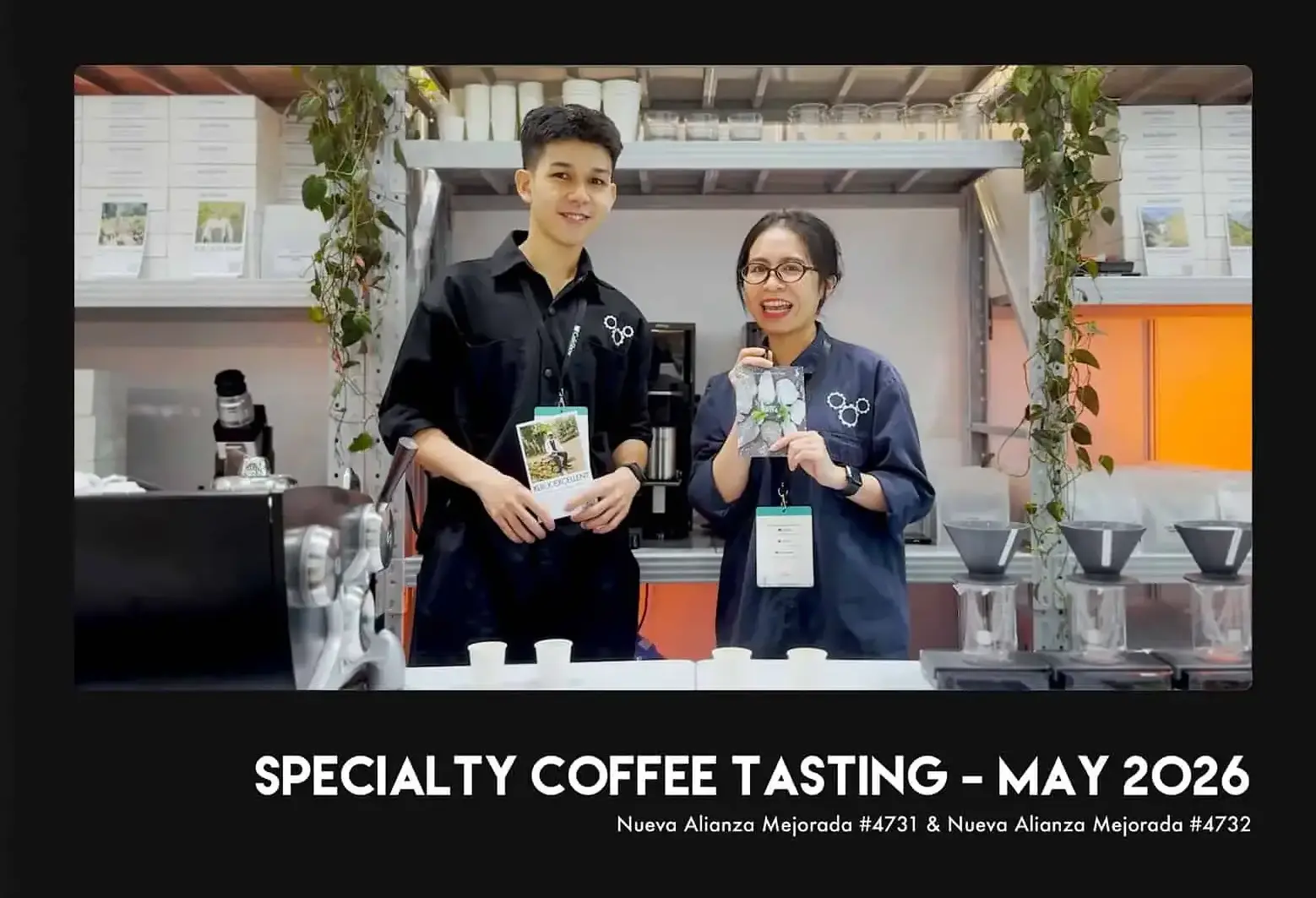
Unveiling May Discovery Subscription: Nueva Alianza Mejorada #4731 & Nueva Alianza Mejorada #4732
The Discovery Subscription is a silent dialogue, a place where the soul of the connoisseur finds a harmonious beat with distant lands. Like a transparent lens, we become storytellers, meticulously peeling back layers of cultural sediment, the breath of the soil, and the human philosophies hidden within every coffee bean.
May arrives with brilliant streaks of golden sunlight, a time when we long to hide beneath the lush, dew-drenched canopies of Santa Teresa. Amidst the silence of the Andes, when compassion touches Mother Earth, what will we hear? Perhaps it is a sweet response that nature reserves solely for souls who know how to wait patiently.

- Taste the Origin
Nueva Alianza Pacamara #4733 – The essence of Cusco with elegant jasmine notes
Nueva Alianza Pacamara #4733 is a testament to the miraculous terroir and dedicated cultivation of the renowned Cusco region. The combination of the characteristic Pacamara bean size and ideal altitude has forged a flavor profile of immense sophistication and depth. From the very first moment, this lot captivates with its elegant jasmine notes, radiating a gentle, pure fragrance akin to a flower blooming in the morning dew.

- Taste the Origin
Nueva Alianza Orange Gesha #4737 – An expedition of recessive genetic traits into the sensory realm
In a world of authenticity, Nueva Alianza Orange Gesha #4737 represents the proud emergence of rare biological traits often obscured by nature’s universality. Carrying a recessive genetic code, Lot #4737 embarks on an “expedition” into the connoisseur’s mind, where record-breaking fructose concentrations are released to perfectly fill every sensory gap with absolute smoothness and purity.
Through washed processing and extremely-light roasting, vibrant citrus nuances and ethereal floral notes, once hidden deep within the genetic structure, now manifest with power, transforming the tasting experience into a journey of ontological completion, where the rarity of recessive genes finally reigns supreme in flavor.

Specialty Coffee in Vietnam
BRAND VALUE
YOU SHOULD HAVE KNOWN
XLIII Coffee has been aiming to become a big, impactful company with social responsibilities,
have access to high-quality raw materials and convey the complete original values of coffee to our customer
