
How does the ability to perceive coffee flavor change with age?
Evaluating coffee taste is an important part of determining the quality and value of coffee. Many factors affect the perception of coffee flavor such as water quality, cupping room conditions, brewing temperature, etc. Currently, many studies are proving that, as we age, our sense of smell decreases. and people’s taste buds began to change. This causes the ability to perceive coffee flavor to change with age. Let’s find out more details with XLIII Coffee!
The ability to perceive the taste of coffee gradually decreases with age
Usually, when people get old, they think about hearing and vision loss. However, research has shown that people can also experience impaired smell and taste. According to a 2006 study, the sense of smell and taste begin to decline around the age of 60. Furthermore, by the age of 70, both senses are severely lost, resulting in the ability to distinguish between flavors. reduce. The main reason for this is that as we age, the decrease in the number of olfactory receptors in the nasal cavity becomes greater. Meanwhile, this is the organ we use to recognize aroma as well as play an important role in sensing taste. Additionally, the rate of receptor cell regeneration also decreases as we age, so our sense of smell and taste becomes less sensitive. Depending on several factors, the degree of weakening of these organs will vary, such as health status and access to medical care.

On the contrary, children’s sense of smell and taste are very sensitive, especially to sweet and salty tastes. According to 2005 research from the Monell Chemical Senses Center, infants can quickly perceive sweet flavors and often prefer those flavors to non-sweet flavors. Additionally, research shows that between adolescence and adulthood, our palates begin to develop strongly. Cells sense and recognize more flavors. The reason is that around this stage, you can try different foods and cooking methods, exposing your sensory cells to a variety of flavors and textures. This causes people from adolescence to adulthood to become more familiar with the five taste elements such as sweet, salty, sour, bitter, and umami.

The ability to evaluate coffee flavor is influenced by age and experience
Gary Au – co-founder of Urban Coffee Roasters, said that cupping experience affects the perception and scoring of coffee. People new to specialty coffee tend to like new and exciting flavors, such as fermented coffee or special new varieties. At the same time they can often taste the flavor notes described in the flavor profile.

However, to achieve proficiency and accurate recognition, you need to try tasting many types of coffee from different origins, varieties and processing methods. Older coffee drinkers often appreciate the original, floral flavors and high sophistication. This difference can lead to differences in quality assessment results and coffee scores during cupping sessions. For example, at the 2022 BoP auction, there were differences of five or six points between certain coffee varieties.
Besides, according to Gary’s experience as a judge, cultural background also affects the evaluation of coffee scores. People from Southeast Asia or the Middle East often prefer fermented and wine flavors in their coffee. North Americans and Europeans tend to favor more traditional flavors.

How to ensure objectivity in evaluating coffee flavor
With the different sensory abilities and experiences of each age group, differences in coffee flavor scores between tasters are inevitable. SCA describes this as “intersubjectivity”. Specifically, instead of scoring coffee objectively, professional coffee tasters evaluate coffee quality based on characteristics desired by a specific market. This leads to some bias, affecting the fairness and consistency of coffee quality in different markets. Therefore, SCA began developing a Coffee Value Assessment System. The new system will be enhanced to remove any intentional or unintentional bias in cupping, as well as move towards greater inclusion of different cultures and cuisines.

Although age may play some role in influencing coffee cupping scores. But experts say that the level of tasting experience is still the most important factor in evaluating flavor quality. Furthermore, there are an increasing number of experimental processing techniques as well as new varieties and species. So we need to appreciate each diversity of coffee flavors.

As a business providing sustainable specialty coffee, XLIII Coffee understands and cherishes the unique identity of each type of coffee and growing region. We source green bean specialty coffee lots from sustainable cooperative farms. We do everything to protect and cherish the original flavors and deliver those quintessential flavors to customers. If you want to explore the uniqueness of coffee flavors from different growing regions, come to XLIII Coffee to experience and feel.
Don’t forget to follow XLIII Coffee’s Journal channel to continue to discover useful information.
Related articles:
– Is single origin coffee really better than blended coffee?

Bài viết mới

- Taste the Origin
Nigussie Nare – Murago Outgrowers #03028: Cultivated from the Values of Sustainable Reciprocity
Nestled beneath the shade trees of Sidama, Bensa, the Nigussie Nare – Murago Outgrowers #03028 coffee lot serves as a living testament to the values of sustainable reciprocity. This symbiosis begins with the intimate bond between a rich indigenous ecosystem and the smallholder farmers of the Murago region. Each harvested bean is the culmination of a virtuous cycle: a stable environment produces exceptional bean quality, and sustainable economic growth, in turn, continues to protect the verdant canopy of the great forest.

- Taste the Origin
Rift Valley Coffee Caucus #03757 – A Testament to Western Kenya’s Collective Spirit
Turning our gaze to the Great Rift Valley of East Africa, the fertile volcanic landscapes are witnessing an inspiring transformation. Moving away from fierce, survival-driven competition, smallholder farmers in Western Kenya have chosen to join forces, forging a resilient and unified network. The Rift Valley Coffee Caucus #03757 lot stands as the ultimate testament to this remarkable collective synergy.

- Breaking News
Airworks Coffee & XLIII Coffee – A “handshake” that brings original flavors across borders
XLIII Coffee, alongside our key wholesale partner Airworks Coffee, officially announces the latest release of specialty coffee lots for the North American market. This event reaffirms our commitment to bringing original flavors across all geographical barriers to coffee enthusiasts.
Early access (for Subscribers of Airworks): 10:00 AM (PST) | Wednesday, April 29, 2026
General access: 10:00 AM (PST) | Friday, May 1, 2026
We invite our Customers and Partners to visit (airworkscoffee.com) for detailed information and to prepare for this special release!
- Taste the Origin
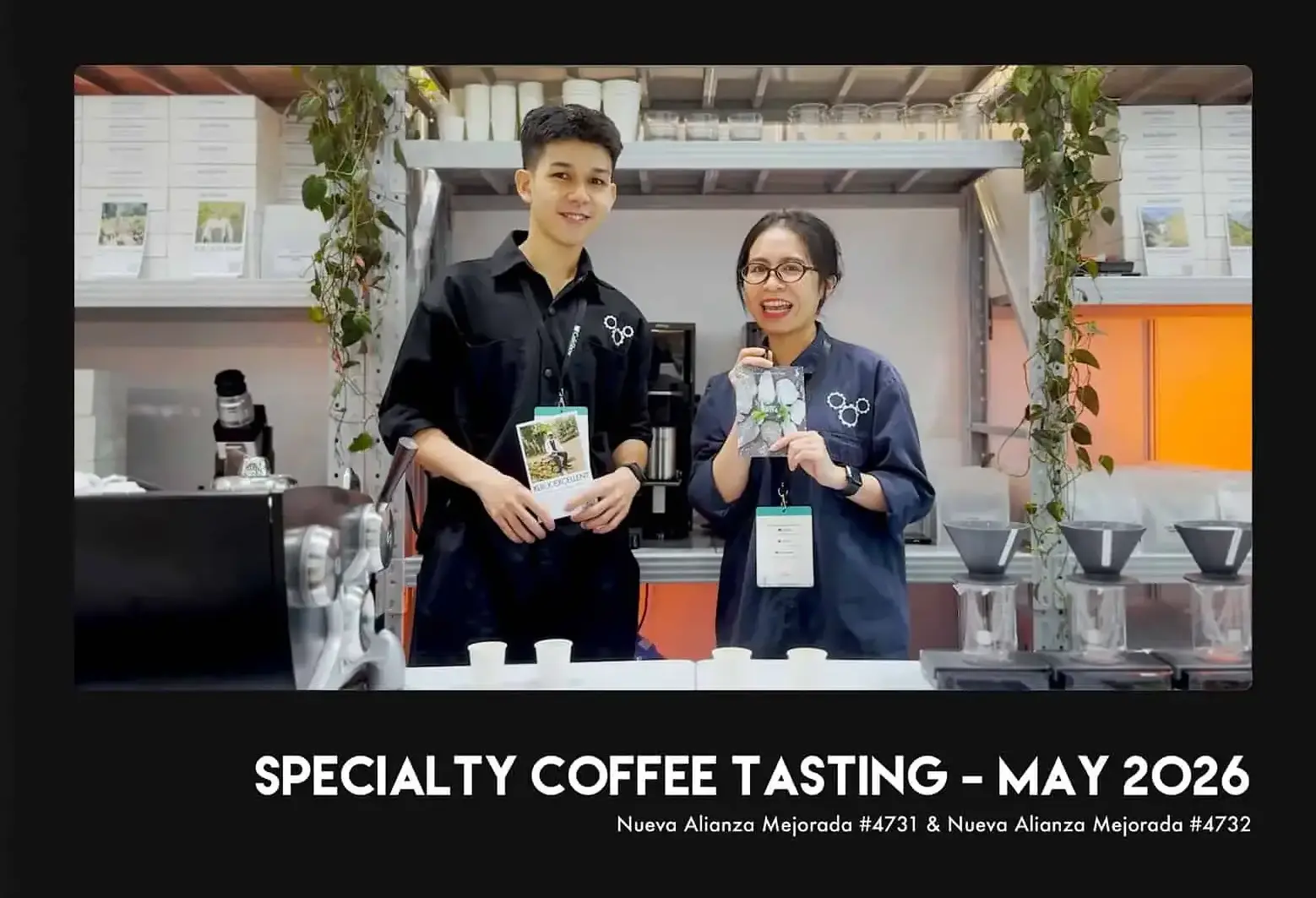
Unveiling May Discovery Subscription: Nueva Alianza Mejorada #4731 & Nueva Alianza Mejorada #4732
The Discovery Subscription is a silent dialogue, a place where the soul of the connoisseur finds a harmonious beat with distant lands. Like a transparent lens, we become storytellers, meticulously peeling back layers of cultural sediment, the breath of the soil, and the human philosophies hidden within every coffee bean.
May arrives with brilliant streaks of golden sunlight, a time when we long to hide beneath the lush, dew-drenched canopies of Santa Teresa. Amidst the silence of the Andes, when compassion touches Mother Earth, what will we hear? Perhaps it is a sweet response that nature reserves solely for souls who know how to wait patiently.

- Taste the Origin
Nueva Alianza Pacamara #4733 – The essence of Cusco with elegant jasmine notes
Nueva Alianza Pacamara #4733 is a testament to the miraculous terroir and dedicated cultivation of the renowned Cusco region. The combination of the characteristic Pacamara bean size and ideal altitude has forged a flavor profile of immense sophistication and depth. From the very first moment, this lot captivates with its elegant jasmine notes, radiating a gentle, pure fragrance akin to a flower blooming in the morning dew.

- Taste the Origin
Nueva Alianza Orange Gesha #4737 – An expedition of recessive genetic traits into the sensory realm
In a world of authenticity, Nueva Alianza Orange Gesha #4737 represents the proud emergence of rare biological traits often obscured by nature’s universality. Carrying a recessive genetic code, Lot #4737 embarks on an “expedition” into the connoisseur’s mind, where record-breaking fructose concentrations are released to perfectly fill every sensory gap with absolute smoothness and purity.
Through washed processing and extremely-light roasting, vibrant citrus nuances and ethereal floral notes, once hidden deep within the genetic structure, now manifest with power, transforming the tasting experience into a journey of ontological completion, where the rarity of recessive genes finally reigns supreme in flavor.

Specialty Coffee in Vietnam
BRAND VALUE
YOU SHOULD HAVE KNOWN
XLIII Coffee has been aiming to become a big, impactful company with social responsibilities,
have access to high-quality raw materials and convey the complete original values of coffee to our customer
