
Racemosa Coffee Roasting: The Key to Unlocking Hidden Flavors
Racemosa coffee offers a gentle taste, low bitterness, and a truly distinctive character compared to other coffees. But to fully awaken its hidden delights, the secret lies in the roasting process. With the right roast, every tiny Racemosa bean releases delicate aromas, subtle sweetness, and a unique tasting experience that lingers from the very first sip.
I. Key factors in the roasting process of Racemosa coffee
Racemosa coffee – a rare species with tiny beans and delicate flavors – requires a roasting process entirely different from Arabica or Robusta. From the choice of roaster, temperature and airflow adjustment, to the sensitivity and intuition of the roaster, every detail must be carefully considered to unlock the hidden beauty in each bean.
Roasting machine
Racemosa beans are extremely small, light, and low in density, making them highly sensitive to excessive heat or strong airflow. Standard roasters, especially perforated drum roasters, are often unsuitable, as the beans may fall through or roast unevenly.
- Solid drum roaster

This type of roaster uses a closed drum without holes, which keeps the Racemosa beans safely inside without risk of falling out.
Thanks to the ability to transfer heat both directly and indirectly through the drum wall, the roaster can precisely adjust the intensity of heat, suitable for this fragile type of bean. Solid drum roasters are especially suitable for small batches, when the roaster needs to observe and control every change in the beans.
- Hot-air roaster

Unlike drum roasters, fluid-bed roasters use strong hot air to make the beans “float” and move evenly. The advantage is that the beans are exposed to heat evenly, avoiding surface scorching. This is especially important for Racemosa, as its small beans can easily burn if the heat is concentrated too much in one spot. However, to avoid blowing away the fragile aroma compounds, the airflow in the roaster must be carefully adjusted – strong enough to agitate the beans but not too strong to “blow off” the flavors.
In general, both types of roasters are suitable, as long as the roaster can flexibly control the heat and airflow. For Racemosa, this precision determines up to 80% of the success of the roast.
Image collected from Khởi Nghiệp Cafe.
Roast level
Since Racemosa beans have delicate and gentle flavors, the roasting process is usually carried out in small batches (from 40-100 grams), both to ensure freshness and to help the roaster maintain better control. The most ideal roast level is usually from light roast to medium roast, where floral, herbal, and natural aftertaste are clearly retained. If pushed to dark roast, the beans will quickly lose their inherent balance, replaced by bitterness and smokiness.
Temperature and Airflow
Racemosa requires meticulous attention to detail in heat control. The process usually begins with a moderate temperature, then gradually increases in a stable way to avoid surface scorching.
- Drying phase
Start at 150–160°C, maintain for about 4-8 minutes to gradually release moisture, avoiding thermal shock.
- Maillard reaction phase
Increase the temperature gradually to 165-185°C, where chemical reactions that create color and complex aroma begin to occur. At this stage, airflow should be set at a medium level to ensure even drying, without staleness.
- Development phase
As it approaches the “first crack,” the temperature is usually around 190-200°C. This is the most important stage to determine the roasting style. Airflow at this point should be adjusted slightly higher to control the rate of development, preventing the beans from advancing too quickly into scorching.
Airflow plays no less important a role: if airflow is too weak, the beans will not dissipate heat evenly, easily leading to “cooked outside, raw inside.” On the other hand, if airflow is too strong, it can blow away fragile flavors. Therefore, the roaster needs to find a delicate balance, allowing the beans to degas properly while retaining the aroma.
The balance between temperature and airflow is the decisive factor: heat must be sufficient to develop aroma, and airflow must circulate flexibly to preserve the “soul” of Racemosa.


The roaster
Roasting Racemosa is not only a technique, but also an art. Since this coffee species is rare and has distinctive flavors, the roaster needs to embody many qualities: experience, patience, sharp sensory perception, and adaptability in order to deliver a cup with the purest and most transparent flavor.
They must know how to listen to sound, observe color, sense aroma, and flexibly respond to every situation throughout the roasting process. The characteristics of Racemosa make roasting a continuous experiment, requiring adaptability and precise decisions at every moment.
Interesting point – “First crack”
The “first crack” sound of Racemosa is typically very subtle, making it difficult to hear. Therefore, it demands that the roaster maintains special focus and dedicates their complete attention to the roasting process to accurately catch the moment the beans crack.
The first crack is a crucial “turning point”:
-
If stopped right after, you get a light roast – floral, fruity, with sweet aftertaste.
-
If continued for 1-2 more minutes, the beans move into medium roast, bringing more balance and depth.
If this moment is missed, the beans may overdevelop, causing Racemosa’s delicate flavors to disappear. Therefore, this is the stage that requires the highest concentration and sensitivity from the roaster.
II. The impact of roasting methods on Racemosa coffee
Coffee roasting is often compared to an ‘art of balance,’ where temperature, time, and technique harmonize to awaken the hidden flavors within the bean. With Coffea Racemosa, this journey demands even greater finesse. Just a slight change in the roasting process can lead to completely different results from the bean’s color and texture to its aroma and aftertaste.
| Roast level | Light roast | Medium roast | Dark roast |
|---|---|---|---|
| Bean color | Light brown | Medium brown | Dark brown or nearly black |
| Bean texture | Hard, brittle, porous | Less hard, easier to grind and extract | Brittle, easy to break, but retains internal structure |
| Surface oil | Almost none | Begins to show slight oil | Oily surface, shiny beans |
| Acidity | Bright, refreshing acidity | Mild, rounded acidity | Acidity almost completely diminished |
| Prominent flavors | Herbal, floral, and cacao nibs | Balanced sweetness and mild acidity, fuller flavors | Bitter, smoky, bold flavors |
| Advantages | Preserves the unique, delicate flavors of Racemosa | Suits many palates, with sweetness and depth | Ideal for espresso, appeals to fans of strong, traditional coffee |
| Limitations | Light flavor, may feel “thin” for those used to bold coffee | Risk of losing delicate herbal notes if roasted too long | Masks the distinctiveness and finesse of Racemosa, bitterness dominates |
From the table above, it can be seen that each roast level brings out a different “portrait” of Racemosa coffee beans. At light roast, we encounter freshness, clarity, and a sense of exploration where floral and local herbal notes bloom. At medium roast, Racemosa becomes more harmonious, retaining sweetness and balance, suitable for many popular tastes. Dark roast, on the other hand, creates a bold and strong style, with more surface oil and less acidity – ideal for those who love traditional intensity, but at the cost of losing the refined subtleties of this rare species.

Thus, choosing the roast level is not merely a technical decision, but also a reflection of how we value and express Racemosa. Light and medium roasts are often seen as the “keys” to honoring its original flavor, while dark roast is a personal choice for those wishing to explore a stronger, unconventional side. At any roast level, the most important thing remains a deep understanding of, and respect for, the essence of Racemosa.
III. Racemosa coffee and the extremely-light roast method at XLIII Coffee
In the journey of exploring Racemosa coffee, the roasting method becomes the key factor to highlight the original beauty of the bean. At XLIII Coffee, the brand goes beyond traditional light or medium roasts, choosing a more innovative approach: extremely-light roast. This is not only a technique, but also a declaration – bringing the coffee bean back as close as possible to its natural essence, so that floral, fruity, and bright acidity notes are revealed clearly.
At XLIII Coffee, extremely-light roasting is carried out at a temperature of only 189-194°C, much lower than typical light roast levels. The process lasts about 8-9 minutes, closely monitored by the roaster. The most crucial point is the first crack: XLIII Coffee usually drops the beans about one minute after hearing the first crack, to minimize caramelization and preserve bean structure. As a result, Racemosa coffee after roasting retains its clarity, low oil residue, and a smooth, bright acidity.


XLIII Coffee’s choice of extremely-light roasting stems from a philosophy of respecting every coffee bean. Racemosa already possesses a distinctive profile: light, gentle, reminiscent of herbs, fruits, and local spices. If roasted darker, these fragile nuances would be overshadowed by bitterness and smokiness. For this reason, the brand sees extremely-light roasting as a way of “removing the veil” to reveal Racemosa’s hidden potential, instead of molding it to the bold flavor preferences that dominate the market.
The future of extremely-light roasting for Racemosa is considered highly promising. In a specialty coffee landscape that increasingly values quality over quantity, extremely-light roasting opens up a new avenue: emphasizing originality, clear acidity, and firm bean structure. This method offers a distinctive experience for drinkers while also helping to position Racemosa as a symbol of refinement in the world of rare coffees.
In conclusion,
For XLIII Coffee, Racemosa is not just a rare coffee, but also an unpredictable journey of discovery. With its extremely low yield, scarce documentation, and almost primal character, every encounter with Racemosa carries an untamed quality yet to be defined. The brand believes that Racemosa is delicious on its own terms, without the need for ready-made molds or borrowed standards from Arabica or Robusta. What XLIII Coffee shares is simply a matter of perception and genuine experience at this moment – unfinished, perhaps, but the most honest way to approach an independent coffee species.
That is why XLIII Coffee has chosen the extremely light roast as a way to preserve Racemosa as close to its true nature as possible. At this level, the beans retain the clarity of their floral, herbal, and native fruity notes. The brand does not impose or attempt to “shape” the flavor, but instead takes the role of a companion, creating the conditions for the beans to reveal their hidden potential.
For XLIII Coffee, to enjoy Racemosa is not to seek a standard, but to open one’s heart to a wild, rare, and authentic experience!
Images owned by XLIII Coffee and various sources.
IV. FAQs
1. What type of roaster is suitable for Racemosa coffee?
Racemosa beans are very small, light, and easily over-roasted, so perforated drum roasters are not suitable. Instead, solid drum roasters or hot-air roasters should be used. Both help keep the beans stable and allow precise control of heat and airflow, ensuring even roasting without scorching.
2. What is the ideal temperature for roasting Racemosa?
Racemosa is often roasted at 189-194°C when applying the extremely-light method. This is lower than Arabica or Robusta, to minimize caramelization and retain floral, fruity notes, along with bright acidity.
3. Why does Racemosa’s “first crack” come later and sound quieter than other coffees?
Racemosa beans have low density and a unique structure compared to Arabica and Robusta. As a result, expansion occurs more slowly, making the first crack later and much quieter – sometimes hard to detect.
4. Why did XLIII Coffee choose the extremely-light roast for Racemosa?
Racemosa naturally offers very delicate flavors: floral, herbal, cacao nibs, long-finish aftertaste, and bright acidity. If roasted darker, these fragile notes would be masked by bitterness and smokiness. XLIII Coffee chose extremely-light roasting to preserve clarity and showcase Racemosa’s purest essence.
5. Does XLIII Coffee apply extremely-light roasting to other coffee varieties besides Racemosa?
Yes. The extremely-light roast is not exclusive to Racemosa – XLIII Coffee also applies it to all other coffee varieties. Each type develops its own “portrait” of flavors under this method. However, for Racemosa, the approach is particularly fitting as it maximizes the rare aromatic layers not commonly found in other coffees.

Bài viết mới

- Taste the Origin
Nigussie Nare – Murago Outgrowers #03028: Cultivated from the Values of Sustainable Reciprocity
Nestled beneath the shade trees of Sidama, Bensa, the Nigussie Nare – Murago Outgrowers #03028 coffee lot serves as a living testament to the values of sustainable reciprocity. This symbiosis begins with the intimate bond between a rich indigenous ecosystem and the smallholder farmers of the Murago region. Each harvested bean is the culmination of a virtuous cycle: a stable environment produces exceptional bean quality, and sustainable economic growth, in turn, continues to protect the verdant canopy of the great forest.

- Taste the Origin
Rift Valley Coffee Caucus #03757 – A Testament to Western Kenya’s Collective Spirit
Turning our gaze to the Great Rift Valley of East Africa, the fertile volcanic landscapes are witnessing an inspiring transformation. Moving away from fierce, survival-driven competition, smallholder farmers in Western Kenya have chosen to join forces, forging a resilient and unified network. The Rift Valley Coffee Caucus #03757 lot stands as the ultimate testament to this remarkable collective synergy.

- Breaking News
Airworks Coffee & XLIII Coffee – A “handshake” that brings original flavors across borders
XLIII Coffee, alongside our key wholesale partner Airworks Coffee, officially announces the latest release of specialty coffee lots for the North American market. This event reaffirms our commitment to bringing original flavors across all geographical barriers to coffee enthusiasts.
Early access (for Subscribers of Airworks): 10:00 AM (PST) | Wednesday, April 29, 2026
General access: 10:00 AM (PST) | Friday, May 1, 2026
We invite our Customers and Partners to visit (airworkscoffee.com) for detailed information and to prepare for this special release!
- Taste the Origin
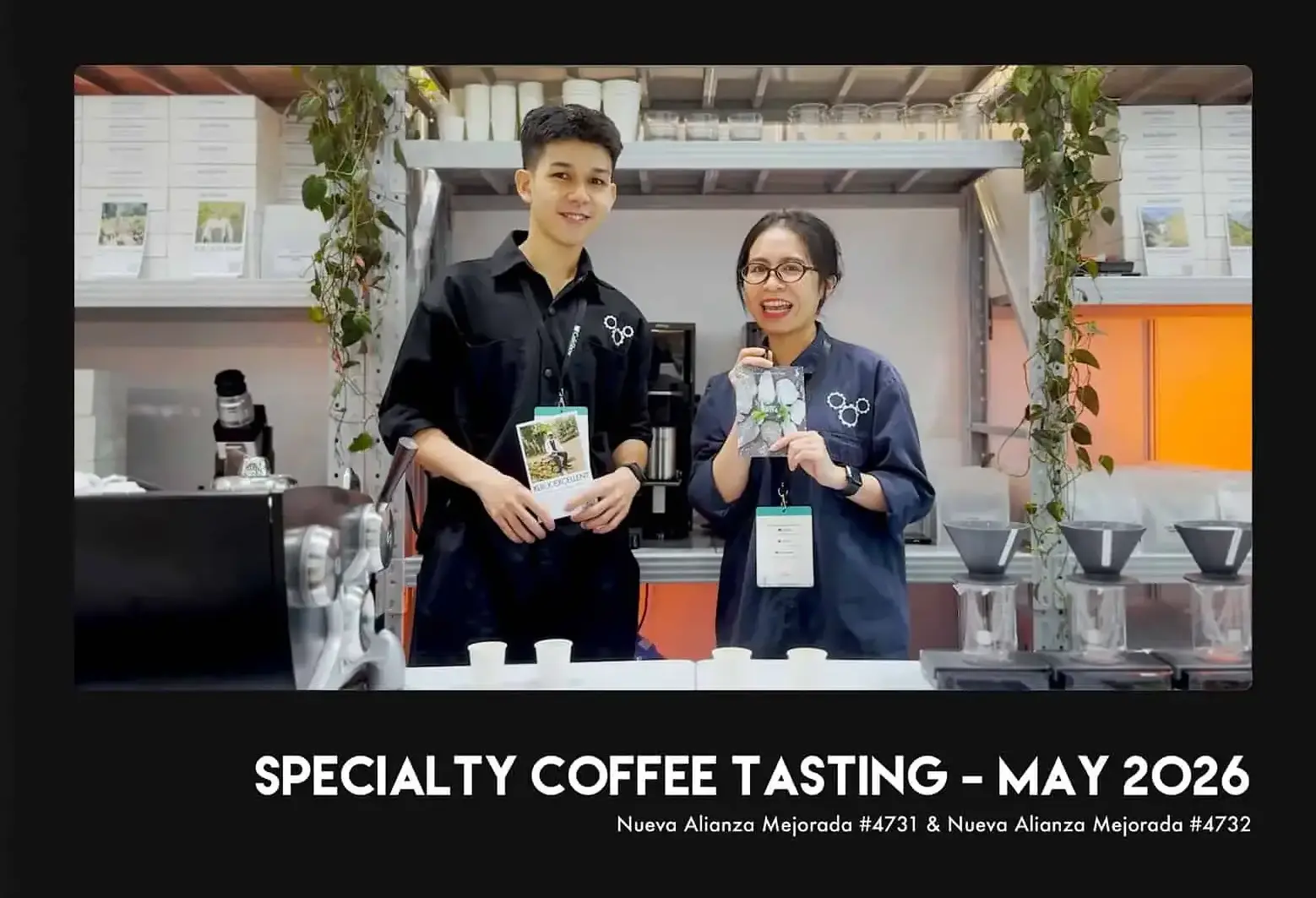
Unveiling May Discovery Subscription: Nueva Alianza Mejorada #4731 & Nueva Alianza Mejorada #4732
The Discovery Subscription is a silent dialogue, a place where the soul of the connoisseur finds a harmonious beat with distant lands. Like a transparent lens, we become storytellers, meticulously peeling back layers of cultural sediment, the breath of the soil, and the human philosophies hidden within every coffee bean.
May arrives with brilliant streaks of golden sunlight, a time when we long to hide beneath the lush, dew-drenched canopies of Santa Teresa. Amidst the silence of the Andes, when compassion touches Mother Earth, what will we hear? Perhaps it is a sweet response that nature reserves solely for souls who know how to wait patiently.

- Taste the Origin
Nueva Alianza Pacamara #4733 – The essence of Cusco with elegant jasmine notes
Nueva Alianza Pacamara #4733 is a testament to the miraculous terroir and dedicated cultivation of the renowned Cusco region. The combination of the characteristic Pacamara bean size and ideal altitude has forged a flavor profile of immense sophistication and depth. From the very first moment, this lot captivates with its elegant jasmine notes, radiating a gentle, pure fragrance akin to a flower blooming in the morning dew.

- Taste the Origin
Nueva Alianza Orange Gesha #4737 – An expedition of recessive genetic traits into the sensory realm
In a world of authenticity, Nueva Alianza Orange Gesha #4737 represents the proud emergence of rare biological traits often obscured by nature’s universality. Carrying a recessive genetic code, Lot #4737 embarks on an “expedition” into the connoisseur’s mind, where record-breaking fructose concentrations are released to perfectly fill every sensory gap with absolute smoothness and purity.
Through washed processing and extremely-light roasting, vibrant citrus nuances and ethereal floral notes, once hidden deep within the genetic structure, now manifest with power, transforming the tasting experience into a journey of ontological completion, where the rarity of recessive genes finally reigns supreme in flavor.

Specialty Coffee in Vietnam
BRAND VALUE
YOU SHOULD HAVE KNOWN
XLIII Coffee has been aiming to become a big, impactful company with social responsibilities,
have access to high-quality raw materials and convey the complete original values of coffee to our customer
