
S795: A Veteran Coffee Variety Revived in the Specialty Wave
If there is a coffee variety that embodies centuries-old cultivation traditions, impressive disease resistance, and surprisingly rich sensory potential, it would be S795. In India, it accounts for 30% of Arabica cultivation. In Indonesia, it appears in numerous Cup of Excellence-winning lots. And on the cupping tables of the Specialty world, S795 is steadily proving its worth.
I. What is the S795 Coffee Variety?
S795—also written as S.795 or S-795—is an Arabica coffee variety developed in India during the 1940s by the Balehonnur Coffee Research Station. It is a hybrid of S288 (a natural cross between C. arabica and C. liberica, known for its vigorous roots and disease resistance) and Kent (a Typica-derived variety renowned for cup quality and rust resistance).
This hybrid combination produced a coffee variety with high resistance to coffee leaf rust, strong growth, wide adaptability, and a well-balanced flavor profile. The name “Selection 795” simply refers to its code number in the sequence of “Selection Line” hybrids developed at the research station.
The Selection Line (S Line) is among the rare Arabica groups with a genetic contribution from Liberica, a valuable trait in global breeding efforts for rust resistance. S795 is a key player in India’s rust-resistant Arabica portfolio, alongside lines such as SLN 274, Cauvery, and SL28.

II. How Does S795 Taste?
S795 offers a flavor profile that is balanced, harmonious, and layered—especially when grown at ideal altitudes and processed with care. In many sensory descriptions, S795 exhibits good intrinsic sweetness, moderate acidity without harshness, a rounded body, and a clean, clear finish. When brewed, it often evokes notes of maple syrup, brown sugar, cocoa, honey, dark berries, and sometimes a hint of mocha.
What stands out most in an S795 cup is its pronounced body and the rich mouthfeel. Thanks to its dense bean structure and good heat conduction, it responds particularly well to light-to-medium roast profiles, preserving its brightness and flavor complexity. In well-executed roast curves, S795 often showcases berry, cocoa, and sometimes dried plum notes—especially when brewed as espresso or cappuccino.
However, this variety is also quite “sensitive” to roasting and processing techniques. Over-roasting or prolonged development phases can result in bitterness, a dry mouthfeel, or a loss of delicate aromatics. This explains why some people who’ve tasted poorly processed S795 lots—particularly from Myanmar—may hold a biased view of its quality.

III. Why Do Specialty Coffee Farmers in India and Indonesia Favor the S795 Variety?
In long-standing coffee-growing regions like India and Indonesia, Coffee Leaf Rust was once a chronic nightmare. As a result, S795 emerged as a reliable solution and was widely cultivated. Within the famous South Asian “S-line” breeding system, S795 stands as the most prominent representative, accounting for 25–30% of India’s total Arabica acreage.
Carrying the SH3 gene inherited from its Liberica lineage, S795 exhibits outstanding resistance to leaf rust—a critical advantage as climate change continues to increase the threat of coffee diseases.
Yet, the appeal of S795 extends beyond disease resistance. This variety is also favored for its ease of cultivation, requiring relatively low inputs in terms of fertilizers or advanced technical interventions—an important benefit for smallholder farmers or newcomers to coffee production. The plant’s structure is notably robust, with strong primary and secondary branches and high productivity, often averaging 14–16 cherries per node.
Moreover, S795 adapts well to a wide range of terrains and microclimates. From the granite hills of Karnataka, India, to the humid highlands of Indonesia, the variety consistently maintains stable yields and notable bean quality—making it a long-term favorite in Asia’s sustainable coffee strategies.

IV. S795's Role in the Specialty Coffee Industry
The Overlooked Potential of S795
Although S795 was among the earliest rust-resistant Arabica varieties ever developed, it was long undervalued in the specialty coffee world. With its reputation for high yield and ease of cultivation, it was often seen as more suitable for large-scale production than for refined, high-end cups.
This stigma partly explains why, during the early stages of the specialty coffee movement, S795 was rarely selected for competitions or single-lot showcases. Roasters and consumers tended to favor varieties with more illustrious pedigrees—like Gesha, Bourbon, or the rising F1 hybrids.

A Variety on the Rise
Today, as specialty coffee broadens its lens—from focusing solely on elite varieties or famous origins to rediscovering the hidden value of heritage cultivars—S795 is re-entering the conversation. Once overlooked, it is now entering a new chapter.
In India, the variety’s homeland, specialty farms such as Ratnagiri Estate are leading the movement to “elevate” S795 through selective cultivation, microbial fermentation, wooden barrel aging, and blending with native varieties. Many S795 lots are now scoring above 85, even 86 points—well within the specialty threshold. In Brazil, S795 is being trialed in new climates, yielding flavor profiles that reflect the character of both India and South America.
Its adaptability to diverse growing conditions makes S795 an ideal candidate for regions transitioning from commodity production to specialty, with its consistent performance, plant resilience, and untapped sensory potential.
Moreover, some producers have begun experimenting with extended naturals, anaerobic processing, honey methods, and innovative fermentations to unlock deeper complexity from this variety. While it hasn’t sparked a revolution like modern Typica or reengineered Catimor lines, the positive momentum is more visible than ever.

Interestingly, S795 responds particularly well to washed processing, often fully cleaned and screened to sizes 15–16 up. Larger screen sizes like 18 up are rare but, when available, tend to deliver dense, berry-toned beans with excellent heat transfer—ideal for light roasting. Bold experiments, such as aging the beans in Pinot Noir or Martinique rum barrels, also demonstrate the variety’s potential for complex flavor integration.
Conclusion
From a widely cultivated commercial variety, S795 is gradually securing its place in the specialty coffee sector—not through novelty, but thanks to its adaptability, rediscovered sensory potential, and resilient vitality amid climate change.
This variety is a clear testament to the idea that “specialty” doesn’t necessarily come from rarity. Sometimes, it arises from how we perceive, nurture, and reawaken the inherent values of familiar cultivars. Perhaps it’s time we stop underestimating varieties like S795—and begin rediscovering their true potential.
V. FAQs
1. What is the S795 coffee variety?
S795 is an Arabica coffee variety developed in the late 1940s in India. It is a hybrid between S288 and Kent, bred to enhance resistance to coffee leaf rust while maintaining consistent cup quality. Today, S795 is widely grown in India, Indonesia, and other tropical regions at medium to high elevations.
2. Is S795 considered a Specialty Coffee variety?
S795 was not originally classified as a “specialty” variety, but it can absolutely meet specialty standards when cultivated, harvested, and processed properly. Several S795 lots and producers have scored above 85 points in international competitions, proving its sensory potential.
3. What does S795 coffee taste like?
Coffee from S795 typically offers a sweet, full-bodied flavor with notes reminiscent of caramel, milk chocolate, nuts, or dried fruits. When grown at higher altitudes and processed with care, it can deliver a smooth, clean cup with gentle acidity and a lingering finish.
4. How does S795 compare to modern varieties like Gesha or SL28?
S795 cannot directly compete with high-end varieties like Gesha or SL28 in terms of flavor complexity. However, its strengths lie in stability, good productivity, disease resistance, and approachable cup quality—making it suitable for both commercial markets and balanced, smooth-oriented specialty segments.
5. Is S795 suitable for Vietnam’s climate conditions?
Yes. With its strong disease resistance and adaptability to mid-to-high elevations, S795 is a promising candidate for Arabica variety diversification programs in Vietnam—especially in regions like Cầu Đất, Khe Sanh, or Sơn La, provided that cultivation and processing are well-managed.

Bài viết mới

- Taste the Origin
Nigussie Nare – Murago Outgrowers #03028: Cultivated from the Values of Sustainable Reciprocity
Nestled beneath the shade trees of Sidama, Bensa, the Nigussie Nare – Murago Outgrowers #03028 coffee lot serves as a living testament to the values of sustainable reciprocity. This symbiosis begins with the intimate bond between a rich indigenous ecosystem and the smallholder farmers of the Murago region. Each harvested bean is the culmination of a virtuous cycle: a stable environment produces exceptional bean quality, and sustainable economic growth, in turn, continues to protect the verdant canopy of the great forest.

- Taste the Origin
Rift Valley Coffee Caucus #03757 – A Testament to Western Kenya’s Collective Spirit
Turning our gaze to the Great Rift Valley of East Africa, the fertile volcanic landscapes are witnessing an inspiring transformation. Moving away from fierce, survival-driven competition, smallholder farmers in Western Kenya have chosen to join forces, forging a resilient and unified network. The Rift Valley Coffee Caucus #03757 lot stands as the ultimate testament to this remarkable collective synergy.

- Breaking News
Airworks Coffee & XLIII Coffee – A “handshake” that brings original flavors across borders
XLIII Coffee, alongside our key wholesale partner Airworks Coffee, officially announces the latest release of specialty coffee lots for the North American market. This event reaffirms our commitment to bringing original flavors across all geographical barriers to coffee enthusiasts.
Early access (for Subscribers of Airworks): 10:00 AM (PST) | Wednesday, April 29, 2026
General access: 10:00 AM (PST) | Friday, May 1, 2026
We invite our Customers and Partners to visit (airworkscoffee.com) for detailed information and to prepare for this special release!
- Taste the Origin
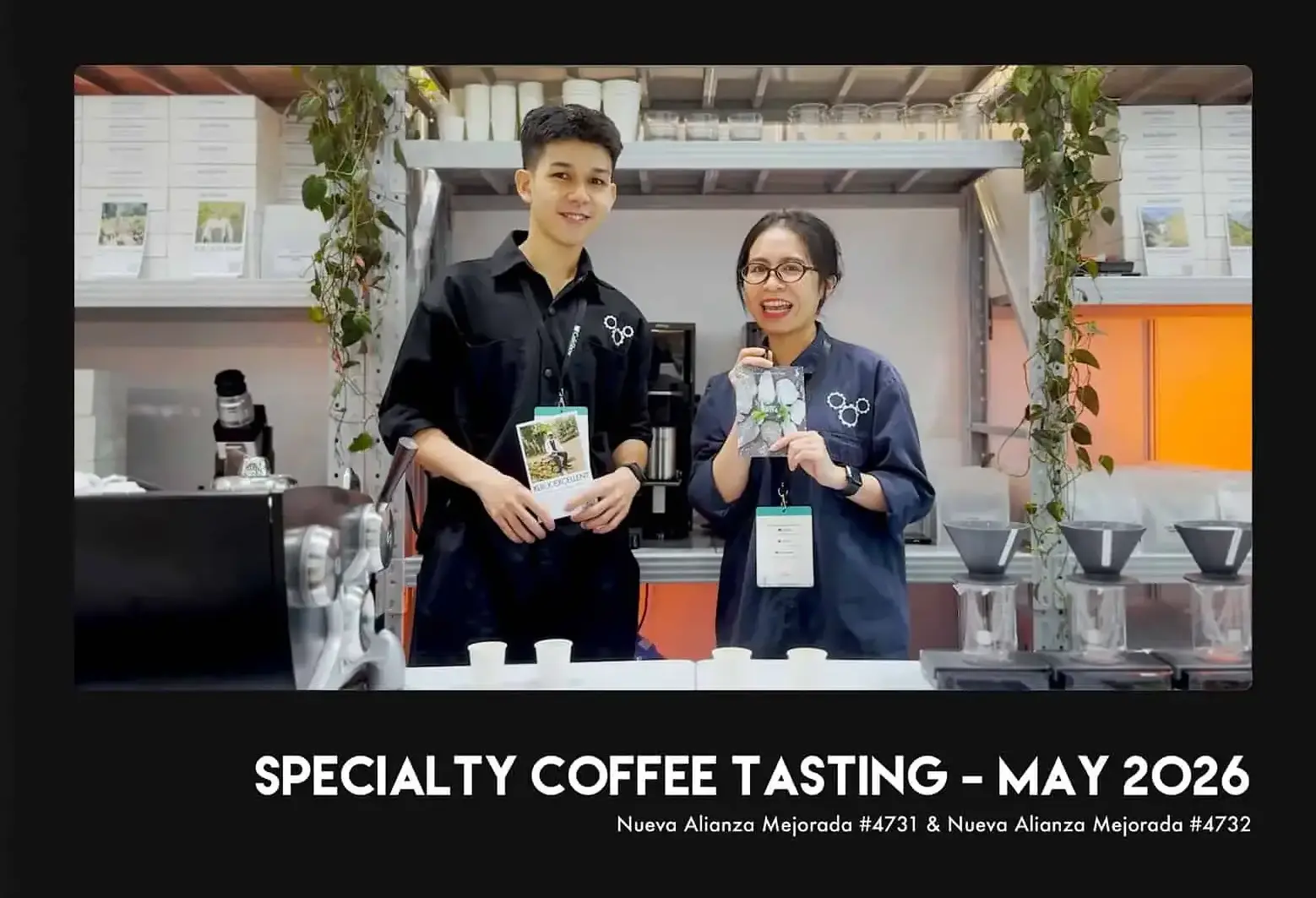
Unveiling May Discovery Subscription: Nueva Alianza Mejorada #4731 & Nueva Alianza Mejorada #4732
The Discovery Subscription is a silent dialogue, a place where the soul of the connoisseur finds a harmonious beat with distant lands. Like a transparent lens, we become storytellers, meticulously peeling back layers of cultural sediment, the breath of the soil, and the human philosophies hidden within every coffee bean.
May arrives with brilliant streaks of golden sunlight, a time when we long to hide beneath the lush, dew-drenched canopies of Santa Teresa. Amidst the silence of the Andes, when compassion touches Mother Earth, what will we hear? Perhaps it is a sweet response that nature reserves solely for souls who know how to wait patiently.

- Taste the Origin
Nueva Alianza Pacamara #4733 – The essence of Cusco with elegant jasmine notes
Nueva Alianza Pacamara #4733 is a testament to the miraculous terroir and dedicated cultivation of the renowned Cusco region. The combination of the characteristic Pacamara bean size and ideal altitude has forged a flavor profile of immense sophistication and depth. From the very first moment, this lot captivates with its elegant jasmine notes, radiating a gentle, pure fragrance akin to a flower blooming in the morning dew.

- Taste the Origin
Nueva Alianza Orange Gesha #4737 – An expedition of recessive genetic traits into the sensory realm
In a world of authenticity, Nueva Alianza Orange Gesha #4737 represents the proud emergence of rare biological traits often obscured by nature’s universality. Carrying a recessive genetic code, Lot #4737 embarks on an “expedition” into the connoisseur’s mind, where record-breaking fructose concentrations are released to perfectly fill every sensory gap with absolute smoothness and purity.
Through washed processing and extremely-light roasting, vibrant citrus nuances and ethereal floral notes, once hidden deep within the genetic structure, now manifest with power, transforming the tasting experience into a journey of ontological completion, where the rarity of recessive genes finally reigns supreme in flavor.

Specialty Coffee in Vietnam
BRAND VALUE
YOU SHOULD HAVE KNOWN
XLIII Coffee has been aiming to become a big, impactful company with social responsibilities,
have access to high-quality raw materials and convey the complete original values of coffee to our customer
