
Specialty Liberica Coffee & the 2030 Climate Scenario in the New Era
Global temperatures are projected to rise by an additional 1.5°C–2°C by 2030, and regulations classifying coffee as a “non-readily available natural resource” are reshaping the market. We are forced to acknowledge the fragility of the Arabica empire. XLIII Coffee believes that the solution to coffee industry security does not lie in desperately trying to preserve Arabica in warming regions, but in empowering a species with superior adaptive genetics – one of which is Coffea Liberica.
This is an inevitable “Biological Insurance” strategy to ensure the survival of the Specialty Coffee industry amid increasingly extreme natural fluctuations.
I. The tipping point between Arabica and Liberica offee
Coffea Arabica is inherently a cool-climate species (18-21°C). However, scientific research is pointing to an alarming future.
According to the landmark report by the Royal Botanic Gardens, Kew, and climate scientists, by 2050, approximately 50% of the land currently suitable for Arabica cultivation will no longer be viable due to rising temperatures and changing rainfall patterns.

In Ethiopia and Brazil, farmers are being forced to move cultivation to higher elevations in search of cooler temperatures. But “mountain peaks are finite,” and Arabica’s growing space is gradually shrinking into a dead end.
Why Is Liberica Coffee a Strong Candidate?
As Arabica retreats, Liberica (and its variant Excelsa) demonstrates resilience in some of the harshest environments.
Research by Dr. Aaron Davis (Head of Coffee Research at Kew) confirms that Liberica can thrive at higher temperatures (24-30°C) and lower elevations (0-1,000 m).
Liberica does not compete for land with Arabica. Instead, it occupies lowland areas abandoned because Arabica cannot survive there, transforming “dead zones” into new raw material regions.
The shift toward Liberica is not a random choice but a natural arrangement. As the Arabica map contracts, the Liberica map expands, creating a necessary balance for global supply.
II. The “super-biological” traits of the Liberica coffee tree
To establish Liberica as a solution, we must examine its superior biological structure compared to its two siblings, Arabica and Robusta.
Taproot System & Drought Resistance
Unlike Arabica’s shallow fibrous root system, Liberica possesses a taproot that penetrates 2-3 times deeper into the soil.
In the 2030 scenario of prolonged drought, this root system allows Liberica to access deep groundwater layers that Arabica cannot reach. At the same time, its thick leaves with a tough waxy cuticle help it resist Hemileia vastatrix (coffee leaf rust) more effectively.


A Carbon-Absorbing Machine
A mature Liberica tree can reach 15 – 20 meters in height, with biomass several times larger than the Arabica shrub.
In regenerative farming models, Liberica functions as a shade forest tree, absorbing large amounts of CO₂. Planting Liberica is a direct action to reduce the greenhouse effect – the root cause threatening the coffee industry.
Liberica is an optimized “survival machine.” It reduces adaptation costs (less irrigation, fewer pesticides) while contributing positively to environmental restoration, making it the most economically sustainable option for smallholder farmers.
III. The revolution from “Jackfruit Coffee” to “Excelsa Specialty”
The biggest barrier facing Liberica coffee is flavor prejudice. However, data from the modern Specialty Coffee wave proves otherwise.
Recent international barista competitions and the rise of the “My Liberica” movement in Malaysia demonstrate that when properly cultivated, the Excelsa variant offers bright berry-like acidity and complexity approaching that of Arabica coffee.
Excelsa is the perfect “bridge”, enabling consumers to transition smoothly from Arabica to the Liberica group.
According to analysis by Coffee Consulate, Liberica beans have a maturation period of 9-11 months, accumulating significantly higher mucilage sugar content than Arabica. Sugar is highly combustible. Traditional dark roasting methods burn these sugars, producing bitterness and the characteristic “fermented jackfruit” aroma.


XLIII Coffee applies an Extremely-Light Roast (ending at ~197°C) based on scientific principles, only at this temperature can sugars be preserved as fruity esters and organic acids instead of being carbonized.
This is how we “build the market”: by creating a new flavor standard that proves the true value of the bean, thereby encouraging farmers to preserve the trees.
The problem does not lie with Liberica beans, but with how humans have treated them. Through roasting science and Excelsa selection, XLIII Coffee is redefining Liberica from a “filler coffee” into an “Exotic Specialty” category.
IV. Liberica coffee in a symbiotic future
Liberica coffee will certainly not eliminate Arabica. In the best-case climate scenario, the coffee industry will transition into a symbiotic polyculture model. Arabica will retain its “Luxury” status, serving the ultra-premium segment at increasingly high prices. Liberica/Excelsa will fill the production gap in the “Accessible Specialty” segment – high-quality, approachable, and sustainable coffee.
At Fifth Wave coffee bars, Liberica will not stand alone. With its heavy body and natural sweetness, Liberica is the perfect blending component, balancing acidity and reducing costs without compromising sensory quality.
“Climate-Resilient Blends” will become the dominant trend, with Liberica’s presence serving as a guarantee of sustainability.
Liberica is the key to solving a dual challenge: maintaining production while Arabica declines, and protecting the environment through biological advantages. Investing in Liberica today is purchasing insurance for tomorrow’s cup of coffee.

In the near future, it can be seen that,
Liberica coffee is an indispensable part of Plan A to save the coffee industry. In the 2030 climate scenario, as heat closes in, it will be Liberica trees with their deep roots and resilient canopies that form the “Green Fortress” protecting humanity’s joy of coffee consumption.
As a guest at XLIII Coffee, every time you choose a cup of Liberica, you are not only tasting an exotic flavor, you are voting for the survival of a fair and sustainable agricultural ecosystem.
Images in this journal are owned by My Liberica, Perfect Daily Grind, Shiren Coffee, Bean & Bean Coffee Roasters.
V. FAQs
1. Is Liberica a genetically modified (GMO) crop to tolerate drought?
No. Liberica is a completely natural species, first discovered in Liberia (West Africa). Its drought tolerance and pest resistance are the result of thousands of years of natural evolution, not laboratory intervention.
2. Why is Excelsa called a “bridge” between Arabica and Liberica?
Excelsa (a member of the Liberica family) has a unique flavor structure. While pure Liberica leans toward deep sweetness and woody notes, Excelsa exhibits higher acidity and complex fruity aromas, making it more similar to Arabica and easier for drinkers to accept.
3. Does growing Liberica really reduce the greenhouse effect better than Arabica?
Yes. Due to its large tree size (greater biomass), Liberica absorbs and stores more CO₂ than Arabica. Additionally, its strong resistance reduces the need for pesticides and chemical fertilizers – major sources of agricultural greenhouse gas emissions making cultivation greener overall.
4. Why is Liberica only now considered a climate solution?
Previously, Arabica supply was abundant and inexpensive, causing the world to overlook other species. Only when scientific reports (such as those from Kew Gardens) warned of a significant decline in Arabica cultivation areas by 2050 did the industry urgently seek alternatives and Liberica emerged as the “forgotten hero.”
5. Will Liberica’s flavor change as the planet warms?
All species are affected, but Liberica has stronger “biological inertia.” While Arabica rapidly loses flavor quality with slight temperature increases (due to forced ripening), Liberica maintains greater stability in bean quality and flavor under harsher conditions.

Bài viết mới
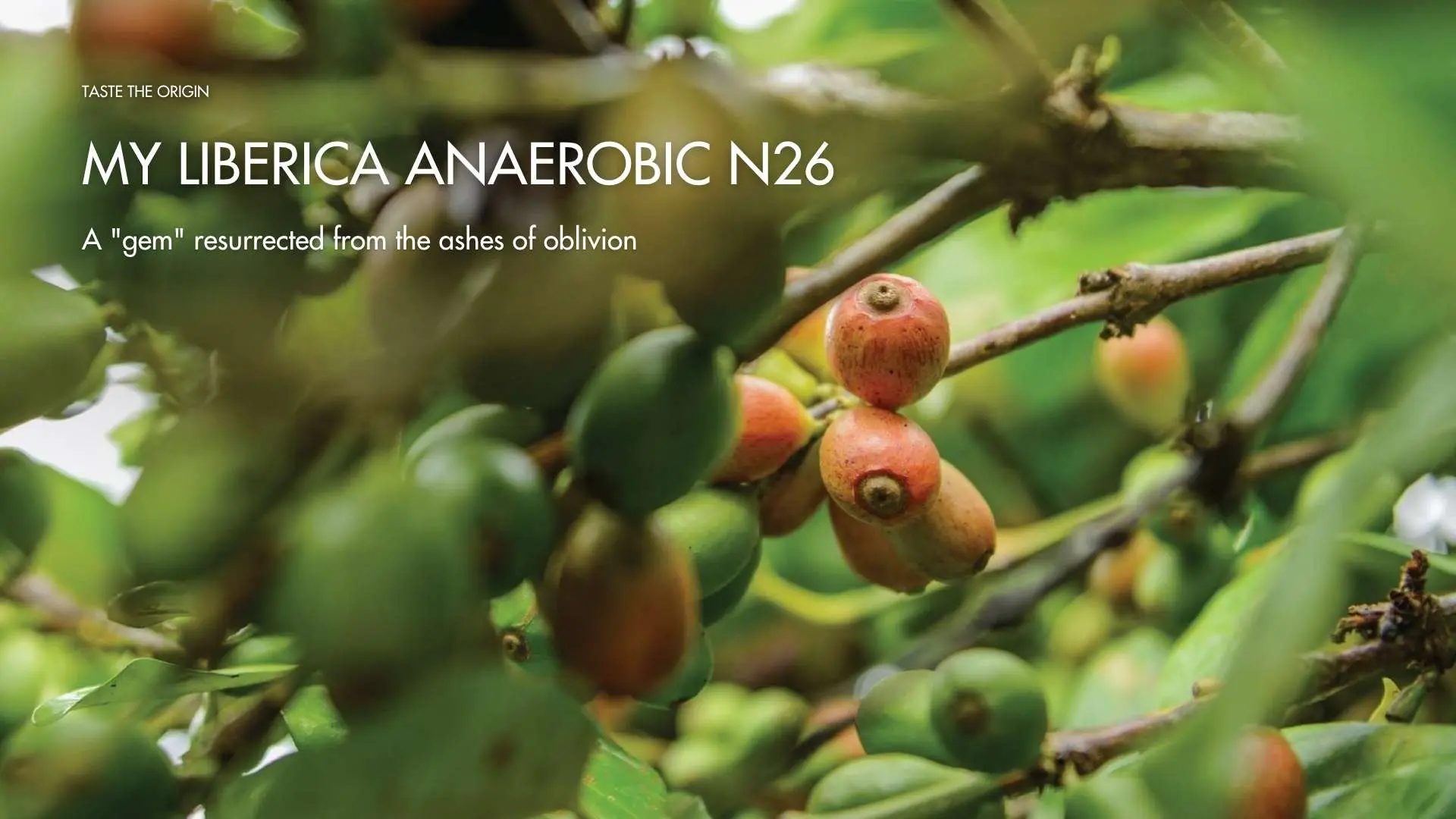
- Taste the Origin
My Liberica Anaerobic N26 – A “gem” resurrected from the ashes of oblivion
The journey of My Liberica Anaerobic N26 is the triumph of a forgotten species, awakened by the depth of understanding, patience, and faith in its original essence. From the heavy clay layers of Kulai to 26 days of transformation in absolute darkness, each step contributes to unlocking layers of flavor that the world once thought could not exist in Liberica. More than just a cup of coffee, My Liberica Anaerobic N26 is a powerful declaration that all great values begin with the courage to delve into their essence, and then rise to a unique voice that resonates throughout the world.


- Taste the Origin
Finca Soledad Mejorado Tyoxy & Fincas Putushio Mejorado – The red thread of the Jijón family
The simultaneous arrival of Finca Soledad Mejorado Tyoxy and Fincas Putushio Mejorado at XLIII Coffee paints a remarkable portrait of the adaptability of the Mejorado variety within Ecuador’s specialty coffee landscape. Nurtured by a shared family philosophy and a commitment to principled cultivation, these two processed lots represent both a breakthrough in microbial innovation and the remarkable return of an exceptional flavor profile.

Finca La Palestina Gesha #5482 – A new chapter in the legend from Cajamarca
From the renowned Cajamarca region, Finca La Palestina Gesha #5482 returns after a period of absence with a proud and fresh appearance. Nurtured in ideal altitude conditions and the cool climate characteristic of the Andes, each coffee bean slowly accumulates subtle flavor nuances before being perfected using the Washed method to maximize the purity of the Gesha variety. Under a carefully refined extremely-light roast profile, this batch of coffee reveals layers of white jasmine, ripe citrus, and sweet golden apricot aromas, interwoven in an elegant and rich flavor structure.

- Taste the Origin
Finca La Palestina ‘Gesha Inca’ #5485 – A masterpiece carved from an ancient civilization
From the mist-covered hills of San José del Alto, Finca La Palestina ‘Gesha Inca’ #5485 emerges as a proud declaration of the convergence between more than seventy years of agricultural heritage and the resilient biological code of an ancient civilization. Through the clarity of meticulously executed Washed Processing, this coffee unveils a magnificent sensory progression across temperature ranges while extending a chain of integrity through the Direct Trade model.

- Taste the Origin
Finca La Palestina Red Bourbon #5487 – A blossoming legacy in the highlands of Cajamarca
Amidst the ethereal clouds of Cajamarca, where the deep forest, Mother Earth, and time harmonize, Finca La Palestina Red Bourbon #5487 is born as a proud epic of heritage. It bears witness to the story of three generations of the Alarcón Coronel family, to their respect for nature, and to their Cup of Excellence achievements. Each layer of fragrance is a journey for all the senses, leading the connoisseur into subtle and captivating depths.

Specialty Coffee in Vietnam
BRAND VALUE
YOU SHOULD HAVE KNOWN
XLIII Coffee has been aiming to become a big, impactful company with social responsibilities,
have access to high-quality raw materials and convey the complete original values of coffee to our customer
