
Liberica coffee roasting techniques to preserve the “DNA” within its giant structure
For decades, Liberica has been boxed into stereotypes as a coffee with “rotten wood”. “smoky”, and “harsh bitter” flavors. But at XLIII Coffee, we ask a different question: Is this truly the nature of the species, or is it the result of human error in how it has been treated? Based on the latest research into Liberica’s biological characteristics and successful precedents in Malaysia (the global stronghold of high-quality Liberica), we assert that the unpleasant flavors of the past were the consequence of excessively dark roasting applied to poorly processed green coffee.
To unlock the true tropical fruit notes of Liberica, XLIII Coffee adopts an Extremely Light Roast philosophy – a strategy built upon three solid scientific foundations.
I. Physical foundations: Thermal furnace effect and the size of Liberica
According to morphological studies, Liberica coffee beans are on average 50% to 80% larger than Arabica beans, with tightly attached husks and elongated, asymmetrical structures. In roasting thermodynamics, bean size is directly proportional to thermal inertia. The larger the bean, the more difficult it is for heat to penetrate the core.
If standard Arabica roasting profiles (rapid heat application, short roast duration) are applied, the surface of Liberica beans will absorb excessive heat and scorch before the heat has time to reach and properly develop the inner core. This phenomenon results in flavor defects such as “green grass” on the inside and “ash” on the outside.

So what is XLIII Coffee’s solution?
A technique known as “Soak” (thermal soaking).
Based on the principles of conductive and convective heat transfer, we extend the initial phase of the roast while maintaining lower heat input.
- We allow the beans to “soak” in heat, enabling thermal energy to gradually penetrate deep into the core.
- Only once this giant structure reaches uniform thermal equilibrium do we accelerate the roast. This ensures even development from the inside out, without the need for dark roasting to mask an underdeveloped core.
With Liberica, patience is the key. We do not use force (high heat) to attack the surface; instead, we use time to tame the bean’s massive size, ensuring absolute uniformity from husk to core before chemical reactions begin.
II. Chemical foundations: Sugar traps and the Maillard reaction in Liberica

Research from Coffee Consulate (Germany), led by Dr. Steffen Schwarz, has shown that due to its extended ripening period on the tree (9-11 months compared to 6-8 months for Arabica), Liberica accumulates exceptionally high levels of natural sugars and mucilage.
Sugar is the fuel for the Maillard reaction (the reaction responsible for aroma and color development). However, sugar is also the compound most susceptible to caramelization and carbonization (burning into carbon).
When dark roasting is applied to sugar-rich Liberica, once temperatures exceed 210°C, the sugars rapidly burn into carbon. This is the root cause of the harsh bitterness and burnt aromas traditionally associated with “Jackfruit Coffee”.


Therefore, to taste sweetness, sugar must be protected, not burned. XLIII Coffee’s solution is precise Maillard control through an Extremely Light Roast strategy. We end the roast at approximately 197°C, immediately after First Crack. At this threshold:
-
Sugars undergo just enough Maillard reaction to form aromatic complexes.
-
More importantly, sugars have not yet degraded into bitter carbon chains. They remain as organic acids and simple sugars, creating the sweetness of ripe jackfruit and the creamy richness reminiscent of durian or cream cheese.
Roasting Liberica is a race against the sugar burn point. Stopping precisely at 197°C is the only way to transform Liberica’s natural sugar reserves into “refined sweetness” rather than “bitter charcoal”.
This is not the first time a special coffee species like Liberica has been studied. XLIII Coffee is not alone on this path of expressive exploration. We are continuing the global “Fine Liberica” movement initiated by pioneers such as:

Jason Liew & My Liberica (Malaysia) – Jason Liew was the first to prove that Liberica can achieve high Specialty scores when properly processed and lightly roasted. His Liberica samples (roasted at Light-Medium levels) revealed strawberry and jasmine notes, completely overturning global prejudice.
At events such as the World Barista Championship 2021, Hugh Kelly (Australia) used Coffea eugenioides (a rare species with low caffeine and sugar dynamics similar to Liberica) to achieve World Runner-Up. His routine emphasized natural sweetness control through roasting and extraction – a major inspiration for our approach to Liberica.
The shift toward light roasting for Liberica is not a spontaneous idea, but a trend validated by scientific communities and international competitions. XLIII Coffee is proud to be a pioneer in applying these global standards to redefine the value of Liberica coffee in Vietnam.
III. XLIII Coffee’s practical Liberica roasting method
From these foundations, XLIII Coffee establishes a proprietary Liberica roasting protocol:
-
Green Selection: Only 100% ripe-picked Liberica beans with clean processing (to eliminate off-flavors and enable confident extremely-light roasting).
-
Phase 1 – Drying: Extended duration with low airflow to stabilize internal bean temperature.
-
Phase 2 – Maillard: Increased drum speed to enhance convection, allowing sugars to react efficiently without surface scorching.
-
Phase 3 – Development: Extremely short. Beans are dropped immediately as the first crack finishes. At this point, the beans retain Liberica’s naturally low acidity, balancing sweetness and creating vibrancy in the cup.

A successful Liberica roast at XLIII Coffee is the result of total integration, from rigorous green selection to disciplined output temperature control. We accept high technical risk in exchange for flavor authenticity.
In conclusion,
We roast Liberica extremely light not to “stand out,” but because science and history have shown this to be the only way for this species to truly express its voice. Dark roasting conceals the mistakes of the past; extremely light roasting honors the qualities of the future. When you hold a bag of XLIII Coffee Liberica, you are holding the result of serious research where physics and chemistry are used to protect the purity of a legacy.
Images are owned by XLIII Coffee and were collected from My Liberica.
IV. FAQs
1. Is there research proving Liberica contains more sugar than Arabica?
Analyses from Coffee Consulate indicate that due to its large cherry size and extended ripening period, Liberica accumulates very thick mucilage sugar layers. This is an advantage but also a roasting risk without proper heat control.
2. Why do many cafés still roast Liberica dark?
Most Liberica on the market is commodity-grade, harvested with mixed ripeness. Dark roasting is the most economical way to homogenize flavor and mask the astringency of unripe beans. XLIII Coffee uses Specialty-grade Liberica, so we neither need nor want to conceal intrinsic flavors.
3. Does roasting at 197°C make Liberica beans too hard?
Yes. Light-roasted Liberica has a very hard, dense cellulose structure. Therefore, we recommend high-quality grinders or enjoying Liberica directly at XLIII Coffee with our professional equipment for the most accurate flavor experience.
4. Where does the “durian” aroma in light-roasted Liberica come from?
It comes from natural volatile sulfur compounds combined with preserved fruity esters due to light roasting. At controlled levels, as in Specialty Liberica, this creates a luxurious creaminess rather than an overpowering smell.
5. Does light roasting make Liberica too acidic?
No. Liberica naturally has much lower citric/malic acid levels than Arabica. Light roasting simply preserves enough acidity to create balance, preventing the cup from feeling cloying due to excessive sweetness or richness.

Bài viết mới
- Taste the Origin
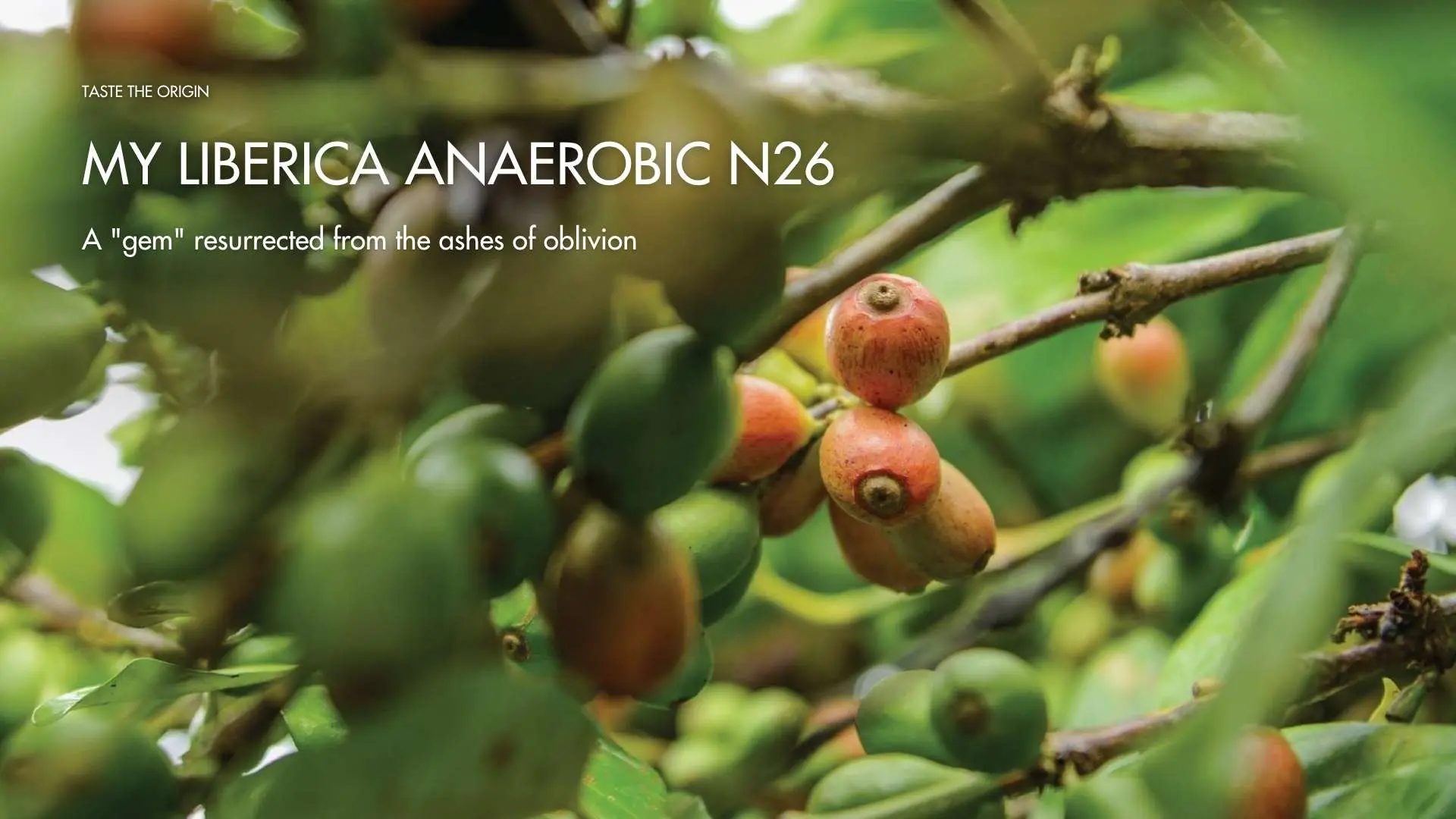
My Liberica Anaerobic N26 – A “gem” resurrected from the ashes of oblivion
The journey of My Liberica Anaerobic N26 is the triumph of a forgotten species, awakened by the depth of understanding, patience, and faith in its original essence. From the heavy clay layers of Kulai to 26 days of transformation in absolute darkness, each step contributes to unlocking layers of flavor that the world once thought could not exist in Liberica. More than just a cup of coffee, My Liberica Anaerobic N26 is a powerful declaration that all great values begin with the courage to delve into their essence, and then rise to a unique voice that resonates throughout the world.


- Taste the Origin
Finca Soledad Mejorado Tyoxy & Fincas Putushio Mejorado – The red thread of the Jijón family
The simultaneous arrival of Finca Soledad Mejorado Tyoxy and Fincas Putushio Mejorado at XLIII Coffee paints a remarkable portrait of the adaptability of the Mejorado variety within Ecuador’s specialty coffee landscape. Nurtured by a shared family philosophy and a commitment to principled cultivation, these two processed lots represent both a breakthrough in microbial innovation and the remarkable return of an exceptional flavor profile.

Finca La Palestina Gesha #5482 – A new chapter in the legend from Cajamarca
From the renowned Cajamarca region, Finca La Palestina Gesha #5482 returns after a period of absence with a proud and fresh appearance. Nurtured in ideal altitude conditions and the cool climate characteristic of the Andes, each coffee bean slowly accumulates subtle flavor nuances before being perfected using the Washed method to maximize the purity of the Gesha variety. Under a carefully refined extremely-light roast profile, this batch of coffee reveals layers of white jasmine, ripe citrus, and sweet golden apricot aromas, interwoven in an elegant and rich flavor structure.

- Taste the Origin
Finca La Palestina ‘Gesha Inca’ #5485 – A masterpiece carved from an ancient civilization
From the mist-covered hills of San José del Alto, Finca La Palestina ‘Gesha Inca’ #5485 emerges as a proud declaration of the convergence between more than seventy years of agricultural heritage and the resilient biological code of an ancient civilization. Through the clarity of meticulously executed Washed Processing, this coffee unveils a magnificent sensory progression across temperature ranges while extending a chain of integrity through the Direct Trade model.

- Taste the Origin
Finca La Palestina Red Bourbon #5487 – A blossoming legacy in the highlands of Cajamarca
Amidst the ethereal clouds of Cajamarca, where the deep forest, Mother Earth, and time harmonize, Finca La Palestina Red Bourbon #5487 is born as a proud epic of heritage. It bears witness to the story of three generations of the Alarcón Coronel family, to their respect for nature, and to their Cup of Excellence achievements. Each layer of fragrance is a journey for all the senses, leading the connoisseur into subtle and captivating depths.

Specialty Coffee in Vietnam
BRAND VALUE
YOU SHOULD HAVE KNOWN
XLIII Coffee has been aiming to become a big, impactful company with social responsibilities,
have access to high-quality raw materials and convey the complete original values of coffee to our customer
