
Parainema Coffee Variety: A Breakthrough in Productivity and Cup Quality
Parainema coffee variety represents a perfect balance between farming efficiency and flavor quality. Bred for strong disease resistance, stable yields, and excellent cup performance, Parainema is becoming a top choice for farmers and roasters worldwide.
I. Genetic Foundation of the Parainema Variety
Parainema coffee variety was born from the dedicated research of the Instituto Hondureño del Café (IHCAFE) during the 1980s, a period when Central American coffee production was severely threatened by coffee leaf rust. The breeders’ goal was clear: to create a coffee variety that combined strong disease resistance with the signature flavor quality of Arabica.
Breeding origin and genetic lineage
Parainema belongs to the Sarchimor group – a hybrid lineage developed to balance the disease resistance of Robusta with the cup quality of Arabica. Specifically, Parainema is a pedigree selection from the Sarchimor line T5296, a cross between:
-
Villa Sarchi (Coffea arabica var. Villa Sarchi): a natural Bourbon mutation from Costa Rica, known for its compact size, good yield, and bright, balanced flavor profile.
-
Timor Hybrid (Híbrido de Timor, or HdT): a natural hybrid between Coffea arabica and Coffea canephora (Robusta), carrying the SH genes that confer strong resistance to coffee leaf rust.
From this combination, the Sarchimor lineage emerged and Parainema is one of its most successful selections, developed and officially released by IHCAFE after years of evaluation across different ecological regions of Honduras.


Breeding Objectives and Development Direction
In developing Parainema, IHCAFE focused on three core goals:
- Sustainable resistance to coffee leaf rust, reducing dependence on chemical control.
- Consistent yield across multiple harvests, even at medium altitudes (1,000 – 1,400 m).
- Noticeable improvement in cup quality enough to meet international specialty coffee standards.
These objectives have proven successful in practice: Parainema has thrived not only in Honduras but also in Nicaragua, El Salvador, and Costa Rica, earning recognition for its productivity and superior cup potential, especially when cultivated in cool climates with fertile volcanic soils.
II. Biological Characteristics of the Parainema Variety
After years of selective breeding, Parainema stands out as one of the most resilient and high-yielding Arabica hybrids available today. Its biological traits reflect IHCAFE’s breeding philosophy of balance between agronomic strength and cup excellence.
Morphological and Growth Traits
-
Plant form: Semi-dwarf structure, shorter than traditional Arabicas like Typica or Bourbon. Compact and balanced canopy, suitable for high-density planting, easy to manage and harvest.
-
Stems and leaves: Strong main stem and well-developed lateral branches ensure even fruit distribution and reduced cherry drop. Thick, dark-green leaves, inherited from Robusta provide resilience to drought and climatic fluctuation.
-
Root system: Vigorous and deep root growth allows efficient nutrient uptake even in low-organic soils, supporting stable yields in mid- and high-altitude regions with large diurnal temperature variations.
Adaptability and Disease Resistance
Parainema’s outstanding trait is its natural resistance to coffee leaf rust (hemileia vastatrix) thanks to SH genes inherited from the Timor Hybrid. Field trials by IHCAFE and farms in Honduras, Nicaragua, and Costa Rica also show strong resistance to certain root-knot nematodes.
The variety performs best at altitudes between 1,000 and 1,400 meters, under moderate climates and well-distributed rainfall. At higher altitudes (above 1,600 m), growth slows slightly, but cup quality improves, producing more complex and refined flavor profiles.


Bean Characteristics and Cup Potential
Parainema typically produces large, slightly elongated green beans, distinct from the rounder shape of many Arabica varieties. This uniformity enhances roasting consistency and flavor control during processing.
Under optimal growing and processing conditions, Parainema delivers a bright citrus profile with notes of caramel, jasmine, and blackberry, finishing with a creamy mouthfeel. Its flavor complexity has earned it high scores in competitions such as Cup of Excellence in Honduras and Nicaragua.
Yield and Agronomic Efficiency
Parainema offers strong and stable productivity, averaging 25 – 30 bags/ha (1,500 – 1,800 kg of green beans per hectare) under standard management. Its balanced physiology allows efficient nutrient distribution, reduced fruit drop, and sustained high yields over multiple years.
The variety also shows synchronized flowering and even cherry ripening, simplifying harvesting and reducing labor costs. With good fertilization and shade management, Parainema adapts well to small-and-medium-scale farming systems.
III. Future Directions for a Promising Variety
With its remarkable advantages, the future of Parainema lies in advancing its role within the specialty coffee sector. To achieve this, farmers should focus on medium-altitude regions (1,000 – 1,400 m) with cool climates and wide day-night temperature ranges that promote sugar and organic acid development in cherries. Maintaining genetic purity, applying proper agronomic practices, and adopting sustainable cultivation techniques are key to ensuring consistent yield and cup quality.
Beyond cultivation, innovation in processing methods will be crucial to unlocking Parainema’s full flavor potential. While the traditional washed process remains popular, producers are now experimenting with honey, natural, and controlled fermentation techniques to highlight fruity, floral, and caramel notes. Honey-processed Parainema lots from Honduras have achieved scores above 86 points in national competitions, demonstrating their value in premium micro-lot markets.

The future of Parainema lies not only in technical advancement but also in building a strong value chain and brand identity. Close collaboration among farmers, cooperatives, roasters, and international markets will help create a transparent and sustainable ecosystem. Parainema has the potential to become a signature mark of Honduran coffee – a symbol of harmony between scientific innovation and regional authenticity. To move toward that vision, farms cultivating this variety need to strengthen traceability systems, consistent quality standards, and effective communication strategies to enhance global recognition of the variety.
In the context of climate change increasingly affecting coffee production, Parainema demonstrates clear advantages in adaptability and disease resistance. This variety could play a vital role in coffee sector restructuring strategies across producing countries, helping to mitigate the impacts of rust and drought while preserving sustainable genetic resources for the future. However, for long-term success, ensuring seed quality and genetic certification from selection to propagation remains essential.
In conclusion,
Parainema is not merely a disease-resistant hybrid; it represents a new direction for the global coffee industry – one that balances productivity, resilience, and cup quality. With proper investment and management, this variety could become a new icon of Central American specialty coffee, and beyond that, an inspiration for breeding programs aimed at a more sustainable, high-quality, and equitable coffee future.
Images collected from various sources.
IV. FAQs
1. How does Parainema differ from traditional Arabica varieties like Typica or Bourbon?
Parainema has a semi-dwarf structure, compact canopy, and higher yield stability. While Typica and Bourbon focus on cup quality, Parainema balances productivity, disease resistance, and specialty potential.
2. What growing conditions are best for Parainema?
It thrives at altitudes between 1,000 – 1,400 m, in moderate climates with fertile, well-drained soils. It performs especially well in mid- and highland regions with large temperature variations.
3. Does Parainema truly have higher yield potential?
Yes. According to World Coffee Research, Parainema is rated as having “Very High Yield Potential”, often outperforming Sarchimor and Catimor under similar conditions.
4. How is Parainema’s cup quality evaluated?
When properly cultivated and processed, Parainema shows bright citrus acidity with caramel, jasmine, and blackberry notes, finishing with a creamy mouthfeel. Its quality ranges from “Good” to “Very Good” in international evaluations.
5. Are there any risks in cultivating Parainema?
While it is highly disease-resistant, genetic inconsistency among seed lots can occur. Farmers should ensure certified seed sources and follow recommended cultivation practices for best performance.

Bài viết mới

- Find the Origin
Mandela coffee variety – A convergence of generations from a masterpiece breeding strategy
Amidst the constant fluctuations of the era, Mandela emerges as a gentle yet resilient response from the soil. Instead of attempting to alter or impose upon nature, this breeding strategy is, in essence, a profound act of listening. Each Mandela coffee bean carries the bloodline of multiple generations, possessing both the serene, steadfast nature of native trees and the sparkling elegance of premium varieties. It is a sacred continuation, where the flow of generations ultimate honors the original value of the species, imparting an intact and sustainable vitality into every cup.


- Taste the Origin
Nigussie Nare – Murago Outgrowers #03028: Cultivated from the Values of Sustainable Reciprocity
Nestled beneath the shade trees of Sidama, Bensa, the Nigussie Nare – Murago Outgrowers #03028 coffee lot serves as a living testament to the values of sustainable reciprocity. This symbiosis begins with the intimate bond between a rich indigenous ecosystem and the smallholder farmers of the Murago region. Each harvested bean is the culmination of a virtuous cycle: a stable environment produces exceptional bean quality, and sustainable economic growth, in turn, continues to protect the verdant canopy of the great forest.

- Taste the Origin
Rift Valley Coffee Caucus #03757 – A Testament to Western Kenya’s Collective Spirit
Turning our gaze to the Great Rift Valley of East Africa, the fertile volcanic landscapes are witnessing an inspiring transformation. Moving away from fierce, survival-driven competition, smallholder farmers in Western Kenya have chosen to join forces, forging a resilient and unified network. The Rift Valley Coffee Caucus #03757 lot stands as the ultimate testament to this remarkable collective synergy.

- Breaking News
Airworks Coffee & XLIII Coffee – A “handshake” that brings original flavors across borders
XLIII Coffee, alongside our key wholesale partner Airworks Coffee, officially announces the latest release of specialty coffee lots for the North American market. This event reaffirms our commitment to bringing original flavors across all geographical barriers to coffee enthusiasts.
Early access (for Subscribers of Airworks): 10:00 AM (PST) | Wednesday, April 29, 2026
General access: 10:00 AM (PST) | Friday, May 1, 2026
We invite our Customers and Partners to visit (airworkscoffee.com) for detailed information and to prepare for this special release!
- Taste the Origin
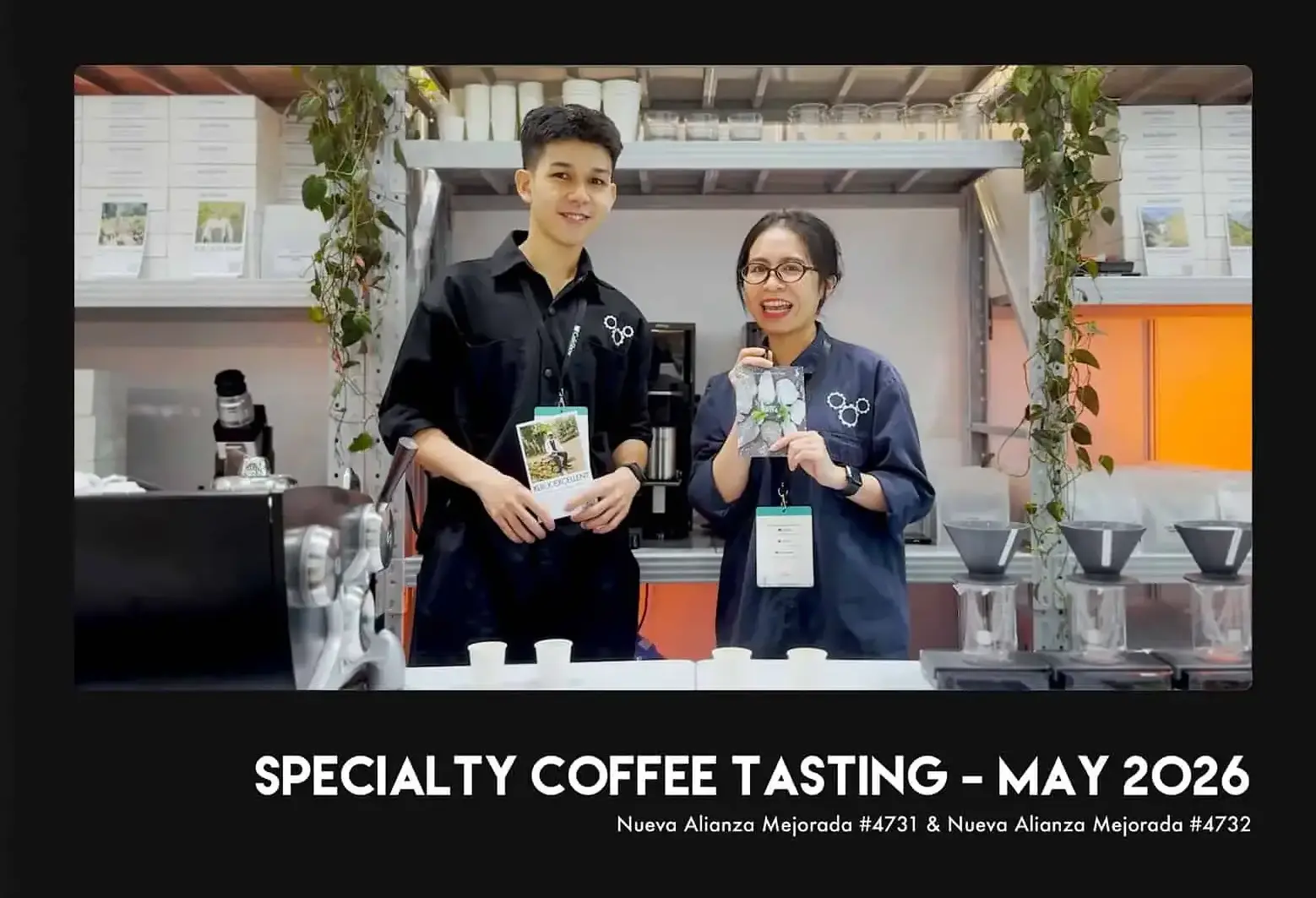
Unveiling May Discovery Subscription: Nueva Alianza Mejorada #4731 & Nueva Alianza Mejorada #4732
The Discovery Subscription is a silent dialogue, a place where the soul of the connoisseur finds a harmonious beat with distant lands. Like a transparent lens, we become storytellers, meticulously peeling back layers of cultural sediment, the breath of the soil, and the human philosophies hidden within every coffee bean.
May arrives with brilliant streaks of golden sunlight, a time when we long to hide beneath the lush, dew-drenched canopies of Santa Teresa. Amidst the silence of the Andes, when compassion touches Mother Earth, what will we hear? Perhaps it is a sweet response that nature reserves solely for souls who know how to wait patiently.

Specialty Coffee in Vietnam
BRAND VALUE
YOU SHOULD HAVE KNOWN
XLIII Coffee has been aiming to become a big, impactful company with social responsibilities,
have access to high-quality raw materials and convey the complete original values of coffee to our customer
